
Higher November 2024 Paper 1 Q13
13. In this question all lengths are in metres.
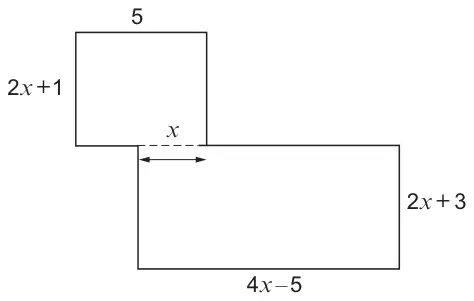
Diagram not drawn to scale
The shape above is made from two rectangles arranged as shown.
The total area of the shape is 98 m2.
(a) Show that \(2x^2 + 3x - 27 = 0\). [4]
(b) Calculate the perimeter of the shape.
You must use an algebraic method and show all your working. [6]
You must use an algebraic method and show all your working. [6]
| Scheme | Marks | Comments |
|---|---|---|
| FT until 2nd error | ||
| \(5(2x + 1) + (4x - 5)(2x + 3)\ (= 98)\) | B1 | Forming equation |
| \(10x + 5 + 8x^2 + 12x - 10x - 15\ (= 98)\) | B1 | Expanding both sets of brackets |
| \(8x^2 + 12x - 108 = 0\) | B1 | Collecting all terms on one side |
| \(2x^2 + 3x - 27 = 0\) | B1 | CAO without wrong working seen |
| Scheme | Marks | Comments |
|---|---|---|
| \((2x + 9)(x - 3)\) | B2 | B1 for one of the following:
|
| \((x = -4.5),\ x = 3\) | B1 | STRICT FT provided at least B1 previously awarded. FT ‘their derived positive \(x\) value(s)’ provided \(2 \lt x \lt 5\) If two positive values found, both substitutions will need to be performed for M2/M1 |
| Perimeter: \(2(5 + (2\times3+1)) - 3\) + \(2((2\times3+3) + (4\times3-5)) - 3\) OR \((7+7+5+(5-3)+9+9+7+(7-3))\) OR \(14x + 8\) oe | M2 | FT ‘their 3’ for possible M2 A0 provided at least one mark previously awarded M1 for one arithmetic slip in substitution – if lengths seen. Slip may be repeated. If substituting for two positive values only allow 1 slip for M1 OR (if using expression for perimeter) M1 for \(14x + k\) or \(kx + 8\) provided \(k \gt 0\) |
| 50 (m) | A1 | CAO If no marks awarded, SC2 for an answer of 50 (m) from \(x = 3\) |
Alternative method - using the formula for first 3 marks only
| Scheme | Marks | Comments |
|---|---|---|
| \((x =)\ \dfrac{-3 \pm \sqrt{(3)^2 - (4\times2\times-27)}}{2\times2}\) | M1 | Allow 1 slip in substitution, but must be correct formula |
| \(= \dfrac{-3 \pm \sqrt{225}}{4}\) | A1 | |
| \((x = -4.5),\ x = 3\) | A1 |
| (10) |
Corrected by Westie's Workshop
- The board's mark scheme printed “2((2×3+3) + 2(4×3−5)) − 3”. Changed to “2((2×3+3) + (4×3−5)) − 3” because with the extra 2 the two working lines add up to 64 m, but the perimeter of the shape is 50 m (the answer given below); without it they add up to 21 + 29 = 50.
- The board's mark scheme printed “(7+7+5+(5−3)+9+9+7+(7−3)”. Changed to “(7+7+5+(5−3)+9+9+7+(7−3))” because the opening bracket was never closed (the sum itself, 50, is right).
Original: see the board's mark scheme PDF (link above).