
D1 June 2014 Q7
7.
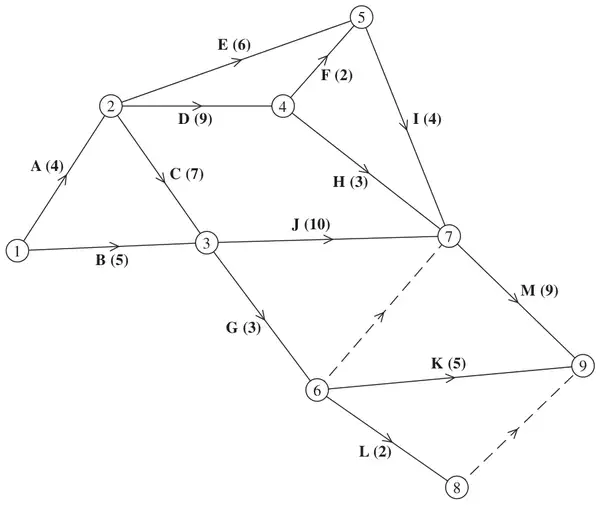
Figure 3 is the activity network for a building project. The activities are represented by the arcs. The number in brackets on each arc gives the time, in days, to complete the activity. Each activity requires exactly one worker. The project is to be completed in the shortest possible time.
The project is to be completed in the minimum time using as few workers as possible.
| Scheme | Marks |
|---|---|
| The total float \(F(i, j)\) of activity \((i, j)\) is defined to be \(F(i, j) = l_j - e_i -\) duration \((i, j)\), where \(e_i\) is the earliest time for event \(i\) and \(l_j\) is the latest time for event \(j\) (see note below) | B2,1,0 |
| (2) |
Notes
a1B1 For the first mark: the idea that total float is ‘how long an activity can be delayed for’. Give bod.
a2B1 For both marks: A clear correct statement e.g. the total amount of time that an activity may be delayed from its early start without delaying the project finish time. The candidate must clearly demonstrate a knowledge that total float = latest finish – earliest start – duration of activity. Ignore comments that infer that total refers to the sum of the floats for all activities in an activity network. Note that B1B0 should be awarded for an answer that has the pertinent idea of ‘float’ (see a1B1 above) and B1B1 for a clear correct statement (see a2B1 above) – B0B1 cannot be awarded in this part.
| Scheme | Marks |
|---|---|
 | M1 A1 A1 |
| (3) |
Notes
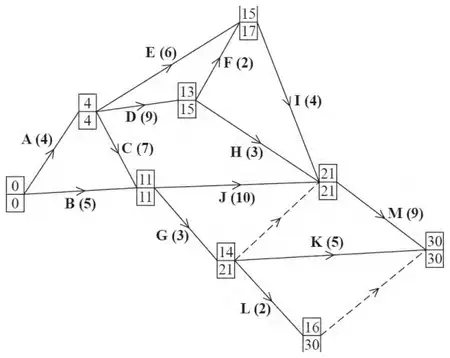
b1M1 All top boxes and all bottom boxes completed. Values generally increasing from left to right (for top boxes) and values generally decreasing from right to left (for bottom boxes) . Condone missing 0 or 30 for M only (for bottom boxes). Condone one rogue value in top boxes and one rouge value in bottom boxes (if values do not increase from left to right (or decrease right to left) then if one value is ignored and then the values do increase from left to right (or decrease right to left) then this is considered to be one rogue value).
b1A1 CAO for top boxes.
b2A1 CAO for bottom boxes.
| Scheme | Marks |
|---|---|
| Critical activities: A C J M | B1 |
| (1) |
Notes
c1B1 CAO
| Scheme | Marks |
|---|---|
| G can be delayed by 21 – 11 – 3 = 7 (days) | M1 A1 |
| (2) |
Notes
d1M1 Correct calculation for their activity G seen - all three numbers correct (ft). Final value must be non-negative.
d1A1 CAO (no follow through on this A mark). Answer of 7 with no working scores no marks in this part.
| Scheme | Marks |
|---|---|
| \(\dfrac{69}{30} = 2.3\) so lower bound is 3 workers | M1 A1 |
| (2) |
Notes
e1M1 Attempt to find lower bound [59 – 79 / their finish time]
e1A1 CAO – correct calculation seen then 3. [As 30/13 also gives 3, an answer of 3 with no working scores M0A0.]
| Scheme | Marks |
|---|---|
e.g.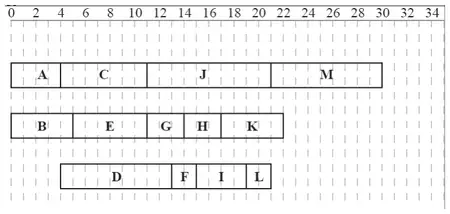 | M1 A1 A1 A1 |
| (4) | |
| (14 marks) |
Notes
f1M1 Not a cascade chart. 4 ‘workers’ used at most and at least 8 activities placed.
f1A1 The critical (A, C, J, M) activities and B and D correct A – 4, C – 7, J – 10, M – 9, B – 5, D – 9. B must be completed by its late finish time (11) and D must start after A and finishing before its late finish time (15).
Now check the last 7 activities – the last two marks are for E, F, G, H, I, K and L only
First check that there are only three workers and that all 13 activities are present (just once).
Then check precedences (see table below) – each row of the table could give rise to 1 error only in precedences
Finally check the length of each activity and the time interval in which the activity must take place (interval is inclusive).
| Activity | Duration | Time interval | IPA |
|---|---|---|---|
| E | 6 | 4 – 17 | A |
| F | 2 | 13 – 17 | D |
| G | 3 | 11 – 21 | B, C |
| H | 3 | 13 – 21 | D |
| I | 4 | 15 – 21 | E, F |
| K | 5 | 14 – 30 | G |
| L | 2 | 14 – 30 | G |
f2A1 3 workers. All 13 activities present (just once). Condone one error either precedence, time interval or activity length, on activities E, F, G, H, I, K and L only.
f3A1 3 workers. All 13 activities present (just once). No errors on activities E, F, G, H, I, K and L.