
FP3 June 2013 (R) Q7
7.
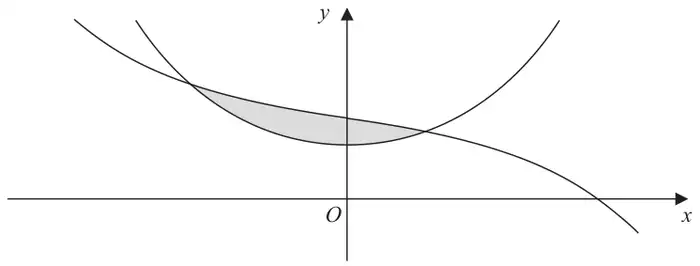
The curves shown in Figure 1 have equations \[y = 6\cosh x \text{ and } y = 9 - 2\sinh x\]
(a) Using the definitions of \(\sinh x\) and \(\cosh x\) in terms of \(\mathrm{e}^x\), find exact values for the \(x\)-coordinates of the two points where the curves intersect. (6)
The finite region between the two curves is shown shaded in Figure 1.
(b) Using calculus, find the area of the shaded region, giving your answer in the form \(a\ln b + c\), where \(a\), \(b\) and \(c\) are integers. (6)
| Scheme | Marks |
|---|---|
| Put \(6\cosh x = 9 - 2\sinh x\) | M1 |
| \(6 \times \tfrac{1}{2}(\mathrm{e}^x + \mathrm{e}^{-x}) = 9 - 2 \times \tfrac{1}{2}(\mathrm{e}^x - \mathrm{e}^{-x})\) Replaces \(\cosh x\) and \(\sinh x\) by the correct exponential forms | M1 |
| \(4\mathrm{e}^x + 2\mathrm{e}^{-x} - 9 = 0 \Rightarrow 4\mathrm{e}^{2x} - 9\mathrm{e}^x + 2 = 0\) M1: Multiplies by \(\mathrm{e}^x\) A1: Correct quadratic in \(\mathrm{e}^x\) in any form with terms collected | M1 A1 |
| So \(\mathrm{e}^x = \tfrac{1}{4}\) or 2 and \(x = \ln 2\) or \(\ln\tfrac{1}{4}\) M1: Solves their quadratic in \(\mathrm{e}^x\) A1: Correct values of \(x\) (Any correct equivalent form) | M1 A1 |
| (6) |
| Scheme | Marks |
|---|---|
| Area is \(\displaystyle\int (9 - 2\sinh x - 6\cosh x)\,\mathrm{d}x\) \(\displaystyle\int (9 - 2\sinh x - 6\cosh x)\,\mathrm{d}x\) or \(\displaystyle\int (6\cosh x - (9 - 2\sinh x))\,\mathrm{d}x\) or the equivalent in exponential form | M1 |
| \(\pm(9x - 2\cosh x - 6\sinh x)\) or \(\pm(9x - 4\mathrm{e}^x + 2\mathrm{e}^{-x})\) M1: Attempt to integrate A1: Correct integration | M1 A1 |
| \(\pm\left([9\ln 2 - 2\cosh\ln 2 - 6\sinh\ln 2] - [9\ln\tfrac{1}{4} - 2\cosh\ln\tfrac{1}{4} - 6\sinh\ln\tfrac{1}{4}]\right)\) Complete substitution of their limits from part (a). Depends on both previous M’s | dM1 |
| \(= \pm\left(9\ln\left(2 \div \tfrac{1}{4}\right) - (\mathrm{e}^{\ln 2} + \mathrm{e}^{-\ln 2}) - 3(\mathrm{e}^{\ln 2} - \mathrm{e}^{-\ln 2}) + (\mathrm{e}^{\ln\frac{1}{4}} + \mathrm{e}^{-\ln\frac{1}{4}}) + 3(\mathrm{e}^{\ln\frac{1}{4}} - \mathrm{e}^{-\ln\frac{1}{4}})\right)\) Combines logs correctly and uses cosh and sinh of ln correctly at least once | M1 |
| \(\left(9\ln 8 - \dfrac{5}{2} - \dfrac{18}{4} + 4.25 - 11.25\right) = 9\ln 8 - 14\) or \(27\ln 2 - 14\) Any correct equivalent | A1cao |
| Subtracting the wrong way round could score 5/6 max | |
| (6) | |
| (12 marks) |
Notes
Note
If they use \(4\mathrm{e}^{2x} - 9\mathrm{e}^x + 2\) in (b) to find the area – no marks