
FP3 June 2013 (R) Q8
8.
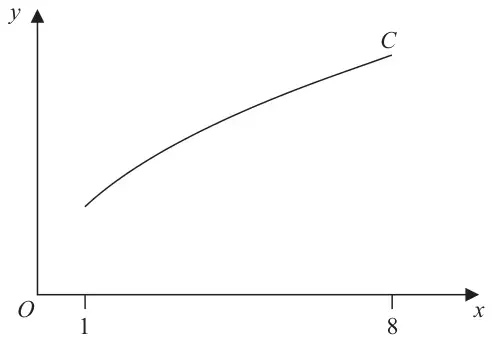
The curve \(C\), shown in Figure 2, has equation \[y = 2x^{\frac{1}{2}}, \qquad 1 \leqslant x \leqslant 8\]
(a) Show that the length \(s\) of curve \(C\) is given by the equation \[s = \int_1^8 \sqrt{\left(1 + \frac{1}{x}\right)}\,\mathrm{d}x\] (2)
(b) Using the substitution \(x = \sinh^2 u\), or otherwise, find an exact value for \(s\).
Give your answer in the form \(a\sqrt{2} + \ln(b + c\sqrt{2})\) where \(a\), \(b\) and \(c\) are integers. (9)
Give your answer in the form \(a\sqrt{2} + \ln(b + c\sqrt{2})\) where \(a\), \(b\) and \(c\) are integers. (9)
| Scheme | Marks |
|---|---|
| \(\dfrac{\mathrm{d}y}{\mathrm{d}x} = x^{-\frac{1}{2}}\) Correct derivative (may be un-simplified) | B1 |
| \(s = \displaystyle\int \sqrt{1 + (x^{-\frac{1}{2}})^2}\,\mathrm{d}x = \int_1^8 \sqrt{\left(1 + \frac{1}{x}\right)}\,\mathrm{d}x\) A correct formula quoted or implied. There must be some working before the printed answer. | B1 |
| (2) |
| Scheme | Marks |
|---|---|
| \(x = \sinh^2 u \Rightarrow \dfrac{\mathrm{d}x}{\mathrm{d}u} = 2\sinh u\cosh u\) Correct derivative | B1 |
| \(\left(1 + \tfrac{1}{x}\right) = 1 + \mathrm{cosech}^2 u = \coth^2 u\) \(\left(1 + \tfrac{1}{x}\right) = \coth^2 u\) or \(\left(1 + \tfrac{1}{x}\right) = \dfrac{\cosh^2 u}{\sinh^2 u}\) (may be implied by later work) | B1 |
| \(s = \displaystyle\int \coth u \cdot 2\sinh u\cosh u\,\mathrm{d}u = \int 2\cosh^2 u\,\mathrm{d}u\) M1: Complete substitution A1: \(\displaystyle\int 2\cosh^2 u\,\mathrm{d}u\) | M1 A1 |
| \(= u + \tfrac{1}{2}\sinh 2u\) or \(\tfrac{1}{4}\mathrm{e}^{2u} + u - \tfrac{1}{4}\mathrm{e}^{-2u}\) M1: Uses \(\cosh 2u = \pm 2\cosh^2 u \pm 1\) or changes to exponentials in an attempt to integrate an expression of the form \(k\cosh^2 u\) A1: Correct integration | dM1 A1 |
| \(x = 8 \Rightarrow u = \mathrm{arsinh}\sqrt{8} = \ln(3 + 2\sqrt{2}),\ x = 1 \Rightarrow u = \mathrm{arsinh}\,1 = \ln(1 + \sqrt{2})\) | |
| \(\left[u + \tfrac{1}{2}\sinh 2u\right]_{\mathrm{arsinh}\,1}^{\mathrm{arsinh}\sqrt{8}}\) \(= \mathrm{arsinh}\sqrt{8} + \tfrac{1}{2}\sinh(2\,\mathrm{arsinh}\sqrt{8}) - (\mathrm{arsinh}\,1 + \tfrac{1}{2}\sinh(2\,\mathrm{arsinh}\,1))\) or \(\left[\tfrac{1}{4}\mathrm{e}^{2u} + u - \tfrac{1}{4}\mathrm{e}^{-2u}\right]_{\mathrm{arsinh}\,1}^{\mathrm{arsinh}\sqrt{8}}\) \(= \tfrac{1}{4}\mathrm{e}^{2\,\mathrm{arsinh}\sqrt{8}} + \mathrm{arsinh}\sqrt{8} - \tfrac{1}{4}\mathrm{e}^{-2\,\mathrm{arsinh}\sqrt{8}} - \left(\tfrac{1}{4}\mathrm{e}^{2\,\mathrm{arsinh}\,1} + \mathrm{arsinh}\,1 - \tfrac{1}{4}\mathrm{e}^{-2\,\mathrm{arsinh}\,1}\right)\) or \(\left[\mathrm{arsinh}\sqrt{x} + \tfrac{1}{2}\sinh(2\,\mathrm{arsinh}\sqrt{x})\right]_1^8\) \(= \mathrm{arsinh}\sqrt{8} + \tfrac{1}{2}\sinh(2\,\mathrm{arsinh}\sqrt{8}) - (\mathrm{arsinh}\,1 + \tfrac{1}{2}\sinh(2\,\mathrm{arsinh}\,1))\) M1: The limits \(\mathrm{arsinh}\sqrt{8}\) and \(\mathrm{arsinh}\,1\) or their \(\ln(3 + 2\sqrt{2})\) and \(\ln(1 + \sqrt{2})\) used correctly in their f(\(u\)) or the limits 8 and 1 used correctly if they revert to \(x\) Dependent on both previous M’s A1: A completely correct expression | ddM1A1 |
| \(\ln(1 + \sqrt{2}) + 5\sqrt{2}\) | A1 |
| (9) | |
| (11 marks) |
Notes
(corrected from the printed mark scheme: the exponential line is printed as \(= \tfrac{1}{4}\mathrm{e}^{\mathrm{arsinh}\sqrt{8}} + \mathrm{arsinh}\sqrt{8} - \tfrac{1}{4}\mathrm{e}^{-2\mathrm{arsinh}1}\), which drops the 2 in the first exponent and the other terms; the full substitution is shown above)