
FP2 June 2014 (R) Q4
4.
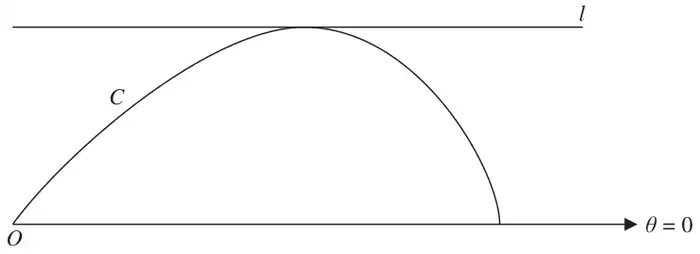
Figure 1 shows the curve \(C\) with polar equation \[r = 2\cos 2\theta, \qquad 0 \leqslant \theta \leqslant \frac{\pi}{4}\]
The line \(l\) is parallel to the initial line and is a tangent to \(C\).
Find an equation of \(l\), giving your answer in the form \(r = \mathrm{f}(\theta)\). (9)
| Scheme | Marks |
|---|---|
| \((y =)\, r\sin\theta = 2\cos 2\theta\sin\theta\) | M1 |
| \(\dfrac{\mathrm{d}y}{\mathrm{d}\theta} = -4\sin 2\theta\sin\theta + 2\cos 2\theta\cos\theta\) | M1A1 |
| \(2\sin 2\theta\sin\theta - \cos 2\theta\cos\theta = 0\) | |
| \(4\sin^2\theta\cos\theta - \left(1 - 2\sin^2\theta\right)\cos\theta = 0\) | dM1 |
| \(\left(6\sin^2\theta - 1\right)\cos\theta = 0\) | |
| \(\left(\cos\theta = 0 \quad \text{no solutions in range}\right)\) | |
| \(\therefore\ \sin\theta = \dfrac{1}{\sqrt{6}}\) | ddM1A1 |
| ALT for last 3 marks above: \(\cos 2\theta\cos\theta = 2\sin 2\theta\sin\theta \Rightarrow \tan 2\theta\tan\theta = 1/2\) | |
| \(\dfrac{2\tan^2\theta}{1 - \tan^2\theta} = \dfrac{1}{2}\) | dM1(double angle formula) |
| \(5\tan^2\theta = 1 \quad \tan\theta = 1/\sqrt{5}\) | ddM1A1 |
| \((\sin\theta = 1/\sqrt{6} \quad \cos\theta = \sqrt{5/6}\) | |
| \(r\sin\theta = 2\cos 2\theta\sin\theta\) | |
| \(\sin\theta = \dfrac{1}{\sqrt{6}} \Rightarrow \cos 2\theta = 1 - 2\sin^2\theta = 1 - 2\times\dfrac{1}{6} = \dfrac{2}{3}\) | M1 |
| Eqn. \(l\): \(\quad r\sin\theta = 2\times\dfrac{2}{3}\times\dfrac{1}{\sqrt{6}} = \dfrac{4}{3\sqrt{6}}\) | M1 |
| \(r = \dfrac{2\sqrt{6}}{9}\operatorname{cosec}\theta\) oe \((0 \lt \theta \lt \pi)\) Must be seen in exact form | A1 |
| (9 marks) |
Notes
M1 Using \(y = r\sin\theta = 2\cos 2\theta\sin\theta\)
M1 differentiate \(r\sin\theta\) or \(r\cos\theta\) using product rule or \(\cos 2\theta = 1 - 2\sin^2\theta\) and chain rule
A1 correct differentiation of \(r\sin\theta\)
dM1 equate their derivative to 0 and use \(\cos 2\theta = 1 - 2\sin^2\theta\) if not used prior to differentiation, or an appropriate double angle formula for their derivative. Depends on second M mark
ddM1 solve the resulting equation. Depends on second and third M mark
A1 correct value for \(\sin\theta\) or \(\tan\theta\) or \(\cos\theta\) depending on the equation solved
M1 use their value for a trig function to obtain an exact value for \(\cos 2\theta\) and \(\sin\theta\) if needed now. May be implied by the next stage.
M1 use their values for \(\sin\theta\) and \(\cos 2\theta\) in \(r\sin\theta = 2\cos 2\theta\sin\theta\)
NB: These two M marks require
\(0 \leqslant \sin\theta \leqslant 1/\sqrt{2},\quad 1/\sqrt{2} \leqslant \cos\theta \leqslant 1,\quad 0 \leqslant \tan\theta \leqslant 1\)
A1 correct equation in form \(r = \ldots\) \((0 \lt \theta \lt \pi\) not needed\()\)
(Corrected from the printed mark scheme: the dM1 line is printed as \(4\sin^2\cos\theta - \ldots\), and the ALT line as \(\dfrac{2\tan^2\theta}{1 - \tan\theta} = \dfrac{1}{2}\); the correct denominator is \(1 - \tan^2\theta\).)