
FP2 June 2015 Q6
6.
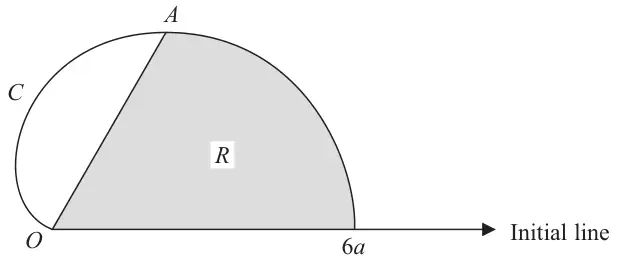
The curve \(C\), shown in Figure 1, has polar equation \[r = 3a(1 + \cos\theta), \qquad 0 \leqslant \theta \lt \pi\]
The tangent to \(C\) at the point \(A\) is parallel to the initial line.
The finite region \(R\), shown shaded in Figure 1, is bounded by the curve \(C\), the initial line and the line \(OA\).
| Scheme | Marks |
|---|---|
| \(r\sin\theta = 3a\sin\theta + 3a\sin\theta\cos\theta\) OR \(3a\sin\theta + \dfrac{3}{2}a\sin 2\theta\) | M1 |
| \(\dfrac{\mathrm{d}(r\sin\theta)}{\mathrm{d}\theta} = 3a\cos\theta + 3a\cos^2\theta - 3a\sin^2\theta\) OR \(3a\cos\theta + 3a\cos 2\theta\) | dM1 |
| \(2\cos^2\theta + \cos\theta - 1 = 0\) terms in any order | A1 |
| \((2\cos\theta - 1)(\cos\theta + 1) = 0\) | |
| \(\cos\theta = \dfrac{1}{2} \quad \theta = \dfrac{\pi}{3} \qquad (\theta = \pi\) need not be seen\()\) | ddM1A1 |
| \(r = 3a\times\dfrac{3}{2} = \dfrac{9}{2}a\) | A1 |
| (6) |
Notes
M1: using \(r\sin\theta\) \(r\cos\theta\) scores M0
dM1: Attempt the differentiation of \(r\sin\theta\), inc use of product rule or \(\sin 2\theta = 2\sin\theta\cos\theta\)
A1: Correct 3 term quadratic in \(\cos\theta\)
ddM1: dep on both M marks. Solve their quadratic (usual rules) giving one or two roots
A1: Correct quadratic solved to give \(\theta = \dfrac{\pi}{3}\)
A1: Correct \(r\) obtained No need to see coordinates together in brackets
Special Case: If \(r\cos\theta\) used, score M0M1A0M0A0A0to
| Scheme | Marks |
|---|---|
| Area \(= \dfrac{1}{2}\displaystyle\int r^2\,\mathrm{d}\theta = \frac{1}{2}\int_0^{\frac{\pi}{3}} 9a^2(1 + \cos\theta)^2\,\mathrm{d}\theta\) | |
| \(= \dfrac{9a^2}{2}\displaystyle\int_0^{\frac{\pi}{3}}\left(1 + 2\cos\theta + \cos^2\theta\right)\mathrm{d}\theta\) | M1 |
| \(= \dfrac{9a^2}{2}\displaystyle\int_0^{\frac{\pi}{3}}\left(1 + 2\cos\theta + \frac{1}{2}(\cos 2\theta + 1)\right)\mathrm{d}\theta\) | M1 |
| \(= \dfrac{9a^2}{2}\left[\theta + 2\sin\theta + \dfrac{1}{2}\left(\dfrac{1}{2}\sin 2\theta + \theta\right)\right]_0^{\frac{\pi}{3}}\) | dM1A1 |
| \(\dfrac{9a^2}{2}\left[\dfrac{\pi}{3} + \sqrt{3} + \dfrac{1}{4}\times\dfrac{\sqrt{3}}{2} + \dfrac{\pi}{6}\ (-0)\right]\) | |
| \(\dfrac{9a^2}{2}\left[\dfrac{\pi}{2} + \dfrac{9\sqrt{3}}{8}\right] = \left(\dfrac{9\pi}{4} + \dfrac{81\sqrt{3}}{16}\right)a^2\) | A1 |
| (5) | |
| (11 marks) |
Notes
M1: Use of correct area formula, \(\dfrac{1}{2}\) may be seen later, inc squaring the bracket to obtain 3 terms - limits need not be shown.
M1: Use double angle formula (formula to be of form \(\cos^2\theta = \pm\dfrac{1}{2}(\cos 2\theta \pm 1)\)) to obtain an integrable function - limits need not be shown, \(\dfrac{1}{2}\) from area formula may be missing,
dM1: attempt the integration - limits not needed – dep on 2nd M mark but not the first
A1: correct integration – substitution of limits not required
A1: correct final answer any equivalent provided in the demanded form.