
FP2 June 2007 Q8
8.
(a) Sketch the curve \(C\) with polar equation \[r = 5 + \sqrt{3}\cos\theta, \qquad 0 \leqslant \theta \leqslant 2\pi.\] (2)
(b) Find the polar coordinates of the points where the tangents to \(C\) are parallel to the initial line \(\theta = 0\). Give your answers to 3 significant figures where appropriate. (6)
(c) Using integration, find the area enclosed by the curve \(C\), giving your answer in terms of \(\pi\). (6)
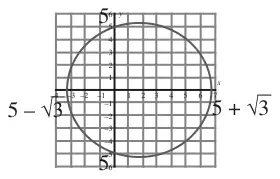
| Scheme | Marks |
|---|---|
| Shape (close curve, approx. symmetrical about the initial line, in all ‘quadrants’ and ‘centred’ to the right of the pole/origin). | B1 |
| Shape (at least one correct ‘intercept’ \(r\) value... shown on sketch or perhaps seen in a table). (Also allow awrt 3.27 or awrt 6.73). | B1 |
| (2) |
| Scheme | Marks |
|---|---|
| \(y = r\sin\theta = 5\sin\theta + \sqrt{3}\sin\theta\cos\theta\) | M1 |
| \(\dfrac{\mathrm{d}y}{\mathrm{d}\theta} = 5\cos\theta - \sqrt{3}\sin^2\theta + \sqrt{3}\cos^2\theta\ (= 5\cos\theta + \sqrt{3}\cos 2\theta)\) | A1 |
| \(5\cos\theta - \sqrt{3}(1 - \cos^2\theta) + \sqrt{3}\cos^2\theta = 0\) \(2\sqrt{3}\cos^2\theta + 5\cos\theta - \sqrt{3} = 0\) | M1 |
| \((2\sqrt{3}\cos\theta - 1)(\cos\theta + \sqrt{3}) = 0 \qquad \cos\theta = \ldots\ (0.288\ldots)\) \(\left(\text{Also allow } \pm\arccos\dfrac{1}{2\sqrt{3}}\right)\) | M1 |
| \(\theta = 1.28\) and \(5.01\) (awrt) (Allow \(\pm 1.28\) awrt) | A1 |
| \(r = 5 + \sqrt{3}\left(\dfrac{1}{2\sqrt{3}}\right) = \dfrac{11}{2}\) (Allow awrt 5.50) | A1 |
| (6) |
Notes
2nd M: Forming a quadratic in \(\cos\theta\).
3rd M: Solving a 3 term quadratic to find a value of \(\cos\theta\) (even if called \(\theta\)).
1st M1 for \(r\cos\theta = 5\cos\theta + \sqrt{3}\cos^2\theta\)
1st A1 for derivative \(-5\sin\theta - 2\sqrt{3}\sin\theta\cos\theta\), then no further marks.
| Scheme | Marks |
|---|---|
| \(r^2 = 25 + 10\sqrt{3}\cos\theta + 3\cos^2\theta\) | B1 |
| \(\displaystyle\int 25 + 10\sqrt{3}\cos\theta + 3\cos^2\theta\,\mathrm{d}\theta = \underline{\frac{53\theta}{2} + 10\sqrt{3}\sin\theta} + \underline{3\left(\frac{\sin 2\theta}{4}\right)}\) (ft for integration of \((a + b\cos\theta)\) and \(c\cos 2\theta\) respectively) | M1 A1ft A1ft |
| \(\dfrac{1}{2}\left[25\theta + 10\sqrt{3}\sin\theta + \dfrac{3\sin 2\theta}{4} + \dfrac{3\theta}{2}\right]_0^{2\pi} = \ldots\ldots\) | M1 |
| \(= \dfrac{1}{2}(50\pi + 3\pi) = \dfrac{53\pi}{2}\) or equiv. in terms of \(\pi\). | A1 |
| (6) | |
| (14 marks) |
Notes
1st M: Attempt to integrate at least one term.
2nd M: Requires use of the \(\dfrac{1}{2}\), correct limits (which could be 0 to \(2\pi\), or \(-\pi\) to \(\pi\), or ‘double’ 0 to \(\pi\)), and subtraction (which could be implied).