
FP2 June 2008 Q4
4.
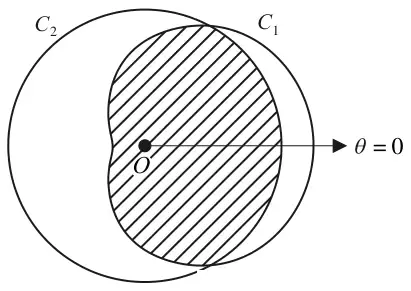
The diagram above shows the curve \(C_1\) which has polar equation \(r = a(3 + 2\cos\theta)\), \(0 \leqslant \theta < 2\pi\) and the circle \(C_2\) with equation \(r = 4a\), \(0 \leqslant \theta < 2\pi\), where \(a\) is a positive constant.
The regions enclosed by the curves \(C_1\) and \(C_2\) overlap and this common region \(R\) is shaded in the figure.
| Scheme | Marks |
|---|---|
| \(a(3 + 2\cos\theta) = 4a\) | M1 |
| Solve to obtain \(\cos\theta = \dfrac{1}{2}\) | M1 |
| \(\theta = \pm\dfrac{\pi}{3}\) and points are \(\left(4a, \dfrac{\pi}{3}\right)\) and \(\left(4a, \dfrac{5\pi}{3}\right)\) | A1, A1 |
| (4) |
Notes
First A for \(r = 4a\) second for both values in radians.
Accept 1.0471… and 5.2359…. 2 dp or better for final A
| Scheme | Marks |
|---|---|
| Use area \(= \dfrac{1}{2}\displaystyle\int r^2\,\mathrm{d}\theta\) to give \(\dfrac{1}{2}a^2\displaystyle\int (3 + 2\cos\theta)^2\,\mathrm{d}\theta\) | M1 |
| Obtain \(\displaystyle\int (9 + 12\cos\theta + 2\cos 2\theta + 2)\,\mathrm{d}\theta\) | A1 |
| Integrate to give \(11\theta + 12\sin\theta + \sin 2\theta\) | M1 A1 |
| Use limits \(\dfrac{\pi}{3}\) and \(\pi\), then double or \(\dfrac{\pi}{3}\) and \(\dfrac{5\pi}{3}\) or theirs | M1 |
| Find a third area of circle \(= \dfrac{16\pi a^2}{3}\) | B1 |
| Obtain required area \(= \dfrac{38\pi a^2}{3} - \dfrac{13\sqrt{3}a^2}{2}\) | A1, A1 |
| (8) |
Notes
First M for substitution, expansion and attempt to use double angles.
Second M for integrating expression of the form \(a + b\cos\theta + c\cos 2\theta\)
Lose final A only if \(a^2\) missing in last line
| Scheme | Marks |
|---|---|
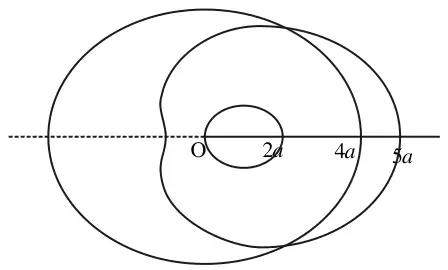
| correct shape | B1 |
| 5a and 4a marked | B1 |
| 2a marked and passes through O | B1 |
| (3) | |
| (15 marks) |
Notes
First B for approximately symmetrical shape about initial line, only 1 loop which is convex strictly within shaded region