
FP2 June 2007 Q4
4.
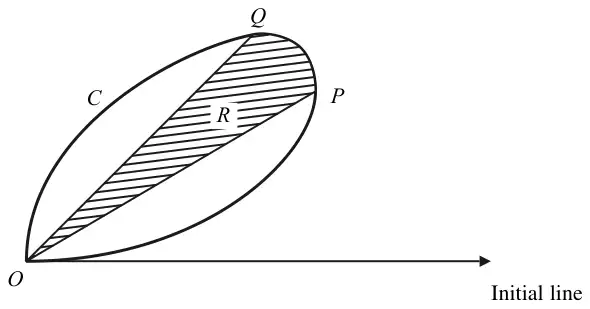
The diagram above shows a sketch of the curve \(C\) with polar equation \[r = 4\sin\theta\cos^2\theta, \qquad 0 \leqslant \theta \lt \frac{\pi}{2}.\]
The tangent to \(C\) at the point \(P\) is perpendicular to the initial line.
The point \(Q\) on \(C\) has polar coordinates \(\left(\sqrt{2}, \dfrac{\pi}{4}\right)\).
The shaded region \(R\) is bounded by \(OP\), \(OQ\) and \(C\), as shown in the diagram above.
| Scheme | Marks |
|---|---|
| \(x = r\cos\theta = 4\sin\theta\cos^3\theta\) | M1 |
| \(\dfrac{\mathrm{d}x}{\mathrm{d}\theta} = 4\cos^4\theta - 12\cos^2\theta\sin^2\theta\) any correct expression | M1A1 |
| Solving \(\dfrac{\mathrm{d}x}{\mathrm{d}\theta} = 0\) \(\left[\dfrac{\mathrm{d}x}{\mathrm{d}\theta} = 0 \Rightarrow 4\cos^2\theta(\cos^2\theta - 3\sin^2\theta) = 0\right]\) | M1 |
| \(\sin\theta = \dfrac{1}{2}\) or \(\cos\theta = \dfrac{\sqrt{3}}{2}\) or \(\tan\theta = \dfrac{1}{\sqrt{3}} \Rightarrow \theta = \dfrac{\pi}{6}\) AG | A1 cso |
| \(r = 4\sin\dfrac{\pi}{6}\cos^2\dfrac{\pi}{6} = \dfrac{3}{2}\) AG | A1cso |
| (6) |
Notes
So many ways \(x\) may be expressing e.g. \(2\sin 2\theta\cos^2\theta,\ \sin 2\theta(1 + \cos 2\theta),\ \sin 2\theta + (1/2)\sin 4\theta\) leading to many results for \(\dfrac{\mathrm{d}x}{\mathrm{d}\theta}\)
Some relevant equations in solving \([(1 - 4\sin^2\theta) = 0,\ (4\cos^2\theta - 3) = 0,\ (1 - 3\tan^2\theta) = 0,\ \cos 3\theta = 0]\)
Showing that \(\theta = \dfrac{\pi}{6}\) satisfies \(\dfrac{\mathrm{d}x}{\mathrm{d}\theta} = 0\), allow M1 A1 providing \(\dfrac{\mathrm{d}x}{\mathrm{d}\theta}\) correct
Starting with \(x = r\sin\theta\) can gain M0M1M1
| Scheme | Marks |
|---|---|
| \(A = \dfrac{1}{2}\displaystyle\int_{\pi/6}^{\pi/4} r^2\,\mathrm{d}\theta = \frac{1}{2} \cdot 16\int_{\pi/6}^{\pi/4} \sin^2\theta\cos^4\theta\,\mathrm{d}\theta\) | |
| \(8\sin^2\theta\cos^4\theta = 2\cos^2\theta(4\sin^2\theta\cos^2\theta) = 2\cos^2\theta\sin^2 2\theta\) | M1 |
| \(= (\cos 2\theta + 1)\sin^2 2\theta\) | M1 |
| \(= \cos 2\theta\sin^2 2\theta + \dfrac{1 - \cos 4\theta}{2}\) = Answer AG | A1 cso |
| (3) |
Notes
First M1 for use of double angle formula for \(\sin 2A\)
Second M1 for use of \(\cos 2A = 2\cos^2 A - 1\)
Answer given: must be intermediate step, as shown, and no incorrect work
| Scheme | Marks |
|---|---|
| Area \(= \left[\dfrac{1}{6}\sin^3 2\theta + \dfrac{\theta}{2} - \dfrac{\sin 4\theta}{8}\right]_{\left(\frac{\pi}{6}\right)}^{\left(\frac{\pi}{4}\right)}\) ignore limits | M1A1 |
| \(= \left(\dfrac{1}{6}\sin^3\dfrac{\pi}{2} + \dfrac{\pi}{8} - \dfrac{\sin\pi}{8}\right) - \left(\dfrac{1}{6}\sin^3\dfrac{\pi}{3} + \dfrac{\pi}{12} - \dfrac{\sin\frac{2\pi}{3}}{8}\right)\) (sub. limits) | M1 |
| \(= \left(\dfrac{1}{6} + \dfrac{\pi}{8}\right) - \left(\dfrac{\sqrt{3}}{16} + \dfrac{\pi}{12} - \dfrac{\sqrt{3}}{16}\right) = \dfrac{1}{6},\ + \dfrac{\pi}{24}\) both cao | A1, A1 |
| (5) | |
| (14 marks) |
Notes
For first M, of the form \(a\sin^3 2\theta + \dfrac{\theta}{2} \pm b\sin 4\theta\) (Allow if two of correct form)
On ePen the order of the As in answer is as written