
S4 June 2013 (R) Q3
3. The number of houses sold per week by a firm of estate agents follows a Poisson distribution with mean 2. The firm believes that the appointment of a new salesman will increase the number of houses sold. The firm tests its belief by recording the number of houses sold, \(x\), in the week following the appointment. The firm sets up the hypotheses \(\mathrm{H}_0 : \lambda = 2\) and \(\mathrm{H}_1 : \lambda \gt 2\), where \(\lambda\) is the mean number of houses sold per week, and rejects the null hypothesis if \(x \geqslant 3\)
The table below gives the values of the power function to 2 decimal places.
| \(\lambda\) | 2.5 | 3.0 | 3.5 | 4.0 | 5.0 | 7.0 |
| Power | 0.46 | \(r\) | 0.68 | \(s\) | 0.88 | 0.97 |
Table 1
| Scheme | Marks |
|---|---|
| \(X \sim \mathrm{Po}(2)\) | |
| Size \(= \mathrm{P}(X \geqslant 3 / \lambda = 2)\) | |
| \(= 1 - 0.6767\) | M1 |
| \(= 0.3233\) awrt 0.323 | A1 |
| (2) |
Notes
M1 for correct expression for size using Po(2)
| Scheme | Marks |
|---|---|
| Power \(= 1 - \mathrm{P}(0) - \mathrm{P}(1) - \mathrm{P}(2)\) | M1 |
| \(= 1 - \mathrm{e}^{-\lambda} - \lambda\mathrm{e}^{-\lambda} - \dfrac{\lambda^2\mathrm{e}^{-\lambda}}{2!}\) | A1 |
| \(= 1 - \dfrac{1}{2}\mathrm{e}^{-\lambda}\left(2 + 2\lambda + \lambda^2\right)\) | A1 cso |
| (3) |
Notes
1st M1 for a correct expression in terms of probabilities. Allow \(1 - \mathrm{P}(X \leqslant 2)\) or \(1 - \mathrm{P}(X \lt 3)\)
1st A1 for correct equation in \(\lambda\)
2nd A1 cso
| Scheme | Marks |
|---|---|
| \(r = 0.58 \qquad s = 0.76\) | B1, B1 |
| (2) |
Notes
SC if both correct but not to 2dp award B1B0
| Scheme | Marks |
|---|---|
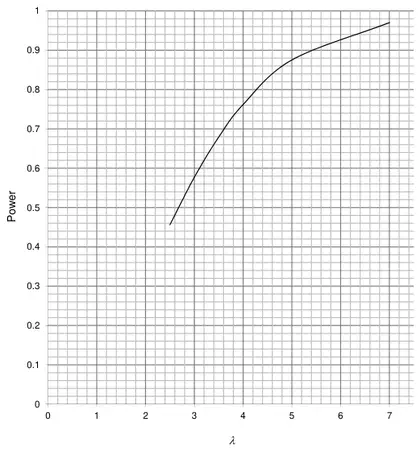 | B1ft points B1ft curve |
| (2) |
Notes
1st B1ft points
2nd B1ft curve (or straight lines) through points
| Scheme | Marks |
|---|---|
| \(\lambda \gt 3.1\) allow numbers in range 3.1–3.2 | B1 |
| (1) | |
| (10 marks) |