
S4 June 2013 Q5
5. Water is tested at various stages during a purification process by an environmental scientist. A certain organism occurs randomly in the water at a rate of \(\lambda\) every 10 ml. The scientist selects a random sample of 20 ml of water to check whether there is evidence that \(\lambda\) is greater than 1. The criterion the scientist uses for rejecting the hypothesis that \(\lambda = 1\) is that there are 4 or more organisms in the sample of 20 ml.
A statistician suggests using an alternative test. The statistician’s test involves taking a random sample of 10 ml and rejecting the hypothesis that \(\lambda = 1\) if 2 or more organisms are present but accepting the hypothesis if no organisms are in the sample. If only 1 organism is found then a second random sample of 10 ml is taken and the hypothesis is rejected if 2 or more organisms are present, otherwise the hypothesis is accepted.
Table 1 below gives some values, to 2 decimal places, of the power function of the statistician’s test.
| \(\lambda\) | 1.5 | 2 | 2.5 | 3 | 3.5 | 4 |
|---|---|---|---|---|---|---|
| Power | 0.59 | 0.75 | 0.86 | \(r\) | 0.96 | 0.97 |
Table 1
Figure 1 shows a graph of the power function for the scientist’s test.
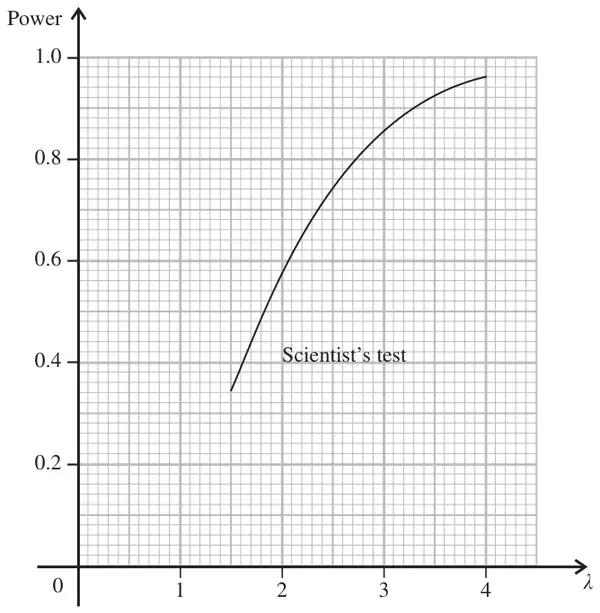
Given that it takes 20 minutes to collect and test a 20 ml sample and 15 minutes to collect and test a 10 ml sample
| Scheme | Marks |
|---|---|
| \(Y\) = no. of organisms in 20 ml. \(Y \sim \mathrm{Po}(2\lambda)\) Size \(= \mathrm{P}(Y \geqslant 4 \mid Y \sim \mathrm{Po}(2)),\ = 1 - \mathrm{P}(Y \leqslant 3) = 1 - 0.8571 = \underline{\mathbf{0.1429}}\) | M1, A1 |
| (2) |
Notes
M1 for correct expression for size using Po(2)
| Scheme | Marks |
|---|---|
| \(\mathrm{P}(\text{Type II error}) = 1 - \mathrm{P}(Y \geqslant 4 \mid Y \sim \mathrm{Po}(5)),\ = \mathrm{P}(Y \leqslant 3) = \underline{\mathbf{0.2650}}\) | M1, A1 |
| (2) |
Notes
M1 for correct expression using Po(5)
| Scheme | Marks |
|---|---|
| \(X\) = no. of organisms in 10 ml. \(X \sim \mathrm{Po}(\lambda)\) Power \(= \mathrm{P}(X \geqslant 2) + \mathrm{P}(X = 1) \times \mathrm{P}(X \geqslant 2)\) | M1 |
| \(= \mathrm{P}(X \geqslant 2)\,[1 + \mathrm{P}(X = 1)] = \left[1 - \mathrm{e}^{-\lambda}(1 + \lambda)\right] \times \left[1 + \lambda\mathrm{e}^{-\lambda}\right]\) | M1A1 |
| \(= 1 - \mathrm{e}^{-\lambda} - \lambda\mathrm{e}^{-\lambda} + \lambda\mathrm{e}^{-\lambda} - \lambda(1 + \lambda)\mathrm{e}^{-2\lambda} = 1 - \mathrm{e}^{-\lambda} - \lambda(1 + \lambda)\mathrm{e}^{-2\lambda}\) | A1cso |
| (4) |
Notes
1st M1 for a correct expression in terms of probabilities
Alternate answer \(1 - [\mathrm{P}(X = 0) + \mathrm{P}(X = 1) \times \mathrm{P}(X \leqslant 1)]\)
2nd M1 for an attempt at a correct equation in \(\lambda\)
1st A1 for a correct expression in \(\lambda\)
| Scheme | Marks |
|---|---|
| \(r = 0.92\) | B1 |
| (1) |
| Scheme | Marks |
|---|---|
See Graph paper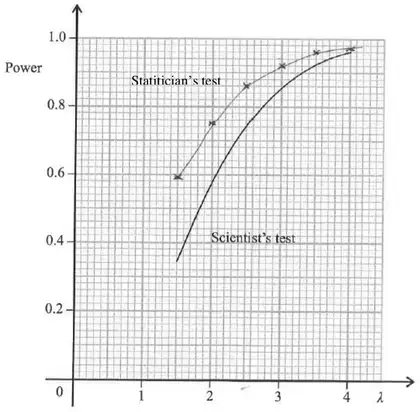 | B1B1 |
| (2) |
Notes
1st B1 points
2nd B1 curve (or straight lines)
| Scheme | Marks |
|---|---|
| Expected time for statistician’s test: \(30 \times \mathrm{P}(X = 1) + 15 \times [1 - \mathrm{P}(X = 1)]\) | M1 |
| \(= 30\lambda\mathrm{e}^{-\lambda} + 15\left(1 - \lambda\mathrm{e}^{-\lambda}\right) = 15\left(1 + \lambda\mathrm{e}^{-\lambda}\right)\) | A1 |
| slower if: \(15\left(1 + \lambda\mathrm{e}^{-\lambda}\right) \gt 20,\ \Rightarrow \lambda\mathrm{e}^{-\lambda} \gt \dfrac{1}{3}\) | M1,A1cso |
| (4) |
Notes
1st M1 for an attempt to calculate expected time
Alternate method \(15 + 15 \times \mathrm{P}(X = 1)\)
1st A1 for a correct expression in terms of \(\lambda\)
2nd M1 for attempt at correct inequality
| Scheme | Marks |
|---|---|
| \(\lambda\mathrm{e}^{-\lambda}\) with \(\lambda = 1\) is 0.36…, with \(\lambda = 2\) is 0.27…so second(statisticians) test is slower if \(\lambda = 1\) but faster for \(\lambda = 2\). Second test is more powerful for all \(\lambda\) | B1 |
| Choose second test - more powerful and faster for \(\lambda \geqslant 2\) | B1 |
| (2) | |
| (17 marks) |
Notes
1st B1 for a comment about power & timings
2nd B1 for selecting second test