
C3 June 2013 Q8
8.
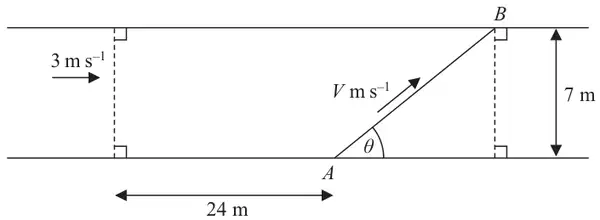
Kate crosses a road, of constant width 7 m, in order to take a photograph of a marathon runner, John, approaching at 3 m s−1.
Kate is 24 m ahead of John when she starts to cross the road from the fixed point \(A\).
John passes her as she reaches the other side of the road at a variable point \(B\), as shown in Figure 2.
Kate’s speed is \(V\) m s−1 and she moves in a straight line, which makes an angle \(\theta\), \(0<\theta<150^\circ\), with the edge of the road, as shown in Figure 2.
You may assume that \(V\) is given by the formula\[V=\frac{21}{24\sin\theta+7\cos\theta},\qquad 0<\theta<150^\circ\]
Given that \(\theta\) varies,
Given that Kate’s speed has the value found in part (b),
Given instead that Kate’s speed is 1.68 m s−1,
| Scheme | Marks |
|---|---|
| \(R=\sqrt{\left(7^2+24^2\right)}=25\) | B1 |
| \(\tan\alpha=\dfrac{24}{7},\quad\Rightarrow\quad\alpha=\text{awrt }73.74^\circ\) | M1A1 |
| (3) |
Notes
B1 25. Accept 25.0 but not \(\sqrt{625}\) or answers that are not exactly 25. Eg 25.0001
M1 For \(\tan\alpha=\pm\dfrac{24}{7},\ \tan\alpha=\pm\dfrac{7}{24}\).
If the value of R is used only accept \(\sin\alpha=\pm\dfrac{24}{R},\ \cos\alpha=\pm\dfrac{7}{R}\)
A1 Accept answers which round to 73.74 – must be in degrees for this mark
| Scheme | Marks |
|---|---|
| maximum value of \(24\sin x+7\cos x=25\) so \(V_{\min}=\dfrac{21}{25}=(0.84)\) | M1A1 |
| (2) |
Notes
M1 Calculates \(V=\dfrac{21}{\textit{their}\ 'R'}\) NOT - R
A1 Obtains correct answer. \(V=\dfrac{21}{25}\) Accept 0.84
Do not accept if you see incorrect working- ie from \(\cos(\theta-\alpha)=-1\) or the minus just disappearing from a previous line.
Questions involving differentiation are acceptable. To score M1 the candidate would have to differentiate \(V\) by the quotient rule (or similar), set \(V'=0\) to find \(\theta\) and then sub this back into V to find its value.
| Scheme | Marks |
|---|---|
| Distance \(AB=\dfrac{7}{\sin\theta}\), with \(\theta=\alpha\) | M1, B1 |
| So distance = 7.29m \(\ =\dfrac{175}{24}\) m | A1 |
| (3) |
Notes
M1 Uses the trig equation \(\sin\theta=\dfrac{7}{AB}\) with a numerical \(\theta\) to find \(AB=\ldots\)
B1 Uses \(\theta=\) their value of \(\alpha\) in a trig calculation involving sin. (\(\sin\alpha=\dfrac{AB}{7}\) is condoned)
A1 Obtains answer \(\dfrac{175}{24}\) or awrt 7.29
| Scheme | Marks |
|---|---|
| \(R\cos(\theta-\alpha)=\dfrac{21}{1.68}\Rightarrow\cos(\theta-\alpha)=0.5\) | M1, A1 |
| \(\theta-\alpha=60\Rightarrow\theta=..,\ \theta-\alpha=-60\Rightarrow\theta=..\) | dM1, dM1 |
| \(\theta=\text{awrt }133.7,\ 13.7\) | A1, A1 |
| (6) | |
| (14 marks) |
Notes
M1 Substitutes \(V=1.68\) and their answer to part (a) in \(V=\dfrac{21}{24\sin\theta+7\cos\theta}\) to get an equation of the form \(R\cos(\theta\pm\alpha)=\dfrac{21}{1.68}\) or \(1.68R\cos(\theta\pm\alpha)=21\) or \(\cos(\theta\pm\alpha)=\dfrac{21}{1.68R}\).
Follow through on their \(R\) and \(\alpha\)
A1 Obtains \(\cos(\theta\pm\alpha)=0.5\) oe. Follow through on their \(\alpha\). It may be implied by later working.
dM1 Obtains one value of \(\theta\) in the range \(0<\theta<150\) from inverse cos +their \(\alpha\)
It is dependent upon the first M being scored.
dM1 Obtains second angle of \(\theta\) in the range \(0<\theta<150\) from inverse cos +their \(\alpha\)
It is dependent upon the first M being scored.
A1 one correct answer awrt \(\theta=133.7\ or\ 13.7\) 1dp
A1 both correct answers awrt \(\theta=133.7\ and\ 13.7\) 1dp.
Extra solutions in the range loses the last A1.
Answers in radians, lose the first time it occurs. Answers must be to 3dp
For your info \(\alpha=1.287,\ \theta_1=2.334,\ \theta_2=0.240\)