
C4 January 2013 Q4
4.
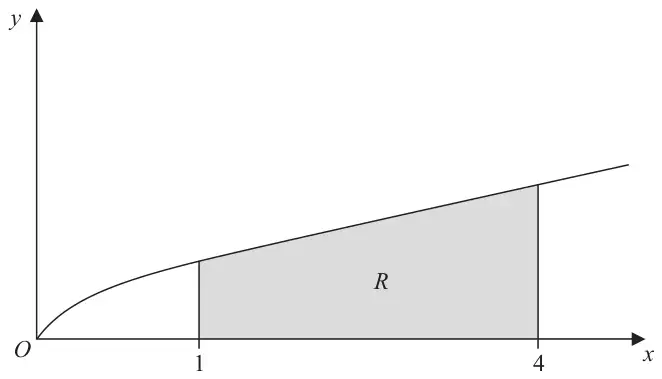
Figure 1 shows a sketch of part of the curve with equation \(y = \dfrac{x}{1 + \sqrt{x}}\). The finite region \(R\), shown shaded in Figure 1, is bounded by the curve, the \(x\)-axis, the line with equation \(x = 1\) and the line with equation \(x = 4\).
| \(x\) | 1 | 2 | 3 | 4 |
|---|---|---|---|---|
| \(y\) | 0.5 | 0.8284 | 1.3333 |
| Scheme | Marks |
|---|---|
| 1.0981 | B1 cao |
| (1) |
Notes
B1: 1.0981 correct answer only. Look for this on the table or in the candidate’s working.
| Scheme | Marks |
|---|---|
| \(\text{Area} \approx \dfrac{1}{2} \times 1;\ \times \underline{\left[0.5 + 2(0.8284 + \text{their } 1.0981) + 1.3333\right]}\) | B1; M1 |
| \(= \dfrac{1}{2} \times 5.6863 = 2.84315 = 2.843\ \text{(3 dp)}\) 2.843 or awrt 2.843 | A1 |
| (3) |
Notes
B1: Outside brackets \(\dfrac{1}{2} \times 1\) or \(\dfrac{1}{2}\)
M1: For structure of trapezium rule \(\left[\ \underline{\ldots\ldots\ldots\ldots}\ \right]\)
A1: anything that rounds to 2.843
Note: Working must be seen to demonstrate the use of the trapezium rule. Note: actual area is 2.85573645…
Note: Award B1M1 A1 for \(\dfrac{1}{2}(0.5 + 1.3333) + (0.8284 + \text{their } 1.0981) = 2.84315\)
Bracketing mistake: Unless the final answer implies that the calculation has been done correctly
Award B1M0A0 for \(\dfrac{1}{2} \times 1 + 0.5 + 2(0.8284 + \text{their } 1.0981) + 1.3333\) (nb: answer of 6.1863).
Award B1M0A0 for \(\dfrac{1}{2} \times 1\ (0.5 + 1.3333) + 2(0.8284 + \text{their } 1.0981)\) (nb: answer of 4.76965).
Alternative method for part (b): Adding individual trapezia
| Scheme | Marks |
|---|---|
| \(\text{Area} \approx 1 \times \left[\dfrac{0.5 + 0.8284}{2} + \dfrac{0.8284 + 1.0981}{2} + \dfrac{1.0981 + 1.3333}{2}\right] = 2.84315\) |
B1: 1 and a divisor of 2 on all terms inside brackets.
M1: First and last ordinates once and two of the middle ordinates twice inside brackets ignoring the 2.
A1: anything that rounds to 2.843
| Scheme | Marks |
|---|---|
| \(\left\{u = 1 + \sqrt{x}\right\} \Rightarrow \underline{\dfrac{\mathrm{d}u}{\mathrm{d}x} = \dfrac{1}{2}x^{-\frac{1}{2}}}\) or \(\underline{\dfrac{\mathrm{d}x}{\mathrm{d}u} = 2(u - 1)}\) | B1 |
| \(\left\{\displaystyle\int \frac{x}{1 + \sqrt{x}}\,\mathrm{d}x =\right\} \displaystyle\int \frac{(u - 1)^2}{u}.\,2(u - 1)\,\mathrm{d}u\) \(\displaystyle\int \frac{(u - 1)^2}{u}\ldots\ldots\) | M1 |
| \(\displaystyle\int \frac{(u - 1)^2}{u}.\,2(u - 1)\) | A1 |
| \(= 2\displaystyle\int \frac{(u - 1)^3}{u}\,\mathrm{d}u = \{2\}\int \frac{(u^3 - 3u^2 + 3u - 1)}{u}\,\mathrm{d}u\) Expands to give a “four term” cubic in \(u\). Eg: \(\pm Au^3 \pm Bu^2 \pm Cu \pm D\) | M1 |
| \(= \{2\}\displaystyle\int \left(u^2 - 3u + 3 - \frac{1}{u}\right)\mathrm{d}u\) An attempt to divide at least three terms in their cubic by \(u\). See notes. | M1 |
| \(= \{2\}\left(\dfrac{u^3}{3} - \dfrac{3u^2}{2} + 3u - \ln u\right)\) \(\displaystyle\int \frac{(u - 1)^3}{u} \to \left(\frac{u^3}{3} - \frac{3u^2}{2} + 3u - \ln u\right)\) | A1 |
| \(\text{Area}(R) = \left[\dfrac{2u^3}{3} - 3u^2 + 6u - 2\ln u\right]_2^3\) \(= \left(\dfrac{2(3)^3}{3} - 3(3)^2 + 6(3) - 2\ln 3\right) - \left(\dfrac{2(2)^3}{3} - 3(2)^2 + 6(2) - 2\ln 2\right)\) Applies limits of 3 and 2 in \(u\) or 4 and 1 in \(x\) and subtracts either way round. | M1 |
| \(= \dfrac{11}{3} + 2\ln 2 - 2\ln 3\) or \(\dfrac{11}{3} + 2\ln\left(\dfrac{2}{3}\right)\) or \(\dfrac{11}{3} - \ln\left(\dfrac{9}{4}\right)\), etc Correct exact answer or equivalent. | A1 |
| (8) | |
| (12 marks) |
Notes
B1: \(\dfrac{\mathrm{d}u}{\mathrm{d}x} = \dfrac{1}{2}x^{-\frac{1}{2}}\) or \(\mathrm{d}u = \dfrac{1}{2\sqrt{x}}\,\mathrm{d}x\) or \(2\sqrt{x}\,\mathrm{d}u = \mathrm{d}x\) or \(\mathrm{d}x = 2(u - 1)\,\mathrm{d}u\) or \(\dfrac{\mathrm{d}x}{\mathrm{d}u} = 2(u - 1)\) oe.
1st M1: \(\dfrac{x}{1 + \sqrt{x}}\) becoming \(\dfrac{(u - 1)^2}{u}\) (Ignore integral sign).
1st A1 (B1 on epen): \(\dfrac{x}{1 + \sqrt{x}}\,\mathrm{d}x\) becoming \(\dfrac{(u - 1)^2}{u}.\,2(u - 1)\{\mathrm{d}u\}\) or \(\dfrac{(u - 1)^2}{u}.\dfrac{2}{(u - 1)^{-1}}\{\mathrm{d}u\}\).
You can ignore the integral sign and the \(\mathrm{d}u\).
2nd M1: Expands to give a “four term” cubic in \(u\), \(\pm Au^3 \pm Bu^2 \pm Cu \pm D\)
where \(A \neq 0, B \neq 0, C \neq 0\) and \(D \neq 0\) The cubic does not need to be simplified for this mark.
3rd M1: An attempt to divide at least three terms in their cubic by \(u\).
Ie. \(\dfrac{(u^3 - 3u^2 + 3u - 1)}{u} \to u^2 - 3u + 3 - \dfrac{1}{u}\)
2nd A1: \(\displaystyle\int \frac{(u - 1)^3}{u}\,\mathrm{d}u \to \left(\frac{u^3}{3} - \frac{3u^2}{2} + 3u - \ln u\right)\)
4th M1: Some evidence of limits of 3 and 2 in \(u\) and subtracting either way round.
3rd A1: Exact answer of \(\dfrac{11}{3} + 2\ln 2 - 2\ln 3\) or \(\dfrac{11}{3} + 2\ln\left(\dfrac{2}{3}\right)\) or \(\dfrac{11}{3} - \ln\left(\dfrac{9}{4}\right)\) or \(2\left(\dfrac{11}{6} + \ln 2 - \ln 3\right)\)
or \(\dfrac{22}{6} + 2\ln\left(\dfrac{2}{3}\right)\), etc. Note: that fractions must be combined to give either \(\dfrac{11}{3}\) or \(\dfrac{22}{6}\) or \(3\dfrac{2}{3}\)
Alternative method for 2nd M1 and 3rd M1 mark
| Scheme | Marks |
|---|---|
| \(\{2\}\displaystyle\int \frac{(u - 1)^2}{u}.(u - 1)\,\mathrm{d}u = \{2\}\int \frac{(u^2 - 2u + 1)}{u}.(u - 1)\,\mathrm{d}u\) \(= \{2\}\displaystyle\int \left(u - 2 + \frac{1}{u}\right).(u - 1)\,\mathrm{d}u = \{2\}\int \left(u^2 - \ldots\right)\mathrm{d}u\) 2nd M1: An attempt to expand \((u - 1)^2\), then divide the result by \(u\) and then go on to multiply by \((u - 1)\). | 2nd M1 |
| \(= \{2\}\displaystyle\int \left(u^2 - 2u + 1 - u + 2 - \frac{1}{u}\right)\mathrm{d}u\) \(= \{2\}\displaystyle\int \left(u^2 - 3u + 3 - \frac{1}{u}\right)\mathrm{d}u\) 3rd M1: to give three out of four of \(\pm Au^2, \pm Bu, \pm C\) or \(\pm\dfrac{D}{u}\) | 3rd M1 |
Final two marks in part (c): \(u = 1 + \sqrt{x}\)
| Scheme | Marks |
|---|---|
| \(\text{Area}(R) = \left[\dfrac{2\left(1 + \sqrt{x}\right)^3}{3} - 3\left(1 + \sqrt{x}\right)^2 + 6\left(1 + \sqrt{x}\right) - 2\ln\left(1 + \sqrt{x}\right)\right]_1^4\) \(= \left(\dfrac{2\left(1 + \sqrt{4}\right)^3}{3} - 3\left(1 + \sqrt{4}\right)^2 + 6\left(1 + \sqrt{4}\right) - 2\ln\left(1 + \sqrt{4}\right)\right)\) \(\quad - \left(\dfrac{2\left(1 + \sqrt{1}\right)^3}{3} - 3\left(1 + \sqrt{1}\right)^2 + 6\left(1 + \sqrt{1}\right) - 2\ln\left(1 + \sqrt{1}\right)\right)\) M1: Applies limits of 4 and 1 in \(x\) and subtracts either way round. | M1 |
| \(= (18 - 27 + 18 - 2\ln 3) - \left(\dfrac{16}{3} - 12 + 12 - 2\ln 2\right)\) \(= \dfrac{11}{3} + 2\ln 2 - 2\ln 3\) or \(\dfrac{11}{3} + 2\ln\left(\dfrac{2}{3}\right)\) or \(\dfrac{11}{3} - \ln\left(\dfrac{9}{4}\right)\), etc A1: Correct exact answer or equivalent. | A1 |
Alternative method for the final 5 marks in part (c)
| Scheme | Marks |
|---|---|
| \(\displaystyle\int \frac{(u - 1)^3}{u}\,\mathrm{d}u,\quad \left\{\begin{aligned} \text{"}u\text{"} &= u^{-1} &\Rightarrow\ \frac{\mathrm{d}\text{"}u\text{"}}{\mathrm{d}x} &= -u^{-2} \\ \frac{\mathrm{d}v}{\mathrm{d}x} &= (u - 1)^3 &\Rightarrow\ v &= \frac{(u - 1)^4}{4} \end{aligned}\right\}\) \(= \dfrac{(u - 1)^4}{4u} - -\dfrac{1}{4}\displaystyle\int \frac{(u - 1)^4}{u^2}\,\mathrm{d}u\) | |
| \(= \dfrac{(u - 1)^4}{4u} + \dfrac{1}{4}\displaystyle\int \frac{u^4 - 4u^3 + 6u^2 - 4u + 1}{u^2}\,\mathrm{d}u\) M1: Applies integration by parts and expands to give a five term quartic. | M1 |
| \(= \dfrac{(u - 1)^4}{4u} + \dfrac{1}{4}\displaystyle\int u^2 - 4u + 6 - \frac{4}{u} + \frac{1}{u^2}\,\mathrm{d}u\) M1: Dividing at least 4 terms. | M1 |
| \(= \dfrac{(u - 1)^4}{4u} + \dfrac{1}{4}\left(\dfrac{u^3}{3} - 2u^2 + 6u - 4\ln u - \dfrac{1}{u}\right)\) A1: Correct Integration. | A1 |
| \(\displaystyle\int_2^3 \frac{(u - 1)^3}{u}\,\mathrm{d}u = \left[\frac{(u - 1)^4}{4u} + \frac{u^3}{12} - \frac{u^2}{2} + \frac{3u}{2} - \ln u - \frac{1}{4u}\right]_2^3\) \(= \left(\dfrac{16}{12} + \dfrac{27}{12} - \dfrac{9}{2} + \dfrac{9}{2} - \ln 3 - \dfrac{1}{12}\right) - \left(\dfrac{1}{8} + \dfrac{8}{12} - \dfrac{4}{2} + \dfrac{6}{2} - \ln 2 - \dfrac{1}{8}\right)\) \(= (7 - \ln 3) - \left(\dfrac{5}{3} - \ln 2\right)\) \(= \dfrac{11}{6} + \ln\dfrac{2}{3}\) | M1 |
| \(\text{Area}(R) = 2\displaystyle\int_2^3 \frac{(u - 1)^3}{u}\,\mathrm{d}u = 2\left(\frac{11}{6} + \ln\frac{2}{3}\right)\) | A1 |
(corrected from the printed mark scheme: this alternative is headed “final 5 marks in part (b)”; it is for part (c))