
C3 June 2012 Q6
6. The functions f and g are defined by
\[\begin{aligned} &\mathrm{f} : x \mapsto \mathrm{e}^x + 2, && x \in \mathbb{R} \\ &\mathrm{g} : x \mapsto \ln x, && x \gt 0 \end{aligned}\]
| Scheme | Marks |
|---|---|
| f(x)>2 | B1 |
| (1) |
Notes
B1 Range of f(x)>2. Accept y>2, (2,\(\infty\)), f>2, as well as ‘range is the set of numbers bigger than 2’ but don’t accept x>2
| Scheme | Marks |
|---|---|
| \(\mathrm{fg}(x) = e^{\ln x} + 2, = x + 2\) | M1,A1 |
| (2) |
Notes
M1 For applying the correct order of operations. Look for \(e^{\ln x} + 2\). Note that \(\ln e^x + 2\) is M0
A1 Simplifies \(e^{\ln x} + 2\) to \(x + 2\). Just the answer is acceptable for both marks
| Scheme | Marks |
|---|---|
| \(e^{2x + 3} + 2 = 6 \Rightarrow e^{2x + 3} = 4\) | M1A1 |
| \(\Rightarrow 2x + 3 = \ln 4\) \(\Rightarrow x = \dfrac{\ln 4 - 3}{2}\) or \(\ln 2 - \dfrac{3}{2}\) | M1A1 |
| (4) |
Notes
M1 Starts with \(e^{2x + 3} + 2 = 6\) and proceeds to \(e^{2x + 3} = \ldots\)
A1 \(e^{2x + 3} = 4\)
M1 Takes ln’s both sides, \(2x + 3 = \ln..\) and proceeds to x=….
A1 \(x = \dfrac{\ln 4 - 3}{2}\) oe. eg \(\ln 2 - \dfrac{3}{2}\) Remember to isw any incorrect working after a correct answer
| Scheme | Marks |
|---|---|
| Let \(y = e^x + 2 \Rightarrow y - 2 = e^x \Rightarrow \ln(y - 2) = x\) | M1 |
| \(\mathrm{f}^{-1}(x) = \ln(x - 2), \quad x \gt 2.\) | A1 , B1ft |
| (3) |
Notes
Note that this is marked M1A1A1 on EPEN
M1 Starts with \(y = e^x + 2\) or \(x = e^y + 2\) and attempts to change the subject.
All ln work must be correct. The 2 must be dealt with first.
Eg. \(y = e^x + 2 \Rightarrow \ln y = x + \ln 2 \Rightarrow x = \ln y - \ln 2\) is M0
A1 \(\mathrm{f}^{-1}(x) = \ln(x - 2)\) or \(y = \ln(x - 2)\) or \(y = \ln\left|x - 2\right|\) There must be some form of bracket
B1ft Either x>2, or follow through on their answer to part (a), provided that it wasn’t \(y \in \Re\)
Do not accept y>2 or f-1(x)>2.
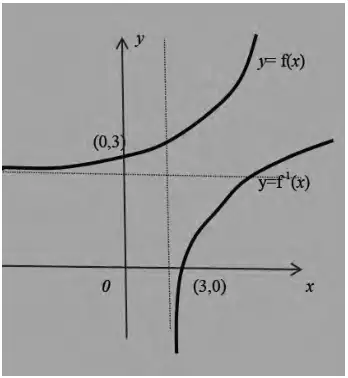
| Scheme | Marks |
|---|---|
| Shape for f(x) | B1 |
| (0, 3) | B1 |
| Shape for f-1(x) | B1 |
| (3, 0) | B1 |
| (4) | |
| (14 marks) |
Notes
B1 Shape for y=ex. The graph should only lie in quadrants 1 and 2. It should start out with a gradient that is approx. 0 above the x axis in quadrant 2 and increase in gradient as it moves into quadrant 1. You should not see a minimum point on the graph.
B1 (0, 3) lies on the curve. Accept 3 written on the y axis as long as the point lies on the curve
B1 Shape for y=lnx. The graph should only lie in quadrants 4 and 1. It should start out with gradient that is approx. infinite to the right of the y axis in quadrant 4 and decrease in gradient as it moves into quadrant 1. You should not see a maximum point. Also with hold this mark if it intersects y=ex
B1 (3, 0) lies on the curve. Accept 3 written on the x axis as long as the point lies on the curve
Condone lack of labels in this part
Examples
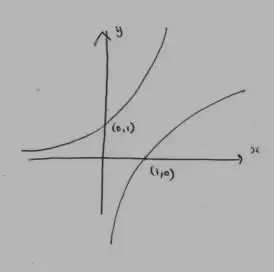
Scores 1,0,1,0.
Both shapes are fine, do not be concerned about asymptotes appearing at x=2, y=2. (See notes)
Both co-ordinates are incorrect
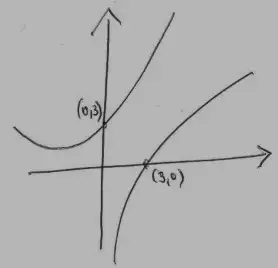
Scores 0,1,1,1
Shape for \(y = e^x\) is incorrect, there is a minimum point on the graph.
All other marks an be awarded