
C3 June 2015 Q2
2. Given that\[\mathrm{f}(x) = 2\mathrm{e}^x - 5, \qquad x \in \mathbb{R}\]
On each diagram, show the coordinates of each point at which the curve meets or cuts the axes.
On each diagram state the equation of the asymptote.
(6)(a)(i)
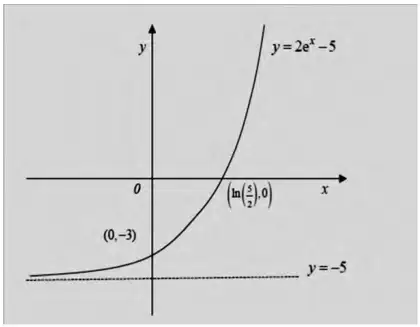
| Scheme | Marks |
|---|---|
| Shape | B1 |
| \(\left(\ln\left(\dfrac{5}{2}\right), 0\right)\) and \((0, -3)\) | B1 |
| \(y = -5\) | B1 |
| (3) |
(a)(ii)
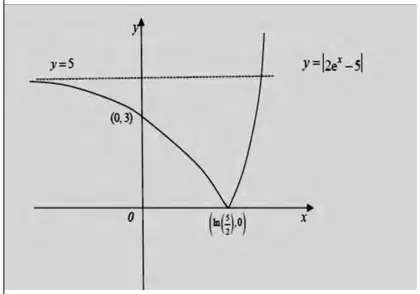
| Scheme | Marks |
|---|---|
| Shape inc cusp | B1ft |
| \(\left(\ln\left(\dfrac{5}{2}\right), 0\right)\) and \((0, 3)\) | B1ft |
| \(y = 5\) | B1ft |
| (3) |
Notes
(a)(i)
B1: For an exponential (growth) shaped curve in any position. For this mark be tolerant on slips of the pen at either end. See Practice and Qualification for examples.
B1: Intersections with the axes at \(\left(\ln\left(\dfrac{5}{2}\right), 0\right)\) and \((0, -3)\).
Allow \(\ln\left(\dfrac{5}{2}\right)\) and \(-3\) being marked on the correct axes.
Condone \(\left(0, \ln\left(\dfrac{5}{2}\right)\right)\) and \((-3, 0)\) being marked on the \(x\) and \(y\) axes respectively.
Do not allow \(\left(\ln\left(\dfrac{5}{2}\right), 0\right)\) appearing as awrt (0.92, 0) for this mark unless seen elsewhere. Allow if seen in body of script. If they are given in the body of the script and differently on the curve (save for the decimal equivalent) then the ones on the curve take precedence.
B1: Equation of the asymptote given as \(y = -5\). Note that the curve must appear to have an asymptote at \(y = -5\), not necessarily drawn. It is not enough to have -5 marked on the axis or indeed \(x = -5\). An extra asymptote with an equation gets B0
(a)(ii)
B1ft: For either the correct shape or a reflection of their curve from (a)(i) in the \(x\)-axis. For this to be scored it must have appeared both above and below the \(x\)-axis. The shape must be correct including the cusp. The curve to the lhs of the cusp must appear to have the correct curvature
B1ft: Score for both intersections or follow through on both the intersections given in part (a)(i), including decimals, as long as the curve appeared both above and below the \(x\)-axis. See part (a) for acceptable forms
B1ft: Score for an asymptote of \(y = 5\) or follow through on an asymptote of \(y = -C\) from part (a)(i). Note that the curve must appear to have an asymptote at \(y = C\) but do not penalise if the first mark in (a)(ii) has been withheld for incorrect curvature on the lhs.
| Scheme | Marks |
|---|---|
| \(x \geqslant \ln\left(\dfrac{5}{2}\right)\) | B1 ft |
| (1) |
Notes
B1ft: Score for \(x \geqslant \ln\left(\dfrac{5}{2}\right)\), \(x \geqslant\) awrt 0.92 or follow through on the \(x\) intersection in part (a)
| Scheme | Marks |
|---|---|
| \(2\mathrm{e}^x - 5 = -2 \Rightarrow (x) = \ln\left(\dfrac{3}{2}\right)\) | M1A1 |
| \((x) = \ln\left(\dfrac{7}{2}\right)\) | B1 |
| (3) | |
| (10 marks) |
Notes
M1: Accept \(2\mathrm{e}^x - 5 = -2\) or \(-2\mathrm{e}^x + 5 = 2 \Rightarrow x = ..\ln(..)\)
Allow squaring so \(\left(2\mathrm{e}^x - 5\right)^2 = 4 \Rightarrow \mathrm{e}^x = ..\text{ and}.. \Rightarrow x = \ln(..), \ln(..)\)
A1: \(x = \ln\left(\dfrac{3}{2}\right)\) or exact equivalents such as \(x = \ln 1.5\). You do not need to see the \(x\).
Remember to isw a subsequent decimal answer 0.405
B1: \(x = \ln\left(\dfrac{7}{2}\right)\) or exact equivalents such as \(x = \ln 3.5\). You do not need to see the \(x\).
Remember to isw a subsequent decimal answer 1.25
If both answers are given in decimals and there is no working \(x =\) awrt 1.25, 0.405 award SC 100