
C3 June 2015 Q7
7.
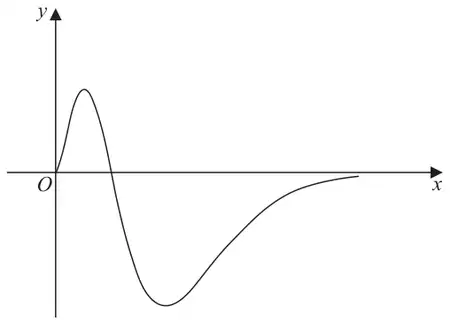
Figure 2 shows a sketch of part of the curve with equation\[\mathrm{g}(x) = x^2(1 - x)\mathrm{e}^{-2x}, \quad x \geqslant 0\]
| Scheme | Marks |
|---|---|
| Applies \(vu' + uv'\) to \(\left(x^2 - x^3\right)\mathrm{e}^{-2x}\) | |
| \(\mathrm{g}'(x) = \left(x^2 - x^3\right) \times -2\mathrm{e}^{-2x} + \left(2x - 3x^2\right) \times \mathrm{e}^{-2x}\) | M1 A1 |
| \(\mathrm{g}'(x) = \left(2x^3 - 5x^2 + 2x\right)\mathrm{e}^{-2x}\) | A1 |
| (3) |
Notes
Note that parts (a) and (b) can be scored together. Eg accept work in part (b) for part (a)M1: Uses the product rule \(vu' + uv'\) with \(u = x^2 - x^3\) and \(v = \mathrm{e}^{-2x}\) or vice versa. If the rule is quoted it must be correct. It may be implied by their \(u = ..\,v = ..\,u' = ..\,v' = ..\) followed by their \(vu' + uv'\). If the rule is not quoted nor implied only accept expressions of the form \(\left(x^2 - x^3\right) \times \pm A\mathrm{e}^{-2x} + \left(Bx \pm Cx^2\right) \times \mathrm{e}^{-2x}\) condoning bracketing issues
Method 2: multiplies out and uses the product rule on each term of \(x^2\mathrm{e}^{-2x} - x^3\mathrm{e}^{-2x}\)
Condone issues in the signs of the last two terms for the method mark
Uses the product rule for \(uvw = u'vw + uv'w + uvw'\) applied as in method 1
Method 3: Uses the quotient rule with \(u = x^2 - x^3\) and \(v = \mathrm{e}^{2x}\). If the rule is quoted it must be correct. It may be implied by their \(u = ..\,v = ..\,u' = ..\,v' = ..\) followed by their \(\dfrac{vu' - uv'}{v^2}\) If the rule is not quoted nor implied accept expressions of the form \(\dfrac{\mathrm{e}^{2x}\left(Ax - Bx^2\right) - \left(x^2 - x^3\right) \times C\mathrm{e}^{2x}}{\left(\mathrm{e}^{2x}\right)^2}\) condoning missing brackets on the numerator and \(\mathrm{e}^{2x^2}\) on the denominator.
Method 4: Apply implicit differentiation to \(y\mathrm{e}^{2x} = x^2 - x^3 \Rightarrow \mathrm{e}^{2x} \times \dfrac{\mathrm{d}y}{\mathrm{d}x} + y \times 2\mathrm{e}^{2x} = 2x - 3x^2\)
Condone errors on coefficients and signs
A1: A correct (unsimplified form) of the answer
\(\mathrm{g}'(x) = \left(x^2 - x^3\right) \times -2\mathrm{e}^{-2x} + \left(2x - 3x^2\right) \times \mathrm{e}^{-2x}\) by one use of the product rule
or \(\mathrm{g}'(x) = x^2 \times -2\mathrm{e}^{-2x} + 2x\mathrm{e}^{-2x} - x^3 \times -2\mathrm{e}^{-2x} - 3x^2 \times \mathrm{e}^{-2x}\) using the first alternative
or \(\mathrm{g}'(x) = 2x(1 - x)\mathrm{e}^{-2x} + x^2 \times -1 \times \mathrm{e}^{-2x} + x^2(1 - x) \times -2\mathrm{e}^{-2x}\) using the product rule on 3 terms
or \(\mathrm{g}'(x) = \dfrac{\mathrm{e}^{2x}\left(2x - 3x^2\right) - \left(x^2 - x^3\right) \times 2\mathrm{e}^{2x}}{\left(\mathrm{e}^{2x}\right)^2}\) using the quotient rule.
A1: Writes \(\mathrm{g}'(x) = \left(2x^3 - 5x^2 + 2x\right)\mathrm{e}^{-2x}\). You do not need to see \(\mathrm{f}(x)\) stated and award even if a correct \(\mathrm{g}'(x)\) is followed by an incorrect \(\mathrm{f}(x)\). If the f(x) is not simplified at this stage you need to see it simplified later for this to be awarded.
| Scheme | Marks |
|---|---|
| Sets \(\left(2x^3 - 5x^2 + 2x\right)\mathrm{e}^{-2x} = 0 \Rightarrow 2x^3 - 5x^2 + 2x = 0\) | M1 |
| \(x\left(2x^2 - 5x + 2\right) = 0 \Rightarrow x = (0), \dfrac{1}{2}, 2\) | M1,A1 |
| Sub \(x = \dfrac{1}{2}, 2\) into \(g(x) = \left(x^2 - x^3\right)\mathrm{e}^{-2x} \Rightarrow g\left(\dfrac{1}{2}\right) = \dfrac{1}{8\mathrm{e}},\ g(2) = -\dfrac{4}{\mathrm{e}^4}\) | dM1,A1 |
| Range \(-\dfrac{4}{\mathrm{e}^4} \leqslant g(x) \leqslant \dfrac{1}{8\mathrm{e}}\) | A1 |
| (6) |
Notes
Note: The last mark in e-pen has been changed from a ‘B’ to an A mark
M1: For setting their f(x) = 0. The = 0 may be implied by subsequent working.
Allow even if the candidate has failed to reach a 3TC for f(\(x\)).
Allow for \(\mathrm{f}(x) \geqslant 0\) or \(\mathrm{f}(x) \leqslant 0\) as they can use this to pick out the relevant sections of the curve
M1: For solving their 3TC = 0 by ANY correct method.
Allow for division of \(x\) or factorising out the \(x\) followed by factorisation of 3TQ. Check first and last terms of the 3TQ. Allow for solutions from either \(\mathrm{f}(x) \geqslant 0\) or \(\mathrm{f}(x) \leqslant 0\)
Allow solutions from the cubic equation just appearing from a Graphical Calculator
A1: \(x = \dfrac{1}{2}, 2\). Correct answers from a correct \(\mathrm{g}'(x)\) would imply all 3 marks so far in (b)
dM1: Dependent upon both previous M’s being scored. For substituting their two (non zero) values of \(x\) into g(\(x\)) to find both \(y\) values. Minimal evidence is required \(x = .. \Rightarrow y = ..\) is OK.
A1: Accept decimal answers for this mark. \(g\left(\dfrac{1}{2}\right) = \dfrac{1}{8\mathrm{e}} = \text{awrt } 0.046\) AND \(g(2) = -\dfrac{4}{\mathrm{e}^4} = \text{awrt } -0.073\)
A1: CSO Allow \(-\dfrac{4}{\mathrm{e}^4} \leqslant \text{Range} \leqslant \dfrac{1}{8\mathrm{e}}\), \(-\dfrac{4}{\mathrm{e}^4} \leqslant y \leqslant \dfrac{1}{8\mathrm{e}}\), \(\left[-\dfrac{4}{\mathrm{e}^4}, \dfrac{1}{8\mathrm{e}}\right]\). Condone \(y \geqslant -\dfrac{4}{\mathrm{e}^4}\) \(y \leqslant \dfrac{1}{8\mathrm{e}}\)
Note that the question states hence and part (a) must have been used for all marks. Some students will just write down the answers for the range from a graphical calculator.
Seeing just \(-\dfrac{4}{\mathrm{e}^4} \leqslant g(x) \leqslant \dfrac{1}{8\mathrm{e}}\) or \(-0.073 \leqslant g(x) \leqslant 0.046\) special case 100000.
They know what a range is!
| Scheme | Marks |
|---|---|
| Accept \(\mathrm{g}(x)\) is NOT a ONE to ONE function Accept \(\mathrm{g}(x)\) is a MANY to ONE function Accept \(\mathrm{g}^{-1}(x)\) would be ONE to MANY | B1 |
| (1) | |
| (10 marks) |
Notes
B1: If the candidate states ‘NOT ONE TO ONE’ then accept unless the explicitly link it to \(\mathrm{g}^{-1}(x)\). So accept ‘It is not a one to one function’. ‘The function is not one to one’ ‘\(\mathrm{g}(x)\) is not one to one’
If the candidate states ‘IT IS MANY TO ONE’ then accept unless the candidate explicitly links it to \(\mathrm{g}^{-1}(x)\). So accept ‘It is a many to one function.’ ‘The function is many to one’ ‘\(\mathrm{g}(x)\) is many to one’
If the candidate states ‘IT IS ONE TO MANY’ then accept unless the candidate explicitly links it to \(\mathrm{g}(x)\)
Accept an explanation like " one value of \(x\) would map/ go to more than one value of \(y\)"
Incorrect statements scoring B0 would be \(\mathrm{g}^{-1}(x)\) is not one to one, \(\mathrm{g}^{-1}(x)\) is many to one and \(\mathrm{g}(x)\) is one to many.