
C2 June 2012 Q3
3.
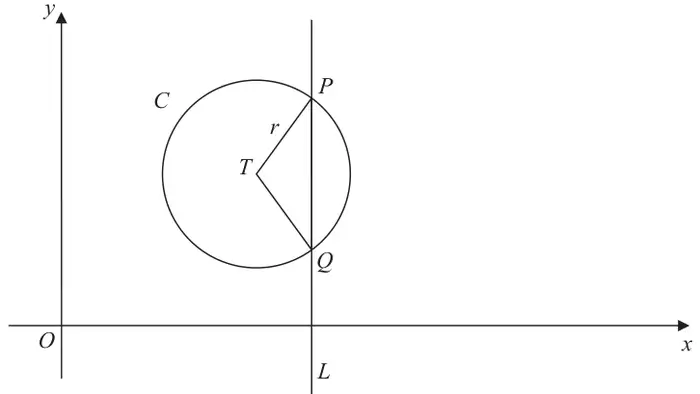
The circle \(C\) with centre \(T\) and radius \(r\) has equation\[x^2 + y^2 - 20x - 16y + 139 = 0\]
The line \(L\) has equation \(x = 13\) and crosses \(C\) at the points \(P\) and \(Q\) as shown in Figure 1.
Given that, to 3 decimal places, the angle \(PTQ\) is 1.855 radians,
| Scheme | Marks |
|---|---|
| Obtain \(\underline{(x \pm 10)^2}\) and \(\underline{\underline{(y \pm 8)^2}}\) | M1 |
| Obtain \(\underline{(x - 10)^2}\) and \(\underline{\underline{(y - 8)^2}}\) | A1 |
| Centre is \((10, 8)\). N.B. This may be indicated on diagram only as \((10, 8)\) | A1 |
| (3) |
Notes
Mark (a) and (b) together
M1 as in scheme and can be implied by \((\pm 10, \pm 8)\) . Correct centre (10, 8) implies M1A1A1
Alternatives (a)
Method 2: From \(x^2 + y^2 + 2gx + 2fy + c = 0\) centre is \((\pm g, \pm f)\) M1
Centre is \((-g, -f)\) , and so centre is \((10, 8)\). A1, A1
OR Method 3: Use any value of \(y\) to give two points (\(L\) and \(M\)) on circle. \(x\) co-ordinate of mid point of \(LM\) is “10” and Use any value of \(x\) to give two points (\(P\) and \(Q\)) on circle. \(y\) co-ordinate of mid point of \(PQ\) is “8” (Centre – chord theorem) . (10,8) is M1A1A1 M1 A1 A1 (3)
| Scheme | Marks |
|---|---|
| See \(\underline{(x \pm 10)^2} + \underline{\underline{(y \pm 8)^2}} = 25\ (= r^2)\) or \((r^2 =)\ \text{“}100\text{”} + \text{“}64\text{”} - 139\) | M1 |
| \(r = 5\) * (this is a printed answer so need one of the above two reasons) | A1 |
| (2) |
Notes
M1 for a correct method leading to \(r = \ldots\), or \(r^2 = \text{“}100\text{”} + \text{“}64\text{”} - 139\) (not \(139 - \text{“}100\text{”} - \text{“}64\text{”}\)) or for using equation of circle in \(\underline{(x \pm 10)^2} + \underline{\underline{(y \pm 8)^2}} = k^2\) form to identify \(r =\)
3rd A1 \(r = 5\) (NB This is a given answer so should follow \(k^2 = 25\) or \(r^2 = 100 + 64 - 139\) )
Special case: if centre is given as \((-10, -8)\) or \((10, -8)\) or \((-10, 8)\) allow M1A1 for \(r = 5\) worked correctly as \(r^2 = 100 + 64 - 139\)
Alternatives (b)
Method 2: Using \(\sqrt{g^2 + f^2 - c}\) or \((r^2 =)\ \text{“}100\text{”} + \text{“}64\text{”} - 139\) M1
\(r = 5\) * A1
OR Method 3: Use point on circle with centre to find radius. Eg \(\sqrt{(13 - 10)^2 + (12 - 8)^2}\) M1
\(r = 5\) * A1 cao (2)
| Scheme | Marks |
|---|---|
| Use \(x = 13\) in either form of equation of circle and solve resulting quadratic to give \(y =\) e.g \(x = 13 \Rightarrow (13 - 10)^2 + (y - 8)^2 = 25 \Rightarrow (y - 8)^2 = 16\) so \(y =\) or \(13^2 + y^2 - 20 \times 13 - 16y + 139 = 0 \Rightarrow y^2 - 16y + 48 = 0\) so \(y =\) | M1 |
| \(y = 4\) or 12 ( on EPEN mark one correct value as A1A0 and both correct as A1 A1) | A1, A1 |
| (3) |
Notes
Alternative (c)
Divide triangle PTQ and use Pythagoras with \(r^2 - (13 - \text{“}10\text{”})^2 = h^2\), then evaluate “\(8 \pm h\)” - (N.B. Could use 3,4,5 Triangle and \(8 \pm 4\)). M1
Accuracy as before
| Scheme | Marks |
|---|---|
| Use of \(r\theta\) with \(r = 5\) and \(\theta = 1.855\) (may be implied by 9.275) | M1 |
| Perimeter \(PTQ = 2r +\) their arc \(PQ\) (Finding perimeter of triangle is M0 here) | M1 |
| \(= 19.275\) or 19.28 or 19.3 | A1 |
| (3) | |
| 11 marks |
Notes
Full marks available for calculation using major sector so Use of \(r\theta\) with \(r = 5\) and \(\theta = 4.428\) leading to perimeter of 32.14 for major sector