
June 2018 Paper 1 Q16
16 \(y = \mathrm{f}(x)\) is a cubic curve with a maximum and a minimum stationary point.
\(\dfrac{\mathrm{d}y}{\mathrm{d}x} = x^2 + 2x - 3\)
The \(y\)-coordinate of the minimum point is \(2\dfrac{1}{3}\)
The \(y\)-coordinate of the maximum point is 13
\((0,\ 4)\) is a point on the curve.
The tangent at \((0,\ 4)\) has a negative gradient.
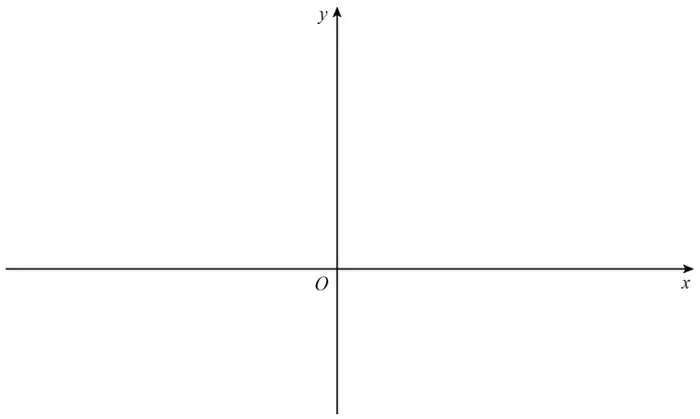
Sketch the curve on the grid below.
Show the coordinates of the stationary points. [4 marks]
| Answer | Mark | Comments |
|---|---|---|
| factorising to get \((x + 3)(x - 1)\ (= 0)\) or completing the square and getting as far as \(x + 1 = \pm 2\) or using the quadratic formula and getting as far as \(x = \dfrac{-2 \pm 4}{2}\) | M1 | 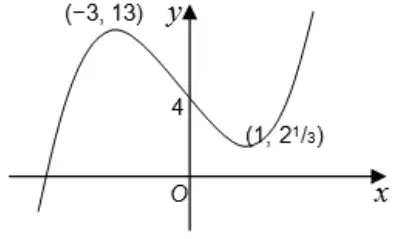 |
| \(x = -3\) and \(x = 1\) | A1 | |
| \((-3,\ 13)\) as a maximum point and \((1,\ 2\tfrac{1}{3})\) as a minimum point, plotted | M1 | |
| Smooth correct curve which must have the stationary points plotted in the correct quadrants and must cross the negative \(x\)-axis | A1 |
Additional guidance
| SC1 for a fully correct sketch with the stationary points in the correct quadrants but lacking any detail in terms of the \(x\) coordinates of the stationary points, or with incorrect values of the stationary points, and with no evidence of a valid method to obtain \(x = -3\) and \(x = 1\) |