
June 2019 Paper 2 Q27
27 The curve \(\quad y = \mathrm{f}(x) \quad\) has \(\quad \dfrac{\mathrm{d}y}{\mathrm{d}x} = (x + 2)^6 + (x + 2)^4\)
The curve has exactly one stationary point at \(P\) where \(\quad x = -2\)
Use the expression for \(\dfrac{\mathrm{d}y}{\mathrm{d}x}\) to show that \(P\) is a point of inflection. [3 marks]
| Answer | Mark | Comments |
|---|---|---|
| Alternative method 1 | ||
| Shows substitution of a value of \(x \lt -2\) into \(\dfrac{\mathrm{d}y}{\mathrm{d}x}\) and shows substitution of a value of \(x \gt -2\) into \(\dfrac{\mathrm{d}y}{\mathrm{d}x}\) | M1 | eg \((-3 + 2)^6 + (-3 + 2)^4\) and \((-1 + 2)^6 + (-1 + 2)^4\) allow \((-1)^6 + (-1)^4\) with \(x = -3\) stated and \((1)^6 + (1)^4\) with \(x = -1\) stated |
| Evaluates both correctly or states that each is positive with M1 seen | M1dep | eg \((-3 + 2)^6 + (-3 + 2)^4 = 2\) and \((-1 + 2)^6 + (-1 + 2)^4 = 2\) allow \((-1)^6 + (-1)^4 = 2\) with \(x = -3\) stated and \((1)^6 + (1)^4 = 2\) with \(x = -1\) stated |
| Statement with M2 seen | A1 | eg either side of \(P\ \dfrac{\mathrm{d}y}{\mathrm{d}x} \gt 0\) with M2 seen SC2 states two values of \(x\) (one \(\lt -2\) and one \(\gt -2\)) and shows the correct value of \(\dfrac{\mathrm{d}y}{\mathrm{d}x}\) for each and makes a statement SC1 states two values of \(x\) (one \(\lt -2\) and one \(\gt -2\)) and shows the correct value of \(\dfrac{\mathrm{d}y}{\mathrm{d}x}\) for each |
| Alternative method 2 | ||
| \(x \lt -2\) and \((-)^6 + (-)^4\) and \(x \gt -2\) and \((+)^6 + (+)^4\) | M1 | allow without brackets allow less than for \(\lt\) etc |
| \(x \lt -2\) and \((-)^6 + (-)^4 \gt 0\) and \(x \gt -2\) and \((+)^6 + (+)^4 \gt 0\) | M1dep | allow without brackets allow \(= +\) for \(\gt 0\) |
| Statement with M2 seen | A1 | eg either side of \(P\ \dfrac{\mathrm{d}y}{\mathrm{d}x} \gt 0\) with M2 seen SC2 states two values of \(x\) (one \(\lt -2\) and one \(\gt -2\)) and shows the correct value of \(\dfrac{\mathrm{d}y}{\mathrm{d}x}\) for each and makes a statement SC1 states two values of \(x\) (one \(\lt -2\) and one \(\gt -2\)) and shows the correct value of \(\dfrac{\mathrm{d}y}{\mathrm{d}x}\) for each |
Additional guidance
| For A1 a clear statement is needed after M2 scored | |||||||
| Examples of acceptable statements with M2 seen eg1 For \(x \lt -2\) gradient is + and for \(x \gt -2\) gradient is + eg2 To the left of \(P\ \ m \gt 0\) \(\phantom{eg2}\) To the right of \(P\ \ m \gt 0\) eg3 (When both of their substitutions correctly evaluate to the same value) They are the same positive value eg4 Both gradients are the same sign eg5 \(m\) is + both times eg6 Gradient is always positive (apart from at \(P\)) eg7 Function (or curve) is increasing (either side of \(P\)) | |||||||
| Allow a statement to be made using a diagram with M2 seen eg accept for eg2 above 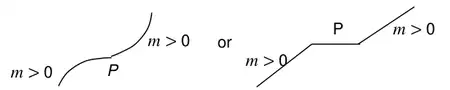 | |||||||
| Allow a statement to be made using a table with M2 seen eg accept for eg1 above
| |||||||
| When both of their substitutions correctly evaluate to the same positive value condone for the statement with M2 seen Gradients are the same (implies both positive) | |||||||
| Do not accept for the statement eg1 Gradient is increasing eg2 \(m\) is positive eg3 Gradient is positive eg4 \(P\) is a point of inflection | |||||||
| Allow gradient or \(m\) for \(\dfrac{\mathrm{d}y}{\mathrm{d}x}\) | |||||||
| For evaluations allow rounding or truncating to 1 sf or better | |||||||
| Ignore higher derivatives | |||||||
| Ignore substitution of \(x = -2\) | |||||||
| \(x = -3 \quad\) gradient \(= 2\) \(x = -1 \quad\) gradient \(= 2\) either side of \(P\) gradient \(\gt 0\) | SC2 | ||||||
| SC2 | ||||||
| SC1 |