
June 2019 Paper 2 Q2
2 Here is a sketch of quadrilateral \(PQRS\).
\(M\) is the midpoint of \(PS\).
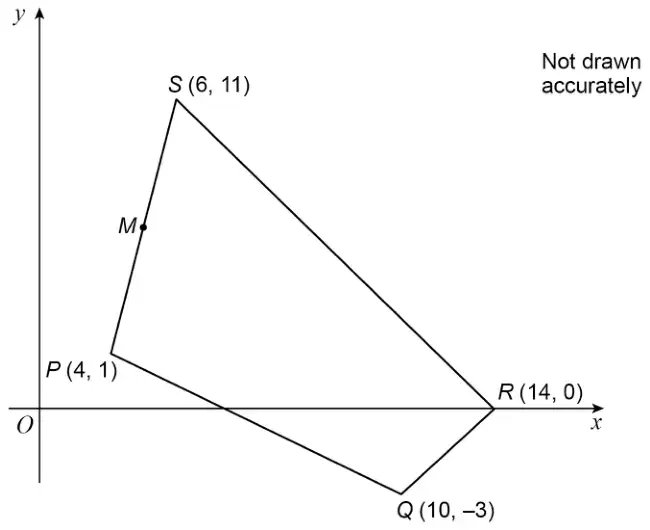
Use gradients to show that \(MR\) is parallel to \(PQ\). [3 marks]
| Answer | Mark | Comments |
|---|---|---|
| \(\left(\dfrac{4 + 6}{2},\ \dfrac{1 + 9}{2}\right)\) or \((5,\ 6)\) | M1 | oe eg \(\left(4 + \dfrac{6 - 4}{2},\ 1 + \dfrac{11 - 1}{2}\right)\) may be on diagram |
| \(\dfrac{1 - -3}{4 - 10}\) or \(\dfrac{4}{-6}\) or \(\dfrac{0 - \text{their } 6}{14 - \text{their } 5}\) or \(\dfrac{-6}{9}\) | M1 | oe method for at least one gradient or at least one unsimplified gradient seen eg \(\dfrac{-3 - 1}{10 - 4}\) or \(\dfrac{-4}{6}\) or \(\dfrac{\text{their } 6 - 0}{\text{their } 5 - 14}\) or \(\dfrac{6}{-9}\) \(\dfrac{6 - 0}{5 - 14}\) or \(\dfrac{6}{-9}\) is M1M1 |
| \(\dfrac{1 - -3}{4 - 10}\) or \(\dfrac{4}{-6}\) and \(\dfrac{0 - 6}{14 - 5}\) or \(\dfrac{-6}{9}\) and shows that the gradients are equal | A1 | oe method for both gradients or two unsimplified gradients seen and gradients shown to be equal eg \(\dfrac{4}{-6}\) and \(\dfrac{-6}{9}\) and these are both \(-\dfrac{2}{3}\) SC2 \((5,\ 6)\) and at least one gradient given as \(-\dfrac{2}{3}\) SC1 at least one gradient given as \(-\dfrac{2}{3}\) |
Additional guidance
| Mark intention for 1st M1 eg condone 5, 6 | M1 |
| \(\dfrac{4}{-6} = -\dfrac{2}{3}\) and \(\dfrac{-6}{9} = -\dfrac{2}{3}\) | M2A1 |
| \(\dfrac{1 - -3}{4 - 10} = -\dfrac{2}{3}\) and \(\dfrac{0 - 6}{14 - 5} = -\dfrac{2}{3}\) | M2A1 |
| \(\dfrac{4}{-6} = \dfrac{-6}{9}\) | M2A1 |
| \(\dfrac{4}{-6}\) and \(\dfrac{-6}{9}\) and parallel | M2A0 |
| \(\dfrac{4}{6}\) is 2nd M0 unless recovered to \(-\dfrac{4}{6}\) | |
| \(\dfrac{4}{6}\) recovered to \(-\dfrac{4}{6}\) and \(\dfrac{6}{9}\) recovered to \(-\dfrac{6}{9}\) could go on to score full marks | |
| both gradients \(= -\dfrac{2}{3}\) with no method or unsimplified gradients seen cannot score the A mark | |
| \(\dfrac{4}{-6}x\) or \(\dfrac{-6}{9}x\) do not score 2nd M1 unless recovered | |
| Equation of a line does not score 2nd M1 unless a method or unsimplified gradient seen | |
| Using the reciprocals of gradients can score a maximum of M1M0A0 | |
| Allow \(-0.66\ldots\) or \(-0.67\) for \(-\dfrac{2}{3}\) and \(\dfrac{4}{-6}\) etc Ignore conversion attempt after a correct fraction is seen | |
| or method for \(\dfrac{4}{-6}\) \(1 = 4m + c\) and \(-3 = 10m + c\) \(4 = -6m\) \(\dfrac{4}{-6} = m \qquad\) (similar method possible for \(\dfrac{-6}{9}\)) | (2nd) M1 |