
A2 June 2019 Q3
3. Numerical (calculator) integration is not acceptable in this question.
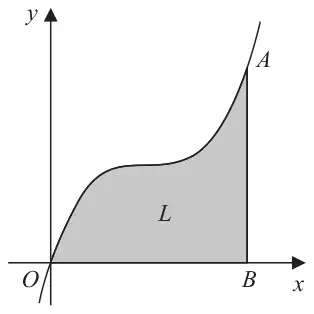
The shaded region \(OAB\) in Figure 2 is bounded by the \(x\)-axis, the line with equation \(x = 4\) and the curve with equation \(y = \dfrac{1}{4}(x - 2)^3 + 2\). The point \(A\) has coordinates \((4, 4)\) and the point \(B\) has coordinates \((4, 0)\).
A uniform lamina \(L\) has the shape of \(OAB\). The unit of length on both axes is one centimetre. The centre of mass of \(L\) is at the point with coordinates \((\bar{x}, \bar{y})\).
Given that the area of \(L\) is \(8\ \text{cm}^2\),
The lamina is freely suspended from \(A\) and hangs in equilibrium with \(AB\) at an angle \(\theta^\circ\) to the downward vertical.
| Scheme | Marks | AO |
|---|---|---|
| Correct strategy | M1 | 3.1a |
| \(8\bar{y} = \dfrac{1}{2}\displaystyle\int y^2\,\mathrm{d}x = \dfrac{1}{2}\int\left\{\dfrac{(x - 2)^6}{16} + (x - 2)^3 + 4\right\}\mathrm{d}x\) | M1 | 2.1 |
| \(= \dfrac{1}{2}\left[\dfrac{(x - 2)^7}{7\times 16} + \dfrac{(x - 2)^4}{4} + 4x\right]_0^4\) | A1 | 1.1b |
| \(8\bar{y} = \dfrac{1}{2}\left[\dfrac{8}{7} + 4 + 16 + \dfrac{8}{7} - 4 - 0\right] = \dfrac{64}{7},\qquad \bar{y} = \dfrac{8}{7}\) * | A1* | 2.2a |
| (4) |
Notes
M1: Complete strategy for \(\bar{y}\): moments equation, use of limits and division by area
M1: Moments equation to obtain terms of the correct form (with or without limits) The integral must be in terms of \(x\) only or \(y\) only
Allow if area (8) not seen
Might see \(\displaystyle\int \frac{x^6}{16} - \frac{3x^5}{4} + \frac{15x^4}{4} - 9x^3 + 9x^2\,\mathrm{d}x\)
Or \(\displaystyle\int xy\,\mathrm{d}y = \int 2y + y\big(4(y - 2)\big)^{\frac{1}{3}}\,\mathrm{d}y\)
A1: Correct unsimplified answer (with or without limits)
Allow if area (8) not seen \(\left(\displaystyle\int xy\,\mathrm{d}y = 12.8\right)\)
A1*: Use moments equation and given area to deduce given answer from correct working
| Scheme | Marks | AO |
|---|---|---|
| \(8\bar{x} = \displaystyle\int\left(\dfrac{x(x - 2)^3}{4} + 2x\right)\mathrm{d}x\) | M1 | 2.1 |
| \(= \left[\dfrac{x(x - 2)^4}{16} - \dfrac{(x - 2)^5}{80} + x^2\right]_0^4\) | A1 | 1.1b |
| \(= \dfrac{64}{16} - \dfrac{32}{80} + 16 - \dfrac{32}{80} = 19.2\) | M1 | 1.1b |
| \(\bar{x} = 2.4\) | A1 | 1.1b |
| Complete strategy to find \(\theta\) | M1 | 3.1a |
| \(\tan\theta = \dfrac{4 - \bar{x}}{4 - \frac{8}{7}}\ \left(= \dfrac{14}{25}\right)\) | A1ft | 3.4 |
| \(\theta = 29.2\) (Accept 29) | A1 | 1.1b |
| (7) | ||
| (11 marks) |
Notes
M1: Relevant integral in terms of \(x\) only or \(y\) only (with or without limits). Allow if area (8) not seen
Could start with \(\displaystyle\int xy\,\mathrm{d}x\) or \(\displaystyle\int \frac{1}{2}x^2\,\mathrm{d}y\)
Might see \(\dfrac{x^4}{4} - \dfrac{6x^3}{4} + 3x^2 - 2x + 2x\)
A1: Correct unsimplified form after integration (with or without limits). Allow if area (8) not seen
M1: Complete process to find \(\bar{x}\) following relevant integral
A1: Correct answer
M1: Complete strategy to find \(\theta\) e.g find \(\bar{x}\) and then use trig to find appropriate angle
A1ft: Use the model to find a relevant angle. Follow their \(\bar{x}\)
A1: 2 s.f. or better 29.2488...