
AS June 2019 Q1
1.
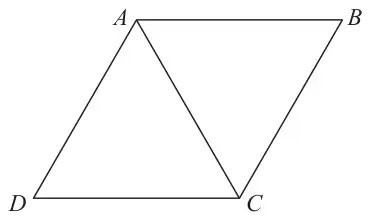
Five identical uniform rods are joined together to form the rigid framework \(ABCD\) shown in Figure 1. Each rod has weight \(W\) and length \(4a\). The points \(A\), \(B\), \(C\) and \(D\) all lie in the same plane.
The centre of mass of the framework is at the point \(G\).
The framework is suspended from the ceiling by two vertical light inextensible strings. One string is attached to the framework at \(A\) and the other string is attached to the framework at \(B\). The framework hangs freely in equilibrium with \(AB\) horizontal.
A particle of weight \(kW\) is now attached to the framework at \(D\) and a particle of weight \(2kW\) is now attached to the framework at \(C\). The framework remains in equilibrium with \(AB\) horizontal and the strings vertical.
Either string will break if the tension in it exceeds \(6W\).
| Scheme | Marks | AO |
|---|---|---|
| The rods are uniform and the axes of symmetry intersect at midpoint of \(AC\). | B1 | 2.4 |
| (1) |
Notes
B1: Any equivalent clear justification. Needs to mention uniformity and symmetry and the midpoint of \(AC\)
| Scheme | Marks | AO |
|---|---|---|
| Use moments: e.g. M(\(A\)): \(\left(2aW + aW + 3aW = 4aT_B + aW\right)\) | M1 | 2.1 |
| e.g. M(\(A\)): \(5W.2a\cos 60^\circ = 4aT_B\) or M(\(B\)): \(3a \times 5W = 4aT_A\) | A1 | 1.1b |
| Resolving vertically: \(T_A + T_B = 5W\) | M1 | 2.1 |
| \(\Rightarrow T_A = \dfrac{15W}{4}\), \(T_B = \dfrac{5W}{4}\) | A1 | 1.1b |
| (4) |
Notes
M1: Form ANY moments equation. Require all terms. Dimensionally correct. Condone sign errors.
A1: Correct unsimplified (including trig) equation
e.g. M(\(G\)): \(T_A.2a\cos 60^\circ = T_B.(4a - 2a\cos 60^\circ)\) or \(T_B.(4a\cos^2 30^\circ)\)
M1: Form a second equation in \(T_A\) and/or \(T_B\) e.g. by resolving vertically or a second moments equation, and solve for \(T_A\) and \(T_B\)
A1: Both tensions correct. If answers reversed, allow M marks.
| Scheme | Marks | AO |
|---|---|---|
| \(T_A\) will be the larger, so the first to exceed \(6W\) so need to use \(T_A = 6W\) (e.g. by M(\(B\)) but they may use two equations) to form an equation in \(k\) only. | M1 | 3.1a |
| \(6W \times 4a = 5W \times 3a + kW \times 6a + 2kW \times 2a\) | A1 | 1.1b |
| \(24aW = 15aW + 10kaW\) | A1 | 1.1b |
| \(k = 0.9\) | A1 | 1.1b |
| (4) | ||
| (9 marks) |
Notes
M1: Realise that the first to break will be the rope at \(A\) and complete method to form an equation in \(k\) only (allow uncancelled \(W\)’s) using \(T_A = 6W\). Require all terms (in all equations used). Dimensionally correct. Condone sign errors.
M0 if they use \(T_B = 6W\) to find \(k\) (this gives \(k = 9.5\))
A1: Unsimplified equation or inequality in \(k\) only with at most one error
A1: Correct unsimplified equation or inequality in \(k\) only
A1: Correct only. Decimal or fraction.