
AS June 2019 Q4
4.
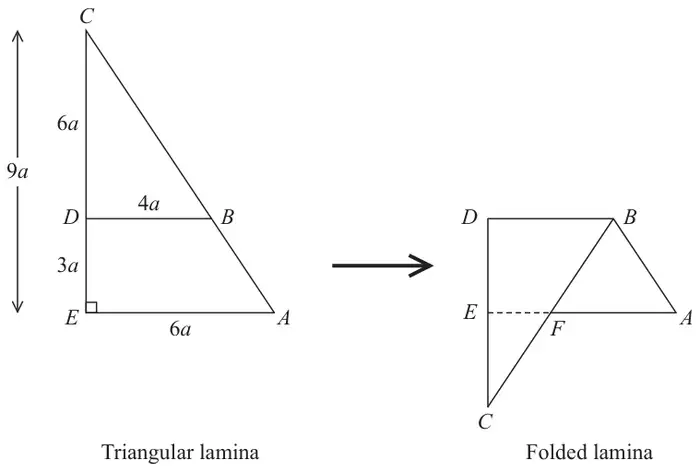
The uniform triangular lamina \(ABCDE\) is such that angle \(CEA = 90^\circ\), \(CE = 9a\) and \(EA = 6a\). The point \(D\) lies on \(CE\), with \(DE = 3a\). The point \(B\) on \(CA\) is such that \(DB\) is parallel to \(EA\) and \(DB = 4a\). The triangular lamina is folded along the line \(DB\) to form the folded lamina \(ABDECF\), as shown in Figure 2.
The distance of the centre of mass of the triangular lamina from \(DC\) is \(d_1\)
The distance of the centre of mass of the folded lamina from \(DC\) is \(d_2\)
The folded lamina is freely suspended from \(B\) and hangs in equilibrium with \(BA\) inclined at an angle \(\alpha\) to the downward vertical through \(B\).
| Scheme | Marks | AO |
|---|---|---|
| In the folding process, each point of the lamina remains the same distance from \(CD\) | B1 | 2.4 |
| (1) |
Notes
B1: Any equivalent explanation e.g. folding doesn’t change the mass distribution relative to \(CD\). A calculation to verify is not the same as an explanation.
Allow use of ‘vertical’ for \(CD\).
| Scheme | Marks | AO | |||||||||||||||||||||||||||||||||||||||
|---|---|---|---|---|---|---|---|---|---|---|---|---|---|---|---|---|---|---|---|---|---|---|---|---|---|---|---|---|---|---|---|---|---|---|---|---|---|---|---|---|---|
| For the folded lamina: \(\bar{x} = 2a\ \ (= d_2)\) oe | B1 | 1.1b | |||||||||||||||||||||||||||||||||||||||
Distances from \(EA\)
Alternative 1
Alternative 2
| |||||||||||||||||||||||||||||||||||||||||
| Area ratios | B1 | 1.2 | |||||||||||||||||||||||||||||||||||||||
| Distances from \(EA\) | B1 | 1.2 | |||||||||||||||||||||||||||||||||||||||
| Moments about \(EA\): | M1 | 2.1 | |||||||||||||||||||||||||||||||||||||||
| \(27 \times 3a - 12 \times 5a + 12 \times a = 27\bar{y}\) | A1ft | 1.1b | |||||||||||||||||||||||||||||||||||||||
| \(\bar{y} = \dfrac{11a}{9}\) | A1 | 1.1b | |||||||||||||||||||||||||||||||||||||||
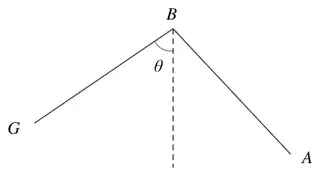 | |||||||||||||||||||||||||||||||||||||||||
| \(\theta = \tan^{-1}\dfrac{4a - \bar{x}}{3a - \bar{y}}\left(= \tan^{-1}\dfrac{9}{8}\right)\) or \((90^\circ - \theta) = \tan^{-1}\) (reciprocal) | M1 | 1.1b | |||||||||||||||||||||||||||||||||||||||
| \(\alpha = \tan^{-1}\dfrac{4a - \bar{x}}{3a - \bar{y}} + \tan^{-1}\dfrac{2}{3}\) or oe | M1 | 3.1b | |||||||||||||||||||||||||||||||||||||||
| \(= 82^\circ\) (nearest degree) | A1 | 1.1b | |||||||||||||||||||||||||||||||||||||||
| (9) | |||||||||||||||||||||||||||||||||||||||||
| (10 marks) |
Notes
B1: Seen anywhere
N.B. B marks only available for viable dissections
Other dissections are possible:
Alternative 1: \(EDBH + BHA + DBC\), where \(H\) is midpoint of \(AF\)
Alternative 2: \(FAB + EFC + (2 \text{ x } DGEF) + (2 \text{ x } GBF)\), where \(G\) is midpoint of \(DB\)
B1: Any equivalent form for the mass (area) ratios
B1: Or correct distances from an alternative axis parallel to \(AE\) e.g. \(BD\)
M1: Moments about \(AE\) or a parallel axis. Need all terms. Must be dimensionally correct. Condone sign errors.
A1ft: Correct unsimplified moments equation ft on their ‘table’
A1: Correct (for their axis) only
M1: Correct use of trigonometry to find a relevant angle
M1: Correct strategy for the required angle.
A1: Correct answer only
Alternative for the final 3 marks
| Scheme | Marks | AO |
|---|---|---|
| \(\overrightarrow{BA}.\overrightarrow{BG} = \dfrac{2}{9}\begin{pmatrix} -9 \\ -8 \end{pmatrix}.\begin{pmatrix} 2 \\ -3 \end{pmatrix}\left(= \dfrac{4}{3}\right)\) | M1 | 1.1b |
| \(\cos\alpha = \dfrac{\dfrac{4}{3}}{\dfrac{2}{9}\sqrt{145}\sqrt{13}}\ (= 0.138\ldots)\) | M1 | 3.1b |
| \(\theta = 82^\circ\) | A1 | 1.1b |