
A2 October 2020 Q4
4. [In this question, \(\mathbf{i}\) and \(\mathbf{j}\) are perpendicular unit vectors in a horizontal plane.]
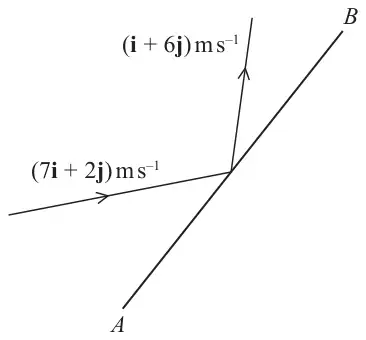
Figure 1 represents the plan view of part of a smooth horizontal floor, where \(AB\) represents a fixed smooth vertical wall.
A small ball of mass 0.5 kg is moving on the floor when it strikes the wall.
Immediately before the impact the velocity of the ball is \((7\mathbf{i} + 2\mathbf{j})\ \text{m s}^{-1}\).
Immediately after the impact the velocity of the ball is \((\mathbf{i} + 6\mathbf{j})\ \text{m s}^{-1}\).
The coefficient of restitution between the ball and the wall is \(e\).
| Scheme | Marks | AO |
|---|---|---|
| Use of \(\mathbf{I} = m\mathbf{v} - m\mathbf{u}\) or \(\mathbf{v} - \mathbf{u}\) | M1 | 2.1 |
| \(\mathbf{I} = 0.5\big((\mathbf{i} + 6\mathbf{j}) - (7\mathbf{i} + 2\mathbf{j})\big)\) \(\big(= (-3\mathbf{i} + 2\mathbf{j})\big)\) | A1 | 1.1b |
| Use of scalar product \((-3\mathbf{i} + 2\mathbf{j}).(2\mathbf{i} + 3\mathbf{j}) = -6 + 6 = 0\) | M1 | 1.1b |
| Hence impulse perpendicular to \((2\mathbf{i} + 3\mathbf{j})\), so \(AB\) must be parallel to \((2\mathbf{i} + 3\mathbf{j})\). * | A1* | 2.2a |
| (4) |
Notes
Correction: In Alternative (a) 2 the ratio is \(b = \dfrac{3}{2}a\) (corrected from the printed mark scheme: \(b = \dfrac{2}{3}a\)).
M1: Must be finding the difference between two momenta or two velocities
A1: Correct unsimplified equation for the impulse or for change in velocity
M1: Use of scalar product or equivalent. In the alt method allow full marks if \(\sqrt{13}\) not used.
A1*: Reach given conclusion from correct working
If working with angles, score
M1 for correct method to find components parallel to the wall
A1 for \(\sqrt{53}\cos 40.36..^\circ\) and \(\sqrt{37}\cos 24.23..^\circ\)
M1 for comparing the two values
A0 because the work has involved decimal approximations (since working towards an exact given answer).
Alternative: Could use \(e\tan 24.2..^\circ = \tan 40.36..^\circ\)
Alternative (a)
| Scheme | Marks | AO |
|---|---|---|
| Components of velocities parallel to \((2\mathbf{i} + 3\mathbf{j})\): | M1 | 2.1 |
| \(\left(\dfrac{1}{\sqrt{13}}\right)(7\mathbf{i} + 2\mathbf{j}).(2\mathbf{i} + 3\mathbf{j}) = \left(\dfrac{1}{\sqrt{13}}\right)(14 + 6)\) \(\left(\dfrac{1}{\sqrt{13}}\right)(\mathbf{i} + 6\mathbf{j}).(2\mathbf{i} + 3\mathbf{j}) = \left(\dfrac{1}{\sqrt{13}}\right)(2 + 18)\) | A1 | 1.1b |
| Simplify and compare values | M1 | 1.1b |
| Hence component of velocity parallel to \((2\mathbf{i} + 3\mathbf{j})\) is unchanged, so \(AB\) must be parallel to \((2\mathbf{i} + 3\mathbf{j})\). * | A1* | 2.2a |
| (4) |
Alternative (a) 2
| Scheme | Marks | AO |
|---|---|---|
| Use conservation of velocity parallel to \(a\mathbf{i} + b\mathbf{j}\) | M1 | 2.1 |
| \((7\mathbf{i} + 2\mathbf{j}).(a\mathbf{i} + b\mathbf{j}) = (\mathbf{i} + 6\mathbf{j}).(a\mathbf{i} + b\mathbf{j})\) \((\Rightarrow 7a + 2b = a + 6b)\) | A1 | 1.1b |
| Find ratio of \(a\) and \(b\) to obtain direction: \(\left(b = \dfrac{3}{2}a\right)\) | M1 | 1.1b |
| Hence \(AB\) must be parallel to \((2\mathbf{i} + 3\mathbf{j})\). * | A1* | 2.2a |
| (4) |
| Scheme | Marks | AO |
|---|---|---|
| Use scalar product to find components of velocities perpendicular to the wall | M1 | 3.1b |
| \(\left(\dfrac{1}{\sqrt{13}}\right)(-3\mathbf{i} + 2\mathbf{j}).(7\mathbf{i} + 2\mathbf{j}) = \left(\dfrac{1}{\sqrt{13}}\right)(-21 + 4) \ \ \left(= \dfrac{-17}{\sqrt{13}}\right)\) \(\left(\dfrac{1}{\sqrt{13}}\right)(-3\mathbf{i} + 2\mathbf{j}).(\mathbf{i} + 6\mathbf{j}) = \left(\dfrac{1}{\sqrt{13}}\right)(-3 + 12) \ \ \left(= \dfrac{9}{\sqrt{13}}\right)\) | A1 A1 | 1.1b 1.1b |
| Use of impact law | M1 | 3.4 |
| \(e = \dfrac{9}{17}\) | A1 | 1.1b |
| (5) | ||
| (9 marks) |
Notes
M1: Condone if not using a unit vector
A1 A1: One correct value
Second correct values
If working with angles, score M1A1A1 for \(\sqrt{53}\sin 40.36..^\circ\) and \(\sqrt{37}\sin 24.23...^\circ\)
M1: Use their components the right way round in the impact law. Condone sign error.
A1: 0.53 or better (0.52941……)