
A2 June 2019 Paper 1 Q1
1.
\[\mathrm{f}(z) = z^4 + az^3 + bz^2 + cz + d\]where \(a\), \(b\), \(c\) and \(d\) are real constants.
Given that \(-1 + 2\mathrm{i}\) and \(3 - \mathrm{i}\) are two roots of the equation \(\mathrm{f}(z) = 0\)
| Scheme | Marks | AO |
|---|---|---|
| \(z = -1 - 2\mathrm{i}\) or \(z = 3 + \mathrm{i}\) | M1 | 1.2 |
| \(z = -1 - 2\mathrm{i}\) and \(z = 3 + \mathrm{i}\) | A1 | 1.1b |
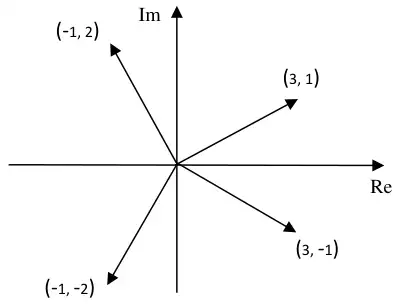 | B1 B1 | 1.1b 1.1b |
| (4) |
Notes
M1: Identifies at least one correct complex conjugate as another root (can be seen/implied by Argand diagram)
A1: Both complex conjugate roots identified correctly (can be seen/implied by Argand diagram)
For the next two marks allow either a cross, dot or line drawn where the end point is labelled with the correct coordinate, corresponding complex number or clearly plotted with correct numbers labelled on the axis or indication of the correct coordinates by use of scale markers. Condone (3, i) etc. The axes do not need to be labelled with Re and Im.
B1: One complex conjugate pair correctly plotted.
B1: Both complex conjugate pair correctly plotted. The \(3 \pm \mathrm{i}\) must be closer to the real axes than the \(-1 \pm 2\mathrm{i}\)
If there is no indication of the coordinates, scale or complex numbers on the Argand diagram this is B0 B0.
Do accept correct labelling e.g.
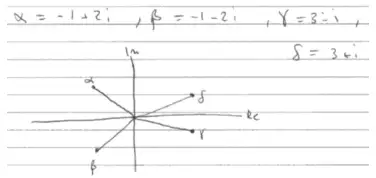
Way 1
| Scheme | Marks | AO |
|---|---|---|
| \(\bigl(z - (-1 + 2\mathrm{i})\bigr)\bigl(z - (-1 - 2\mathrm{i})\bigr) = \ldots\) or \(\bigl(z - (3 + \mathrm{i})\bigr)\bigl(z - (3 - \mathrm{i})\bigr) = \ldots\) or \(\mathrm{f}(z) = \bigl(z - (-1 + 2\mathrm{i})\bigr)\bigl(z - (-1 - 2\mathrm{i})\bigr)\bigl(z - (3 + \mathrm{i})\bigr)\bigl(z - (3 - \mathrm{i})\bigr) = \ldots\) | M1 | 3.1a |
| \(z^2 + 2z + 5\) or \(z^2 - 6z + 10\) e.g. \(\mathrm{f}(z) = \left(z^2 + 2z + 5\right)(\ldots)\) | A1 | 1.1b |
| \(z^2 + 2z + 5\) and \(z^2 - 6z + 10\) or \(\mathrm{f}(z) = \bigl(z^3 + z^2(-1 - \mathrm{i}) + z(-1 + 2\mathrm{i}) - 15 - 5\mathrm{i}\bigr)(\ldots)\) | A1 | 1.1b |
| \(\mathrm{f}(z) = \left(z^2 + 2z + 5\right)\left(z^2 - 6z + 10\right)\) Expands the brackets to forms a quartic | M1 | 3.1a |
| \(\mathrm{f}(z) = z^4 - 4z^3 + 3z^2 - 10z + 50\) or States \(a = -4,\ b = 3,\ c = -10,\ d = 50\) | A1 | 1.1b |
| (5) | ||
| (9 marks) |
Notes
Way 1
M1: Correct strategy for forming at least one of the quadratic factors. Follow through their roots.
A1: At least one correct simplified quadratic factor.
A1: Both simplified quadratic factors correct or a correct simplified cubic factor
M1: A complete strategy to find values for \(a\), \(b\), \(c\) and \(d\) e.g. uses their quadratic factors or cubic and linear factor to form a quartic.
A1: Correct quartic in terms of \(z\) or correct values for \(a\), \(b\), \(c\) and \(d\) stated.
Alternative: Way 2
| Scheme | Marks | AO |
|---|---|---|
| sum roots \(= \alpha + \beta + \gamma + \delta = (-1 + 2\mathrm{i}) + (-1 - 2\mathrm{i}) + (3 + \mathrm{i}) + (3 - \mathrm{i}) = \ldots\) pair sum \(= \alpha\beta + \alpha\gamma + \alpha\delta + \beta\gamma + \beta\delta + \gamma\delta\) \(= (-1 + 2\mathrm{i})(-1 - 2\mathrm{i}) + (-1 + 2\mathrm{i})(3 - \mathrm{i}) + (-1 + 2\mathrm{i})(3 + \mathrm{i}) + (-1 - 2\mathrm{i})(3 - \mathrm{i})\) \(+ (-1 - 2\mathrm{i})(3 + \mathrm{i}) + (3 + \mathrm{i})(3 - \mathrm{i}) = \ldots\) triple sum \(= \alpha\beta\gamma + \alpha\beta\delta + \beta\gamma\delta + \alpha\gamma\delta\) \(= (-1 + 2\mathrm{i})(-1 - 2\mathrm{i})(3 - \mathrm{i}) + (-1 + 2\mathrm{i})(-1 - 2\mathrm{i})(3 + \mathrm{i}) + (-1 + 2\mathrm{i})(3 + \mathrm{i})(3 - \mathrm{i})\) \(+ (-1 - 2\mathrm{i})(3 + \mathrm{i})(3 - \mathrm{i}) = \ldots\) Product \(= \alpha\beta\gamma\delta = (-1 + 2\mathrm{i})(-1 - 2\mathrm{i})(3 - \mathrm{i})(3 + \mathrm{i}) = \ldots\) | M1 | 3.1a |
| sum = 4, pair sum = 3, triple sum = 10 and product = 50 | A1 A1 | 1.1b 1.1b |
| \(a = -(\text{their sum roots}) = -4\) \(b = +(\text{their pair sum}) = 3\) \(c = -(\text{triple sum}) = -10\) \(d = +(\text{product}) = 50\) | M1 A1 | 3.1a 1.1b |
| (5) |
M1: Correct strategy for finding at least three of the sum roots, pair sum, triple sum and product. Follow through their roots. This can be implied by at least three correct values for the sum roots, pair sum, triple sum and product with no working shown. If the calculations are not shown for the sums and product and they have at least two incorrect values this is M0.
A1: At least two correct values for the sum roots, pair sum, triple sum or product.
A1: All correct values for the sum, pair sum, triple sum and product.
M1: Must have real values of \(a\), \(b\), \(c\) and \(d\) and use \(a = -\)their sum roots, \(b =\) their pair sum, \(c = -\)their triple sum and \(d =\) their product.
A1: Correct quartic in terms of \(z\) or correct values for \(a\), \(b\), \(c\) and \(d\) stated.
Alternative: Way 3
| Scheme | Marks | AO |
|---|---|---|
| \(\mathrm{f}(z) = (-1 + 2\mathrm{i})^4 + a(-1 + 2\mathrm{i})^3 + b(-1 + 2\mathrm{i})^2 + c(-1 + 2\mathrm{i}) + d = 0\) \(\mathrm{f}(z) = (3 + \mathrm{i})^4 + a(3 + \mathrm{i})^3 + b(3 + \mathrm{i})^2 + c(3 + \mathrm{i}) + d = 0\) Leading to \(-7 + 11a - 3b - c + d = 0 \qquad 24 - 2a - 4b + 2c = 0\) \(28 + 18a + 8b + 3c + d = 0 \qquad 96 + 26a + 6b + c = 0\) | M1 A1 A1 | 3.1a 1.1b 1.1b |
| Solves their simultaneous equation to find a value for one of the constants | M1 | 3.1a |
| \(a = -4,\ b = 3,\ c = -10,\ d = 50\) | A1 | 1.1b |
| (5) |
M1: Substitutes two roots into \(\mathrm{f}(z) = 0\) and equates coefficients to form 4 equations
A1: At least two correct equations.
A1: All four correct equations
M1: Solve their four equation (using calculator) to find at least one value. This will need checking if incorrect equations used.
A1: Correct quartic in terms of \(z\) or correct values for \(a\), \(b\), \(c\) and \(d\) stated.
Note: Correct answer only will score 5/5