(a) Curve \(C_2\) is a reflection of \(C_1\) in the line \(y = x\)
Write down an equation of \(C_2\) [1 mark]
(b) Curve \(C_3\) is a circle of radius 4, centred at the origin.
Describe a single transformation which maps \(C_1\) onto \(C_3\) [2 marks]
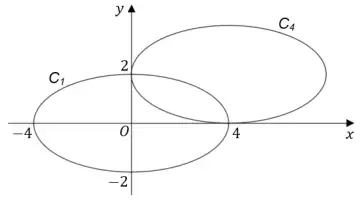
(c) Curve \(C_4\) is a translation of \(C_1\) The positive \(x\)-axis and the positive \(y\)-axis are tangents to \(C_4\)
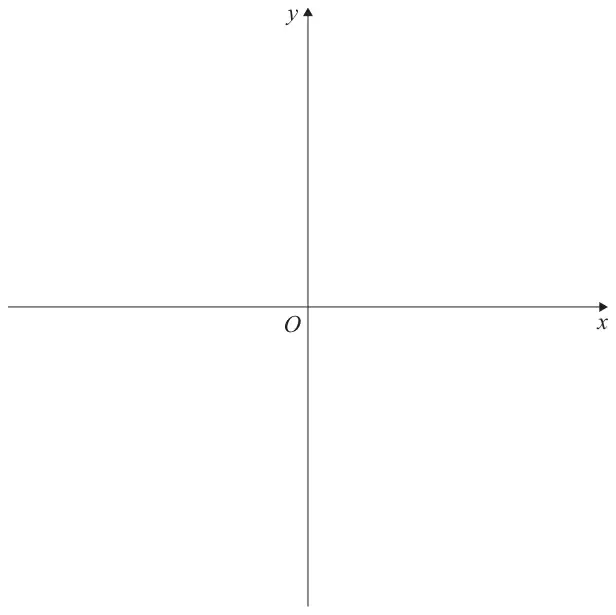
(i) Sketch the graphs of \(C_1\) and \(C_4\) on the axes below. Indicate the coordinates of the \(x\) and \(y\) intercepts on your graphs. [2 marks]
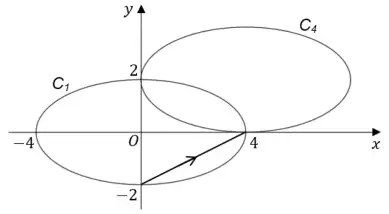
(ii) Determine the translation vector. [2 marks]
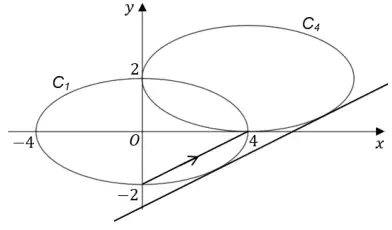
(iii) The line \(y = mx + c\) is a tangent to both \(C_1\) and \(C_4\) Find the value of \(m\) [2 marks]
Mark scheme (a)
Scheme
Marks
AO
Writes down a correct equation.
B1
1.1b
(1)
Typical solution
\[\frac{y^2}{16} + \frac{x^2}{4} = 1\]
Mark scheme (b)
Scheme
Marks
AO
Indicates a stretch. Condone a stretch in any direction.
M1
3.1a
Identifies the correct transformation.
A1
1.1b
(2)
Typical solution
\[y \longrightarrow \frac{y}{2}\]
stretch, parallel to the \(y\)-axis, scale factor 2
Mark scheme (c)
Scheme
Marks
AO
(i) Draws one loop centred on the origin and a second loop, approximately the same shape as the first, in the 1st quadrant with the positive \(x\) and \(y\) axes as tangents. Or draws one correct graph with one correct \(x\)-intercept and one correct \(y\)-intercept.
M1
1.1a
Draws two correct graphs with all four intercepts correctly indicated.
A1
1.1b
(2)
(ii) States a translation vector which contains either \(2\) or \(-2\) and \(4\) or \(-4\) Follow through their intercepts.
M1
3.1a
Obtains the correct translation vector.
A1
1.1b
(2)
(iii) Calculates \(\frac{b}{a}\) or \(\frac{a}{b}\) for their translation vector \(\begin{bmatrix} a \\ b \end{bmatrix}\)
M1
3.1a
Obtains the correct gradient. Follow through their part (cii)