
AS June 2023 Q3
3. A complex number \(z\) is represented by the point \(P\) on an Argand diagram.
Given that
\[\arg\left(\frac{z - 4 - \mathrm{i}}{z - 2 - 7\mathrm{i}}\right) = \frac{\pi}{2}\](a) sketch the locus of \(P\) as \(z\) varies, (2)
(b) determine the exact maximum possible value of \(|z|\) (5)
| Scheme | Marks | AO |
|---|---|---|
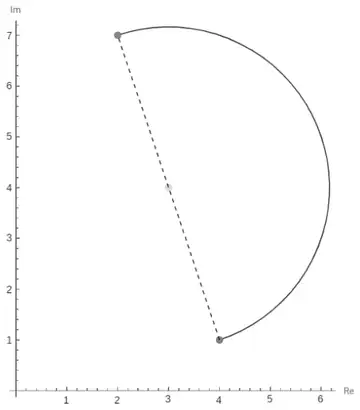 | M1 | 1.1b |
| A semi-circle with end points (4, 1) and (2, 7) to the right | A1 | 1.1b |
| (2) |
Notes
M1: See scheme
A1: See scheme
| Scheme | Marks | AO |
|---|---|---|
| Centre (3, 4) | B1 | 2.2a |
| Finds the radius using Pythagoras \(r = \sqrt{(4 - \text{“}3\text{”})^2 + (1 - \text{“}4\text{”})^2}\) or \(r = \sqrt{(2 - \text{“}3\text{”})^2 + (7 - \text{“}4\text{”})^2}\) or \(r = \dfrac{1}{2}\sqrt{(4 - 2)^2 + (1 - 7)^2}\) | M1 | 1.1b |
| Finds the distance from the origin to their centre using Pythagoras \(d = \sqrt{(\text{“}3\text{”} - 0)^2 + (\text{“}4\text{”} - 0)^2}\) | M1 | 1.1b |
| Adds this distance to their radius | dM1 | 3.1a |
| \(|z| = 5 + \sqrt{10}\) | A1 | 1.1b |
| (5) | ||
| (7 marks) |
Notes
B1: Deduces the correct centre coordinates.
M1: Uses Pythagoras and their centre coordinates to find the radius
\(r = \sqrt{(4 - \text{“their centre } x\text{”})^2 + (1 - \text{“their centre } y\text{”})^2}\) or
\(r = \sqrt{(2 - \text{“their centre } x\text{”})^2 + (7 - \text{“their centre } y\text{”})^2}\) or
half of the diameter \(r = \dfrac{1}{2}\sqrt{(4 - 2)^2 + (1 - 7)^2}\)
M1: Finds the distance from their centre to the origin
dM1: Dependent on previous method mark. A complete method to find the maximum value of \(|z|\) Adds the distance to the centre to their radius
A1: \(|z| = 5 + \sqrt{10}\)