
A2 June 2023 Q2
2. A complex number \(z\) is represented by the point \(P\) in the complex plane.
Given that \(z\) satisfies\[|z - 6| = 2|z + 3\mathrm{i}|\]
| Scheme | Marks | AO |
|---|---|---|
| \(\lvert -4 - 6\rvert = 10\) and \(2\lvert -4 + 3\mathrm{i}\rvert = \left\{2\sqrt{4^2 + 3^2} = 2 \times 5\right\} = 10\) {so \(-4\) is on the locus} Or \(\lvert -8\mathrm{i} - 6\rvert = \left\{\sqrt{64 + 36} =\right\} 10\) and \(2\lvert -8\mathrm{i} + 3\mathrm{i}\rvert \left\{= 2\lvert -5\mathrm{i}\rvert = 2 \times 5\right\} = 10\) {so \(-8\mathrm{i}\) is on the locus} | M1 | 1.1b |
| \(\lvert -4 - 6\rvert = 10\) and \(2\lvert -4 + 3\mathrm{i}\rvert = \left\{2\sqrt{4^2 + 3^2} = 2 \times 5\right\} = 10\) {so \(-4\) is on the locus} and \(\lvert -8\mathrm{i} - 6\rvert = \left\{\sqrt{64 + 36} =\right\} 10\) and \(2\lvert -8\mathrm{i} + 3\mathrm{i}\rvert \left\{= 2\lvert -5\mathrm{i}\rvert = 2 \times 5\right\} = 10\) {so \(-8\mathrm{i}\) is on the locus} and \(\lvert -6\rvert = 6\) and \(|3\mathrm{i}| = 6\) {so the origin is also on the locus} | A1 | 1.1b |
| (2) |
Notes
M1: Verifies the equation is satisfied by at least one of the non-zero points, with evidence of correct method of the modulus seen (e.g. implied by correct value).
A1: All three points correctly checked to be on the locus.
Alternative
| Scheme | Marks | AO |
|---|---|---|
| Finds the Cartesian equation of the circle, any form \((x - 6)^2 + y^2 = 4x^2 + 4(y + 3)^2\) \(3x^2 + 3y^2 + 24y + 12x = 0\) \(x^2 + y^2 + 8y + 4x = 0\) \((x + 2)^2 + (y + 4)^2 = 20\) Substitutes in either \((-4, 0)\) or \((0, -8)\) into the equation to show it holds | M1 | 1.1b |
| Substitutes in \((-4, 0)\) and \((0, -8)\) and \((0, 0)\) into the equation to show it holds | A1 | 1.1b |
| (2) |
M1: Finds the Cartesian equation of the circle and verifies that the equation is satisfied by at least one of the non-zero points.
A1: All three points correctly checked to be on the locus.
Special case: M1A0 Candidates shows that the locus of \(P\) passes through \(z = -4 - 8\mathrm{i}\)
\(\lvert -10 - 8\mathrm{i}\rvert = \left\{\sqrt{100 + 64} =\right\} 2\sqrt{41}\)
\(2\lvert -4 - 5\mathrm{i}\rvert = \left\{\sqrt{16 + 25} =\right\} 2\sqrt{41}\)
Cartesian approach substitutes \((-4, -8)\) to show it satisfies the equation
| Scheme | Marks | AO |
|---|---|---|
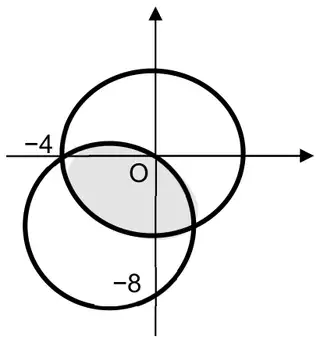 | ||
| (b) Circle passing through the origin | M1 | 2.2a |
| Correct circle, with axis intercepts | A1 | 1.1b |
| (2) | ||
| (c) Circle with centre \((0, 0)\) and radius 4 | B1 | 1.1b |
| Shades area inside both circles. | B1ft | 2.5 |
| (2) | ||
| (6 marks) |
Notes
(b)
M1: Any complete circle passing through the origin.
A1: Correct circle drawn and labelled. Look for centre in the third quadrant and passing through \(-4\), 0 and \(-8\mathrm{i}\).
(c)
B1: Circle centre at origin and some indication that the radius is 4. Can sketch part of the circle as long as sufficient to show the overlap.
B1ft: Area inside both ‘circles’ shaded. Allow as long as they have overlapping circles.