
A2 June 2023 Q9
9.
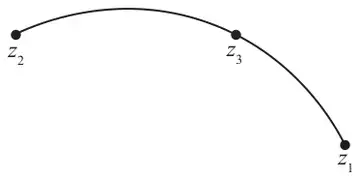
Figure 1 shows a locus in the complex plane.
The locus is an arc of a circle from the point represented by \(z_1 = 3 + 2\mathrm{i}\) to the point represented by \(z_2 = a + 4\mathrm{i}\), where \(a\) is a constant, \(a \neq 1\)
Given that
- the point \(z_3 = 1 + 4\mathrm{i}\) also lies on the locus
- the centre of the circle has real part equal to \(-1\)
(a) determine the value of \(a\). (2)
(b) Hence determine a complex equation for the locus, giving any angles in the equation as positive values. (3)
| Scheme | Marks | AO |
|---|---|---|
| Centre lies on perpendicular bisector of \(z_2\) and \(z_3\), which is vertical as same imaginary components. Hence \(\tfrac{a + 1}{2} = -1 \Rightarrow a = \ldots\) Or \((a - (-1))^2 + (4 - b)^2 = (1 - (-1))^2 + (4 - b)^2 \Rightarrow a = \ldots\) \((a - (-1))^2 = (1 - (-1))^2 \Rightarrow a = \ldots\) Or \(-1 - a = 1 - (-1) \Rightarrow a = \ldots\) | M1 | 1.1b |
| \(a = -3\) | A1 | 2.2a |
| (2) |
Notes
M: Forms a correct strategy to find the value of \(a\), see scheme for various approaches
A1: Correct value
Alternative
| Scheme | Marks | AO |
|---|---|---|
| \((x - (-1))^2 + (y - b)^2 = r^2\) \(\left.\begin{aligned} &(1 + 1)^2 + (4 - b)^2 = r^2 \\ &(3 + 1)^2 + (2 - b)^2 = r^2 \end{aligned}\right\} \Rightarrow 4 + (4 - b)^2 = 16 + (2 - b)^2 \Rightarrow b = \ldots\{0\}\) \(r^2 = 4 + (4 - \text{“}0\text{”})^2 = \ldots\{20\}\) \((a + 1)^2 + (4 - \text{“}0\text{”})^2 = \text{“}20\text{”} \Rightarrow a = \ldots\) | M1 | 1.1b |
| \(a = -3\) only the other root must be rejected | A1 | 2.2a |
| (2) |
| Scheme | Marks | AO |
|---|---|---|
| Equation has form \(\arg\left(\dfrac{z - z_1}{z - z_2}\right) = \theta\) | B1 | 1.2 |
| \[\arg\left(\frac{1 + 4\mathrm{i} - (3 + 2\mathrm{i})}{1 + 4\mathrm{i} - (\text{“}{-}3\text{”} + 4\mathrm{i})}\right) = \arg(-2 + 2\mathrm{i}) - \arg(4) = \ldots \left(= \frac{3\pi}{4}\right)\]Or\[\arg\left(\frac{1 + 4\mathrm{i} - 3 - 2\mathrm{i}}{1 + 4\mathrm{i} - a - 4\mathrm{i}}\right) = \arg\left(\frac{-2 + 2\mathrm{i}}{4}\right) = \arg\left(-\frac{1}{2} + \frac{1}{2}\mathrm{i}\right) = \frac{3\pi}{4}\]or\[\overrightarrow{z_3z_2} = \begin{pmatrix} -4 \\ 0 \end{pmatrix} \text{ and } \overrightarrow{z_3z_1} = \begin{pmatrix} 2 \\ -2 \end{pmatrix}\]\[\cos\theta = \frac{\begin{pmatrix} -4 \\ 0 \end{pmatrix} \bullet \begin{pmatrix} 2 \\ -2 \end{pmatrix}}{4\sqrt{2^2 + (-2)^2}} \Rightarrow \theta = \ldots\]Or\[\cos\theta = \frac{4^2 + 8 - 40}{2 \times 4 \times \sqrt{8}} \Rightarrow \theta = \ldots\]or Using trigonometry 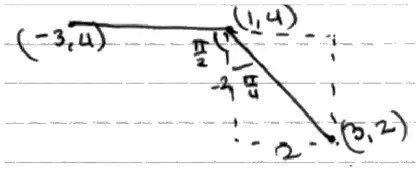 | M1 | 3.1a |
| Equation is \(\arg\left(\tfrac{z - 3 - 2\mathrm{i}}{z + 3 - 4\mathrm{i}}\right) = \tfrac{3\pi}{4}\) o.e.e. Equation is \(\arg(z - 3 - 2\mathrm{i}) - \arg(z + 3 - 4\mathrm{i}) = \tfrac{3\pi}{4}\) o.e.e. | A1 | 2.1 |
| (3) | ||
| (5 marks) |
Notes
B1: Recalls the correct form for the equation of an arc, with any angle or \(\theta\). Look for the correct form, so allow if \(z_1\) and \(z_2\) are the other way round.
M1: Any correct full method to find the value of \(\theta\), see scheme for various approaches
A1: Correct equation.
Correct answer implies full marks