
A2 June 2024 Paper 1 Q1
1.
\[\mathrm{f}(z) = z^4 - 6z^3 + az^2 + bz + 145\]where \(a\) and \(b\) are real constants.
Given that \(2 + 5\mathrm{i}\) is a root of the equation \(\mathrm{f}(z) = 0\)
| Scheme | Marks | AO |
|---|---|---|
| \(z = 2 - 5\mathrm{i}\) | B1 | 1.2 |
| \(\bigl(z - (2 + 5\mathrm{i})\bigr)\bigl(z - (2 - 5\mathrm{i})\bigr) = \ldots\) or Sum of roots \(= 4\), Product of roots \(= 29 \to z^2 + \ldots\) | M1 | 3.1a |
| \(= z^2 - 4z + 29\) | A1 | 1.1b |
| \(z^4 - 6z^3 + az^2 + bz + 145 = \left(z^2 - 4z + 29\right)\left(z^2 + cz + 5\right)\) | M1 | 3.1a |
| \(z^2 - 2z + 5 = 0\) | A1 | 2.2a |
| \(z^2 - 2z + 5 = 0 \Rightarrow z = \ldots\) | M1 | 1.1b |
| \(z = 1 \pm 2\mathrm{i}\) | A1 | 1.1b |
| (7) |
Notes
Note: if there are multiple attempts or attempts which start in main scheme before switching to an Alt, then mark the most complete attempt.
B1: Identifies the correct complex conjugate as another root.
M1: Formulates a correct strategy – main scheme. Uses the conjugate pair and a correct method to find a quadratic factor.
A1: Correct quadratic.
M1: Uses the given quartic and their quadratic to establish the other quadratic factor – by inspection or long division etc. resulting in a 3TQ
A1: Deduces the correct second quadratic.
M1: Solves their second quadratic.
A1: Correct second conjugate pair (isw if they try to write in a factorised equation).
Alt 1 (a)
| Scheme | Marks | AO |
|---|---|---|
| \(z = 2 - 5\mathrm{i}\) | B1 | 1.2 |
| \(\alpha + \beta = 4,\ \alpha\beta = 2^2 + 5^2 = \ldots\) and \(\alpha + \beta + \gamma + \delta = \pm 6,\ \alpha\beta\gamma\delta = \pm 145\) | M1 | 3.1a |
| \(\alpha + \beta = 4,\ \alpha\beta = 29\) and \(\alpha + \beta + \gamma + \delta = 6,\ \alpha\beta\gamma\delta = 145\) | A1 | 1.1b |
| \(\Rightarrow \gamma + \delta = 2,\ \gamma\delta = \dfrac{\text{``}145\text{''}}{\text{``}29\text{''}} \Rightarrow (2 - \delta)\delta = \dfrac{145}{29}\) | M1 | 3.1a |
| \(\delta^2 - 2\delta + 5 = 0\) | A1 | 2.2a |
| \(\delta^2 - 2\delta + 5 = 0 \Rightarrow \delta = \ldots\) | M1 | 1.1b |
| \(= 1 \pm 2\mathrm{i}\) | A1 | 1.1b |
| (7) |
B1: Identifies the correct complex conjugate as another root
M1: Formulates a correct strategy – sum and product approach. Attempts formulae for sum and product of the two know roots and all four roots – allow sign errors, \(\alpha + \beta = 4,\ \alpha\beta = 2^2 + 5^2 = \ldots\) \(\alpha + \beta + \gamma + \delta = \pm 6,\ \alpha\beta\gamma\delta = \pm 145\)
A1: Correct equations \(\alpha + \beta = 4,\ \alpha\beta = 29\) \(\alpha + \beta + \gamma + \delta = 6,\ \alpha\beta\gamma\delta = 145\) (seen or implied).
M1: Uses the sum and product of known roots to reduce to equations in just the unknown roots and attempts to solve simultaneously. Note allow if they assume complex roots and use \(\lambda \pm \mu\mathrm{i}\) for the two unknown roots.
A1: Deduces the correct quadratic for remaining roots.
M1: Solves their quadratic
A1: Correct second conjugate pair
Alt 2 (a)
| Scheme | Marks | AO |
|---|---|---|
| \(z = 2 - 5\mathrm{i}\) | B1 | 1.2 |
| \(\mathrm{f}(2 \pm 5\mathrm{i}) = 0 \Rightarrow -21a + 2b + 1038 \pm (-20a - 5b + 450)\mathrm{i} = 0\) \(\Rightarrow 21a - 2b - 1038 = 0,\ 20a + 5b - 450 = 0\) | M1 A1 | 3.1a 1.1b |
| \(\Rightarrow a = \ldots,\ b = \ldots\) | M1 | 3.1a |
| \(a = 42\) and \(b = -78\) | A1 | 2.2a |
| \(z^4 - 6z^3 + \text{``}42\text{''}z^2 - \text{``}78\text{''}z + 145 = 0 \Rightarrow z = \ldots\) | M1 | 1.1b |
| \(z = 1 \pm 2\mathrm{i},\ (2 \pm 5\mathrm{i})\) | A1 | 1.1b |
| (7) |
B1: Identifies the correct complex conjugate as another root- seen anywhere
M1: Formulates a correct strategy – factor theorem approach. Applies the factor theorem with either complex root and equates real and imaginary terms to form simultaneous equations in \(a\) and \(b\)
A1: Correct equations need not be simplified.
M1: Solves the equations to find values for \(a\) and \(b\). Do not be concerned with the algebra.
A1: Correct values
M1: Solves the resulting quartic – may be by calculator. Note that if roots are stated by calculator they must correspond to their found \(a\) and \(b\), but allow for rounding to nearest integer.
A1: Correct second conjugate pair from fully correct work.
| Scheme | Marks | AO |
|---|---|---|
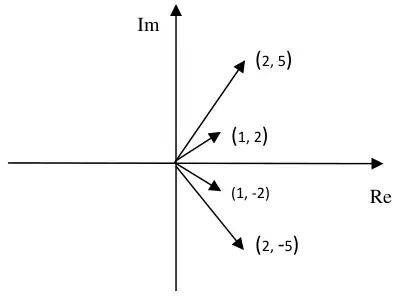 | B1ft B1 | 1.1b 1.1b |
| (2) | ||
| (9 marks) |
Notes
B1ft: A pair of complex roots plotted correctly, either both \(2 \pm 5\mathrm{i}\) or follow through their second pair of complex roots. Just the points are needed. Allow if there is no labelling for this mark, as long as there is a pair of roots symmetric in the real axis.
B1: Fully correct and labelled sketch with both sets of roots shown in approximately the correct locations. Just the points are needed. Labelling may be by coordinates or labels on axes, and accept tick marks as unit increments for labels. The \((1,\ \pm 2)\) roots must be within the sector spanned by \((2,\ \pm 5)\) (as in the diagram).