
June 2019 Paper 2 Q10
10.
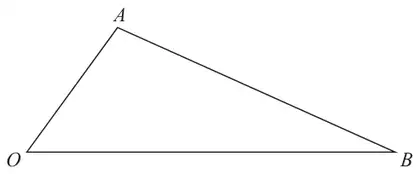
Figure 7 shows a sketch of triangle \(OAB\).
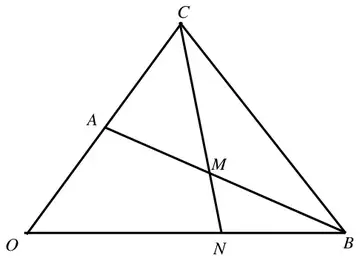
The point \(C\) is such that \(\overrightarrow{OC} = 2\overrightarrow{OA}\).
The point \(M\) is the midpoint of \(AB\).
The straight line through \(C\) and \(M\) cuts \(OB\) at the point \(N\).
Given \(\overrightarrow{OA} = \mathbf{a}\) and \(\overrightarrow{OB} = \mathbf{b}\)
| Scheme | Marks | AO |
|---|---|---|
 | ||
| \(\overrightarrow{OA} = \mathbf{a},\ \overrightarrow{OB} = \mathbf{b}\) | ||
| \(\left\{\overrightarrow{CM} = \overrightarrow{CA} + \overrightarrow{AM} = \overrightarrow{CA} + \dfrac{1}{2}\overrightarrow{AB} \Rightarrow\right\}\ \overrightarrow{CM} = -\mathbf{a} + \dfrac{1}{2}(\mathbf{b} - \mathbf{a})\) or \(\left\{\overrightarrow{CM} = \overrightarrow{CB} + \overrightarrow{BM} = \overrightarrow{CB} + \dfrac{1}{2}\overrightarrow{BA} \Rightarrow\right\}\ \overrightarrow{CM} = (-2\mathbf{a} + \mathbf{b}) + \dfrac{1}{2}(\mathbf{a} - \mathbf{b})\) | M1 | 3.1a |
| \(\Rightarrow \overrightarrow{CM} = -\dfrac{3}{2}\mathbf{a} + \dfrac{1}{2}\mathbf{b}\) (needs to be simplified and seen in (a) only) | A1 | 1.1b |
| (2) |
Notes
M1: Valid attempt to find \(\overrightarrow{CM}\) using a combination of known vectors \(\mathbf{a}\) and \(\mathbf{b}\)
A1: A simplified correct answer for \(\overrightarrow{CM}\)
Note: Give M1 for \(\overrightarrow{CM} = -\mathbf{a} + \dfrac{1}{2}(\mathbf{b} - \mathbf{a})\) or \(\overrightarrow{CM} = (-2\mathbf{a} + \mathbf{b}) + \dfrac{1}{2}(\mathbf{a} - \mathbf{b})\)
or for \(\left\{\overrightarrow{CM} = \overrightarrow{OM} - \overrightarrow{OC} \Rightarrow\right\}\ \overrightarrow{CM} = \dfrac{1}{2}(\mathbf{a} + \mathbf{b}) - 2\mathbf{a}\) only o.e.
(a) Special Case where the point C is believed to be below the origin O
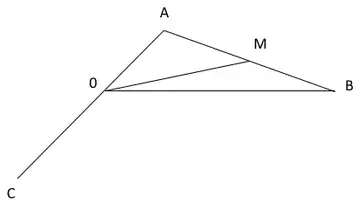
Give Special Case M1 A0 in part (a) for \(\left\{\overrightarrow{CM} = \overrightarrow{CA} + \overrightarrow{AM} \Rightarrow\right\}\ \overrightarrow{CM} = 3\mathbf{a} + \dfrac{1}{2}(\mathbf{b} - \mathbf{a})\)
\(\left\{\text{which leads to } \overrightarrow{CM} = \dfrac{5}{2}\mathbf{a} + \dfrac{1}{2}\mathbf{b}\right\}\)
| Scheme | Marks | AO |
|---|---|---|
| \(\overrightarrow{ON} = \overrightarrow{OC} + \overrightarrow{CN} \Rightarrow \overrightarrow{ON} = \overrightarrow{OC} + \lambda\overrightarrow{CM}\) | M1 | 1.1b |
| \(\overrightarrow{ON} = 2\mathbf{a} + \lambda\left(-\dfrac{3}{2}\mathbf{a} + \dfrac{1}{2}\mathbf{b}\right) \Rightarrow \overrightarrow{ON} = \left(2 - \dfrac{3}{2}\lambda\right)\mathbf{a} + \dfrac{1}{2}\lambda\mathbf{b}\) * | A1* | 2.1 |
| (2) |
Notes
M1: Uses \(\overrightarrow{ON} = \overrightarrow{OC} + \lambda\overrightarrow{CM}\)
A1*: Correct proof
Note: Special Case
Give SC M1 A0 for the solution \(\overrightarrow{ON} = \overrightarrow{OA} + \overrightarrow{AM} + \overrightarrow{MN} \Rightarrow \overrightarrow{ON} = \overrightarrow{OA} + \overrightarrow{AM} + \lambda\overrightarrow{CM}\)\[\overrightarrow{ON} = \mathbf{a} + \dfrac{1}{2}(\mathbf{b} - \mathbf{a}) + \lambda\left(-\dfrac{3}{2}\mathbf{a} + \dfrac{1}{2}\mathbf{b}\right)\ \left\{= \left(\dfrac{1}{2} - \dfrac{3}{2}\lambda\right)\mathbf{a} + \left(\dfrac{1}{2} + \dfrac{1}{2}\lambda\right)\mathbf{b}\right\}\]
Note: Alternative 1:
Give M1 A1 for the following alternative solution:
\(\overrightarrow{ON} = \overrightarrow{OA} + \overrightarrow{AM} + \overrightarrow{MN} \Rightarrow \overrightarrow{ON} = \overrightarrow{OA} + \overrightarrow{AM} + \mu\overrightarrow{CM}\)\[\overrightarrow{ON} = \mathbf{a} + \dfrac{1}{2}(\mathbf{b} - \mathbf{a}) + \mu\left(-\dfrac{3}{2}\mathbf{a} + \dfrac{1}{2}\mathbf{b}\right) = \left(\dfrac{1}{2} - \dfrac{3}{2}\mu\right)\mathbf{a} + \left(\dfrac{1}{2} + \dfrac{1}{2}\mu\right)\mathbf{b}\]\[\mu = \lambda - 1 \Rightarrow \overrightarrow{ON} = \left(\dfrac{1}{2} - \dfrac{3}{2}(\lambda - 1)\right)\mathbf{a} + \left(\dfrac{1}{2} + \dfrac{1}{2}(\lambda - 1)\right)\mathbf{b} \Rightarrow \overrightarrow{ON} = \left(2 - \dfrac{3}{2}\lambda\right)\mathbf{a} + \dfrac{1}{2}\lambda\mathbf{b}\]
Note: Part (b) and part (c) can be marked together.
| Scheme | Marks | AO |
|---|---|---|
| Way 1 \(\left(2 - \dfrac{3}{2}\lambda\right) = 0 \Rightarrow \lambda = \ldots\) | M1 | 2.2a |
| \(\lambda = \dfrac{4}{3} \Rightarrow \overrightarrow{ON} = \dfrac{2}{3}\mathbf{b}\ \left\{\Rightarrow \overrightarrow{NB} = \dfrac{1}{3}\mathbf{b}\right\} \Rightarrow ON : NB = 2:1\ *\) | A1* | 2.1 |
| (2) | ||
| (6 marks) |
Notes
(c) Way 2
| Scheme | Marks | AO |
|---|---|---|
| \(\overrightarrow{ON} = \mu\mathbf{b} \Rightarrow \left(2 - \dfrac{3}{2}\lambda\right)\mathbf{a} + \dfrac{1}{2}\lambda\mathbf{b} = \mu\mathbf{b}\) | ||
| \(\mathbf{a}:\ \left(2 - \dfrac{3}{2}\lambda\right) = 0 \Rightarrow \lambda = \ldots\ \ \left\{\mathbf{b}:\ \dfrac{1}{2}\lambda = \mu\ \ \&\ \ \lambda = \dfrac{4}{3} \Rightarrow \mu = \dfrac{2}{3}\right\}\) | M1 | 2.2a |
| \(\lambda = \dfrac{4}{3}\) or \(\mu = \dfrac{2}{3} \Rightarrow \overrightarrow{ON} = \dfrac{2}{3}\mathbf{b}\ \left\{\Rightarrow \overrightarrow{NB} = \dfrac{1}{3}\mathbf{b}\right\} \Rightarrow ON : NB = 2:1\ *\) | A1* | 2.1 |
| (2) |
(c) Way 3
| Scheme | Marks | AO |
|---|---|---|
| \(\overrightarrow{OB} = \overrightarrow{ON} + \overrightarrow{NB} \Rightarrow \mathbf{b} = \left(2 - \dfrac{3}{2}\lambda\right)\mathbf{a} + \dfrac{1}{2}\lambda\mathbf{b} + K\mathbf{b}\) | ||
| \(\mathbf{a}:\ \left(2 - \dfrac{3}{2}\lambda\right) = 0 \Rightarrow \lambda = \ldots\ \ \left\{\mathbf{b}:\ 1 = \dfrac{1}{2}\lambda + K\ \ \&\ \ \lambda = \dfrac{4}{3} \Rightarrow K = \dfrac{1}{3}\right\}\) | M1 | 2.2a |
| \(\lambda = \dfrac{4}{3}\) or \(K = \dfrac{1}{3} \Rightarrow \overrightarrow{ON} = \dfrac{2}{3}\mathbf{b}\) or \(\overrightarrow{NB} = \dfrac{1}{3}\mathbf{b} \Rightarrow ON : NB = 2:1\) * | A1 | 2.1 |
| (2) |
(c) Way 4
| Scheme | Marks | AO |
|---|---|---|
| \(\overrightarrow{ON} = \mu\mathbf{b}\ \ \&\ \ \overrightarrow{CN} = k\overrightarrow{CM} \Rightarrow \overrightarrow{CO} + \overrightarrow{ON} = k\overrightarrow{CM}\) | ||
| \(-2\mathbf{a} + \mu\mathbf{b} = k\left(-\dfrac{3}{2}\mathbf{a} + \dfrac{1}{2}\mathbf{b}\right)\) | ||
| \(\mathbf{a}:\ -2 = -\dfrac{3}{2}k \Rightarrow k = \dfrac{4}{3},\quad \mathbf{b}:\ \mu = \dfrac{1}{2}k \Rightarrow \mu = \dfrac{1}{2}\left(\dfrac{4}{3}\right) = \ldots\) | M1 | 2.2a |
| \(\mu = \dfrac{2}{3} \Rightarrow \overrightarrow{ON} = \dfrac{2}{3}\mathbf{b}\ \left\{\Rightarrow \overrightarrow{NB} = \dfrac{1}{3}\mathbf{b}\right\} \Rightarrow ON : NB = 2:1\ *\) | A1 | 2.1 |
| (2) |
Way 1, Way 2 and Way 3
M1: Deduces that \(\left(2 - \dfrac{3}{2}\lambda\right) = 0\) and attempts to find the value of \(\lambda\)
A1*: Correct proof
Way 4
M1: Complete attempt to find the value of \(\mu\)
A1*: Correct proof