
June 2019 Paper 1 Q10
10.
State, giving a reason, if the above statement is always true, sometimes true or never true. (2)
Example of an algebraic proof
| Scheme | Marks | AO |
|---|---|---|
| For \(n = 2m,\quad n^2 + 2 = 4m^2 + 2\) | M1 | 2.1 |
| Concludes that this number is not divisible by 4 (as the explanation is trivial) | A1 | 1.1b |
| For \(n = 2m + 1,\quad n^2 + 2 = (2m+1)^2 + 2 = \ldots\) FYI \((4m^2 + 4m + 3)\) | dM1 | 2.1 |
| Correct working and concludes that this is a number in the 4 times table add 3 so cannot be divisible by 4 or writes \(4(m^2 + m) + 3\) ..........AND states ......hence true for all | A1* | 2.4 |
| (4) |
Notes
Notes: Note that M0 A0 M1 A1 and M0 A0 M1 A0 are not possible due to the way the scheme is set up
M1: Awarded for setting up the proof for either the even or odd numbers.
A1: Concludes correctly with a reason why \(n^2 + 2\) cannot be divisible by 4 for either \(n\) odd or even.
dM1: Awarded for setting up the proof for both even and odd numbers
A1: Fully correct proof with valid explanation and conclusion for all \(n\)
General points for marking question 10 (i):
- Students who just try random numbers in part (i) are not going to score any marks.
- Students can mix and match methods. Eg you may see odd numbers via logic and even via algebra
- Students who state \(4m^2 + 2\) cannot be divided by (instead of is not divisible by) cannot be awarded credit for the accuracy/explanation marks, unless they state correctly that \(4m^2 + 2\) cannot be divided by 4 to give an integer.
- Students who write \(n^2 + 2 = 4k \Rightarrow k = \dfrac{1}{4}n^2 + \dfrac{1}{2}\) which is not a whole number gains no credit unless they then start to look at odd and even numbers for instance
- Proofs via induction usually tend to go nowhere unless they proceed as in the main scheme
- Watch for unusual methods that are worthy of credit (See below)
- If the final conclusion is \(n \in \mathbb{R}\) then the final mark is withheld. \(n \in \mathbb{Z}^+\) is correct
Watch for methods that may not be in the scheme that you feel may deserve credit.
If you are uncertain of a method please refer these up to your team leader.
Eg 1. Solving part (i) by modulo arithmetic.
| All \(n \in \mathbb{N}\) mod 4 | 0 | 1 | 2 | 3 |
| All \(n^2 \in \mathbb{N}\) mod 4 | 0 | 1 | 0 | 1 |
| All \(n^2 + 2 \in \mathbb{N}\) mod 4 | 2 | 3 | 2 | 3 |
Hence for all \(n\), \(n^2 + 2\) is not divisible by 4.
Example of a very similar algebraic proof
| Scheme | Marks | AO |
|---|---|---|
| For \(n = 2m,\quad \dfrac{4m^2 + 2}{4} = m^2 + \dfrac{1}{2}\) | M1 | 2.1 |
| Concludes that this is not divisible by 4 due to the \(\dfrac{1}{2}\) (A suitable reason is required) | A1 | 1.1b |
| For \(n = 2m + 1,\quad \dfrac{n^2 + 2}{4} = \dfrac{4m^2 + 4m + 3}{4} = m^2 + m + \dfrac{3}{4}\) | dM1 | 2.1 |
| Concludes that this is not divisible by 4 due to the \(\dfrac{3}{4}\) ...AND states ...... hence for all \(n\), \(n^2 + 2\) is not divisible by 4 | A1* | 2.4 |
| (4) |
Example of a proof via logic
| Scheme | Marks | AO |
|---|---|---|
| When \(n\) is odd, "odd \(\times\) odd" = odd | M1 | 2.1 |
| so \(n^2 + 2\) is odd , so (when \(n\) is odd) \(n^2 + 2\) cannot be divisible by 4 | A1 | 1.1b |
| When \(n\) is even, it is a multiple of 2, so "even \(\times\) even" is a multiple of 4 | dM1 | 2.1 |
| Concludes that when \(n\) is even \(n^2 + 2\) cannot be divisible by 4 because \(n^2\) is divisible by 4…..AND STATES ……..trues for all \(n\). | A1* | 2.4 |
| (4) |
Example of proof via contradiction
| Scheme | Marks | AO |
|---|---|---|
| Sets up the contradiction ‘Assume that \(n^2 + 2\) is divisible by 4 \(\Rightarrow n^2 + 2 = 4k\)’ | M1 | 2.1 |
| \(\Rightarrow n^2 = 4k - 2 = 2(2k - 1)\) and concludes even Note that the M mark (for setting up the contradiction must have been awarded) | A1 | 1.1b |
| States that \(n^2\) is even, then \(n\) is even and hence \(n^2\) is a multiple of 4 | dM1 | 2.1 |
| Explains that if \(n^2\) is a multiple of 4 then \(n^2 + 2\) cannot be a multiple of 4 and hence divisible by 4 Hence there is a contradiction and concludes Hence true for all \(n\). | A1* | 2.4 |
| (4) |
A similar proof exists via contradiction where
A1: \(n^2 = 2(2k - 1) \Rightarrow n = \sqrt{2} \times \sqrt{2k - 1}\)
dM1: States that \(2k - 1\) is odd, so does not have a factor of 2, meaning that \(n\) is irrational
Proof using numerical values
| Scheme | Marks | AO |
|---|---|---|
| SOMETIMES TRUE and chooses any number \(x : 9.25 \lt x \lt 9.5\) and shows false Eg \(x = 9.4\) \(|3x - 28| = 0.2\) and \(x - 9 = 0.4\) ✗ | M1 | 2.3 |
| Then chooses a number where it is true Eg \(x = 12\) \(|3x - 28| = 8\) \(x - 9 = 3\) ✓ | A1 | 2.4 |
| (2) |
Notes
M1: States or implies ‘sometimes true’ or ‘not always true’ and gives an example where it is not true.
A1: and gives an example where it is true,
Graphical Proof
| Scheme | Marks | AO |
|---|---|---|
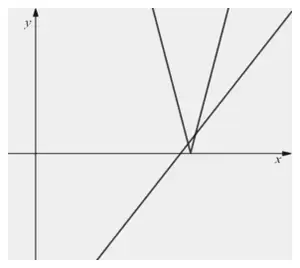 Sketches both graphs on the same axes. Expect shapes and relative positions to be correct. V shape on +ve \(x\)-axis Linear graph with +ve gradient intersecting twice | M1 | 2.3 |
| Graphs accurate and explains that as there are points where \(|3x - 28| \lt x - 9\) and points where \(|3x - 28| \gt x - 9\) oe in words like ‘above’ and ‘below’ or ‘dips below at one point’ | A1 | 2.4 |
| (2) |
Proof via algebra
| Scheme | Marks | AO |
|---|---|---|
| States sometimes true and attempts to solve both \(3x - 28 \lt x - 9\) and \(-3x + 28 \lt x - 9\) or one of these with the bound \(9.\dot{3}\) | M1 | 2.3 |
| States that it is false when \(9.25 \lt x \lt 9.5\) or \(9.25 \lt x \lt 9.\dot{3}\) or \(9.\dot{3} \lt x \lt 9.5\) | A1 | 2.4 |
| (2) |
Alt: It is possible to find where it is always true
| Scheme | Marks | AO |
|---|---|---|
| States sometimes true and attempts to solve where it is just true Solves both \(3x - 28 \geqslant x - 9\) and \(-3x + 28 \geqslant x - 9\) | M1 | 2.3 |
| States that it is false when \(9.25 \lt x \lt 9.5\) or \(9.25 \lt x \lt 9.\dot{3}\) or \(9.\dot{3} \lt x \lt 9.5\) | A1 | 2.4 |
| (2) |