
June 2019 Paper 3 Q9
9
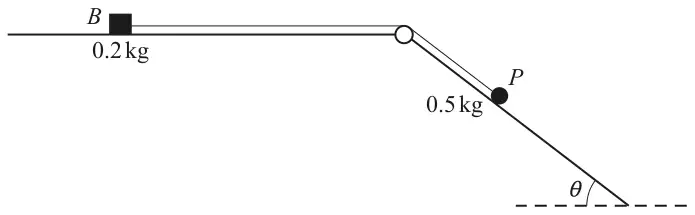
The diagram shows a small block \(B\), of mass \(0.2\text{ kg}\), and a particle \(P\), of mass \(0.5\text{ kg}\), which are attached to the ends of a light inextensible string. The string is taut and passes over a small smooth pulley fixed at the intersection of a horizontal surface and an inclined plane.
The block can move on the horizontal surface, which is rough. The particle can move on the inclined plane, which is smooth and which makes an angle of \(\theta\) with the horizontal where \(\tan\theta = \frac{3}{4}\).
The system is released from rest. In the first 0.4 seconds of the motion \(P\) moves \(0.3\text{ m}\) down the plane and \(B\) does not reach the pulley.
| Scheme | Marks | AO |
|---|---|---|
| \(0.3 = \frac{1}{2}a \times 0.4^2\ (\Rightarrow a = 3.75)\) | B1 | 3.1b |
| \(0.5g\sin\theta - T = 0.5a\) | M1 | 3.3 |
| \(0.5g \times \frac{3}{5} - T = 0.5 \times 3.75\) | A1ft | 1.1 |
| \(T = 1.065\text{ N}\) | A1 | 1.1 |
| [4] |
Notes
B1: Cao seen or implied by correct \(T\)
M1: Use of N II parallel to the plane (correct number of terms) – weight must be resolved (but allow sin/cos confusion in component of the weight – may still be in terms of \(\theta\) and \(a\) (or their incorrect values of \(\theta\) and \(a\)))
Allow sign errors but M0 if using \(0.5g\) for the mass on the rhs or if only resolving the mass (e.g. \(0.5\sin\theta\)) on the lhs
A1ft: 'correct' equation in terms of \(T\) with their \(a\)
Allow \(0.5g \times \sin 36.9 - T = 0.5 \times \text{‘}3.75\text{’}\) or \(0.5g \times \sin 0.644 - T = 0.5 \times \text{‘}3.75\text{’}\) (in radians)
A0 if \(a = 0\) or \(\pm g\) (or a component of \(g\))
A1: Allow 1.07 www
| Scheme | Marks | AO |
|---|---|---|
| \(R = 0.2g\) | B1 | 1.1 |
| \(T - F = 0.2a\) or \(T - \mu R = 0.2a\) | M1* | 3.3 |
| \(1.065 - F = 0.2(3.75)\) | A1 | 1.1 |
| \(0.315 = \mu \times 0.2 \times 9.8\) | M1dep* | 3.4 |
| \(\mu = 0.161\) | A1 | 1.1 |
| [5] |
Notes
B1: Where \(R\) is the normal contact force of surface acting on \(B\) – may be implied in N II applied horizontally
M1*: Use of N II horizontally for \(B\) or \(0.5g\sin\theta - F = 0.7a\) for the whole system (M0 if any other mass used for whole system)
Correct number of terms (M0 if mass is \(0.2g\)) – allow sign errors
A1: Or for a correct statement without explicitly seeing \(F\) e.g. \(1.065 - 0.2g\mu = 0.2(3.75)\) (which would imply the next M mark as well)
\(F = 0.315\) or \(\mu R = 0.315\) or \(F = 0.32\)
M1dep*: Use of \(F = \mu R\) where \(R = 0.2g\) - may be implied in N II applied horizontally
A1: Allow awrt 0.161 or 0.163 from using \(T = 1.07\) www
\(\mu = \frac{9}{56}\)