
October 2020 Paper 3 Q9
9
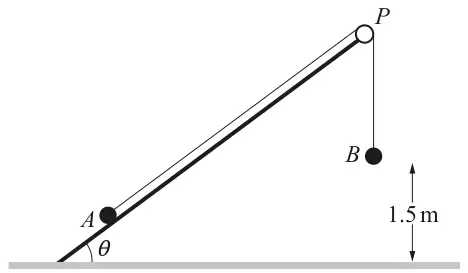
One end of a light inextensible string is attached to a particle \(A\) of mass 2 kg. The other end of the string is attached to a second particle \(B\) of mass 2.5 kg. Particle \(A\) is in contact with a rough plane inclined at \(\theta\) to the horizontal, where \(\cos\theta = \tfrac{4}{5}\). The string is taut and passes over a small smooth pulley \(P\) at the top of the plane. The part of the string from \(A\) to \(P\) is parallel to a line of greatest slope of the plane. Particle \(B\) hangs freely below \(P\) at a distance 1.5 m above horizontal ground, as shown in the diagram.
The coefficient of friction between \(A\) and the plane is \(\mu\). The system is released from rest and in the subsequent motion \(B\) hits the ground before \(A\) reaches \(P\). The speed of \(B\) at the instant that it hits the ground is \(1.2\,\mathrm{m\,s^{-1}}\).
After \(B\) hits the ground, \(A\) continues to travel up the plane before coming to instantaneous rest before it reaches \(P\).
| Scheme | Marks | AO |
|---|---|---|
| \(1.2^2 = 0^2 + 2a(1.5) \Rightarrow a = 0.48\ (\mathrm{m\,s^{-2}})\) | B1 | 2.1 |
| [1] |
Notes
B1: AG
| Scheme | Marks | AO |
|---|---|---|
| M1 | 3.3 | |
| \(2.5g - T = 2.5a\) | A1 | 1.1 |
| \(T = 2.5(9.8) - 2.5(0.48) = 23.3\ (\mathrm{N})\) | A1 | 1.1 |
| [3] |
Notes
M1: N2L for particle \(B\) – correct number of terms – allow sign errors
M0 if mass only on lhs
A1: AG e.g. \(2.5(9.8) - T = 2.5(0.48) \Rightarrow T = 23.3\)
Value of \(a\) must be substituted for this mark
| Scheme | Marks | AO |
|---|---|---|
| \(R = 2g\cos\theta = 2g\left(\tfrac{4}{5}\right)\) | B1 | 1.1 |
| \(T - F - 2g\sin\theta = 2a\) or \(T - \mu R - 2g\sin\theta = 2a\) | M1* | 3.3 |
| \(23.3 - F - 2g\left(\tfrac{3}{5}\right) = 2a\) or \(23.3 - \mu R - 2g\left(\tfrac{3}{5}\right) = 2a\) | A1 | 1.1 |
| \(23.3 - \mu(2g)\left(\tfrac{4}{5}\right) - 2g\left(\tfrac{3}{5}\right) = 2(0.48)\) | M1dep* | 3.4 |
| \(\mu = 0.675\) | A1 | 2.2a |
| [5] |
Notes
B1: Correctly resolves perpendicular to the plane and substitutes the correct value for cosine
\(R = 15.68\)
M1*: N2L for particle \(A\) – correct number of terms with weight component resolved
Allow sign errors
A1: Correct equation with \(T = 23.3\) and \(a = 0.48\)
M1dep*: Use of \(F = \mu R\) with their values for \(F\) and \(R\) – may be implied by N2L
Equation in \(\mu\) only
\(R\) must be a component of \(2g\) only
A1: Correct to at least 3 sf (0.674744898…)
Note that \(\mu = \tfrac{529}{784}\)
| Scheme | Marks | AO |
|---|---|---|
| \(-\mu R - 2g\sin\theta = 2a\) therefore \(-\tfrac{529}{784}(15.68) - 2g\left(\tfrac{3}{5}\right) = 2a\) | M1* | 3.1b |
| \(a = -11.17\) | A1 | 1.1 |
| \(0^2 = 1.2^2 + 2(-11.17)s\) | M1dep* | 3.4 |
| \(s = 0.065\ (\mathrm{m})\) or \(0.064\ (\mathrm{m})\) | A1 | 1.1 |
| [4] |
Notes
M1*: N2L parallel to the plane with \(T = 0\) to find new acceleration
Correct number of terms
A1: \(a = -11.172\) if \(\mu = 0.675\) used
Accept positive \(a\) – may be implied by later working
M1dep*: Applies \(v^2 = u^2 + 2as\) with \(v = 0\) and \(u = 1.2\)
A1: Correct to at least 3 d.p.
0.06445837064… if \(\mu\) exact used or 0.06444683… if 3 sf for \(\mu\) used