
June 2022 Paper 1 Q8
8.
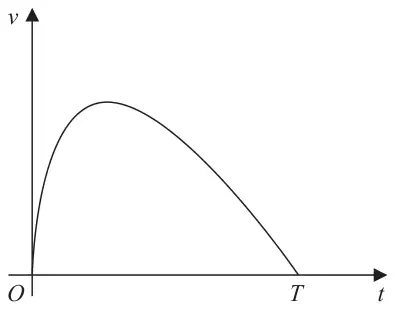
A car stops at two sets of traffic lights.
Figure 2 shows a graph of the speed of the car, \(v\,\mathrm{m\,s}^{-1}\), as it travels between the two sets of traffic lights.
The car takes \(T\) seconds to travel between the two sets of traffic lights.
The speed of the car is modelled by the equation
\[v = (10 - 0.4t)\ln(t + 1) \qquad 0 \leqslant t \leqslant T\]where \(t\) seconds is the time after the car leaves the first set of traffic lights.
According to the model,
Using the iteration formula
\[t_{n+1} = \dfrac{26}{1 + \ln(t_n + 1)} - 1\]with \(t_1 = 7\)
| Scheme | Marks | AO |
|---|---|---|
| 25 | B1 | 3.4 |
| (1) |
Notes
B1: 25 but condone 25 seconds. If another value is given (apart from 0) it is B0
| Scheme | Marks | AO |
|---|---|---|
| Attempts to differentiate using the product rule \(\dfrac{\mathrm{d}v}{\mathrm{d}t} = \ln(t + 1) \times -0.4 + \dfrac{(10 - 0.4t)}{t + 1}\) | M1 A1 | 3.1b 1.1b |
| Sets their \(\dfrac{\mathrm{d}v}{\mathrm{d}t} = 0 \Rightarrow \dfrac{(10 - 0.4t)}{(t + 1)} = 0.4\ln(t + 1)\) and then makes progress towards making "\(\boldsymbol{t}\)" the subject (See notes for this) | dM1 | 1.1b |
| \(\begin{aligned} t &= \dfrac{25 - \ln(t + 1)}{1 + \ln(t + 1)} \\[4pt] t &= \dfrac{26}{1 + \ln(t + 1)} - 1 \ \ast \end{aligned}\) | A1* | 2.1 |
| (4) |
Notes
M1: Attempts to use the product rule in an attempt to differentiate \(v = (10 - 0.4t)\ln(t + 1)\)
Look for \((10 - 0.4t) \times \dfrac{1}{(t + 1)} \pm k\ln(t + 1)\), where \(k\) is a constant, condoning slips.
If you see direct evidence of an incorrect rule used e.g. \(vu^{\prime} - uv^{\prime}\) it is M0
You will see attempts from \(v = 10\ln(t + 1) - 0.4t\ln(t + 1)\) which can be similarly marked.
In this case look for \(\dfrac{a}{t + 1} \pm \dfrac{bt}{t + 1} \pm c\ln(t + 1)\)
A1: Correct differentiation. Condone a missing left hand or it seen as \(v^{\prime}\), \(\dfrac{\mathrm{d}y}{\mathrm{d}x}\) or even \(= 0\)
\(\left(\dfrac{\mathrm{d}v}{\mathrm{d}t}\right) = \ln(t + 1) \times -0.4 + \dfrac{(10 - 0.4t)}{t + 1}\) or equivalent such as \(\left(\dfrac{\mathrm{d}v}{\mathrm{d}t}\right) = \dfrac{10}{t + 1} - \dfrac{0.4t}{(t + 1)} - 0.4\ln(t + 1)\)
dM1: Score for setting their \(\mathrm{d}V/\mathrm{d}t = 0\) (which must be in an appropriate form) and proceeding to an equation where the variable \(t\) occurs only once – ignoring \(\ln(t + 1)\).
See two examples of how this can be achieved below. It is dependent upon the previous M.
Look for the following steps
- An allowable derivative set (or implied) \(= 0\) E.g. \(\ln(t + 1) \times 0.4 = \dfrac{(10 - 0.4t)}{t + 1}\)
- Cross multiplication (or division) and rearrangement to form an equation where the variable \(t\) only occurs once.
E.g.1.
\[\begin{aligned} \ln(t + 1) \times 0.4 &= \dfrac{(10 - 0.4t)}{t + 1} \\ \Rightarrow \ln(t + 1) &= \dfrac{25 - t}{t + 1} \\ \Rightarrow \ln(t + 1) &= -1 + \dfrac{26}{t + 1} \end{aligned}\]E.g 2
\[\begin{aligned} \ln(t + 1) \times 0.4 &= \dfrac{(10 - 0.4t)}{t + 1} \\ \Rightarrow 0.4t\ln(t + 1) + 0.4\ln(t + 1) &= 10 - 0.4t \\ \Rightarrow 0.4t\left(1 + \ln(t + 1)\right) &= 10 - 0.4\ln(t + 1) \end{aligned}\]A1*: Correctly proceeds to the given answer of \(t = \dfrac{26}{1 + \ln(t + 1)} - 1\) showing all key steps.
The key steps must include
- use of \(\dfrac{\mathrm{d}v}{\mathrm{d}t}\) or \(v^{\prime}\) which must be correct
- a correct line preceding the given answer, usually \(t = \dfrac{25 - \ln(t + 1)}{1 + \ln(t + 1)}\) or \(\dfrac{26}{t + 1} - 1 = \ln(t + 1)\)
| Scheme | Marks | AO |
|---|---|---|
| (i) Attempts \(t_2 = \dfrac{26}{1 + \ln 8} - 1\) | M1 | 1.1b |
| awrt 7.298 | A1 | 1.1b |
| (ii) awrt 7.33 seconds | A1 | 3.2a |
| (3) | ||
| (8 marks) |
Notes
(c) (i)
M1: Attempts to use the iteration formula at least once.
Usually to find \(t_2 = \dfrac{26}{1 + \ln 8} - 1\) which may be implied by awrt 7.44
A1: awrt 7.298. This alone will score both marks as iteration is implied. ISW after sight of this value. As \(t_3\) is the only value that rounds to 7.298 just score the rhs, it does not need to be labelled \(t_3\)
(c)(ii)
A1: Uses repeated iteration until value established as awrt 7.33 seconds. Allow awrt 7.33 s
Requires units. It also requires some evidence of iteration which will be usually be awarded from the award of the M