
June 2019 Paper 1 Q15
15 A model for the motion of a small object falling through a thick fluid can be expressed using the differential equation
\(\dfrac{\mathrm{d}v}{\mathrm{d}t} = 9.8 - kv\),
where \(v\,\mathrm{m\,s^{-1}}\) is the velocity after \(t\) s and \(k\) is a positive constant.
Experiments show that for large values of \(t\), the velocity tends to \(7\,\mathrm{m\,s^{-1}}\).
| Scheme | Marks | AO |
|---|---|---|
| \(\displaystyle\int \frac{1}{9.8 - kv}\,\mathrm{d}v = \int 1\,\mathrm{d}t\) | M1 | 3.1a |
| \(-\dfrac{1}{k}\ln(9.8 - kv) = t + c\) | A1 A1 | 1.1b 1.1b |
| \(9.8 - kv = A\mathrm{e}^{-kt}\) | M1 | 1.1a |
| When \(t = 0,\ v = 0\) giving \(0 = \dfrac{1}{k}\left(9.8 - A\mathrm{e}^{-0}\right)\) \(A = 9.8\) | M1 A1 | 3.1a 1.1b |
| Hence \(v = \dfrac{9.8}{k}\left(1 - \mathrm{e}^{-kt}\right)\) | A1 | 1.1b |
| [7] |
Notes
M1: Attempt to separate variables and integrate
Allow up to 3M marks for an attempt with an incorrect rearrangement.
A1: Correct rearrangement
A1: Correctly integrated – must include \(+c\) somewhere
M1: Attempt to write in the form \(v =\) (Clearing natural logs; may be done after evaluation of the constant)
M1: Using initial conditions leading to a value for the constant; may be done before clearing logs
A1: Correct value for \(A\) (or \(c = -\dfrac{1}{k}\ln 9.8\))
A1: Must be in the form \(v = \ldots\)
Alternative using a Further Maths method
| Scheme | Marks |
|---|---|
| \(\dfrac{\mathrm{d}v}{\mathrm{d}t} + kv = 9.8\) | M1 |
| Integrating factor \(\mathrm{e}^{\int P(t)\,\mathrm{d}t} = \mathrm{e}^{kt}\) | A1 |
| \(v\mathrm{e}^{kt} = \displaystyle\int \left(9.8\mathrm{e}^{kt}\right)\mathrm{d}t = \frac{9.8}{k}\mathrm{e}^{kt} + c\) | A1 |
| \(v = \dfrac{9.8}{k} + c\mathrm{e}^{-kt}\) | M1 |
| When \(t = 0,\ v = 0\) giving \(c = -\dfrac{9.8}{k}\) | M1 |
| Hence \(v = \dfrac{9.8}{k}\left(1 - \mathrm{e}^{-kt}\right)\) | A1 A1 |
M1: Writing in the correct form and using integrating factor
A1: Correct integrating factor
A1: Correct equation
M1: Attempt to write in the form \(v =\)
M1: Using initial conditions leading to a value for the constant
A1: Correct value for \(c\)
A1: Must be in the form \(v = \ldots\)
| Scheme | Marks | AO |
|---|---|---|
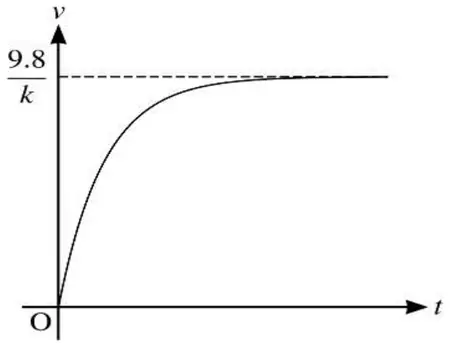 | B1 B1 | 1.1b 1.1b |
| [2] |
Notes
B1: Graph through \((0, 0)\) with the correct general shape or correct for their \(v\).
B1: Horizontal asymptote labelled \(\dfrac{9.8}{k}\)
Ignore any graph for \(t < 0\)
Any graph involving \(\sqrt{t}\) must be concave
| Scheme | Marks | AO |
|---|---|---|
| As \(t \to \infty,\ v \to \dfrac{9.8}{k} = 7\) | M1 | 3.4 |
| \(k = 1.4\) | A1 | 1.1b |
| [2] |
Notes
M1: Recognises the limiting value
Allow M1 for their \(v\) used, provided it has a non-zero limiting value
A1: Any form from correct \(v\)
Alternative solution
| Scheme | Marks |
|---|---|
| Limiting value when \(\dfrac{\mathrm{d}v}{\mathrm{d}t} = 0\) | M1 |
| \(k = \dfrac{9.8}{7} = 1.4\) | A1 |
M1: Could be implied
| Scheme | Marks | AO |
|---|---|---|
| \(v = 3.5 \Rightarrow 1 - \mathrm{e}^{-1.4t} = \dfrac{3.5}{7}\) Hence \(-1.4t = \ln 0.5 \Rightarrow t = 0.495\) | B1 | 3.4 |
| [1] |
Notes
B1: May substitute in other versions of the equation relating \(v\) and \(t\)
Allow for 0.50 or awrt 0.495
No FT from incorrect expression for \(v\)