
June 2023 Paper 1 Q15
15. A curve has equation \(y = \mathrm{f}(x)\), where\[\mathrm{f}(x) = \frac{7x\mathrm{e}^{x}}{\sqrt{\mathrm{e}^{3x} - 2}} \qquad x \gt \ln\sqrt[3]{2}\]
The equation \(x = \dfrac{2\mathrm{e}^{3x} - 4}{\mathrm{e}^{3x} + 4}\) has two positive roots \(\alpha\) and \(\beta\) where \(\beta \gt \alpha\)
A student uses the iteration formula\[x_{n+1} = \frac{2\mathrm{e}^{3x_n} - 4}{\mathrm{e}^{3x_n} + 4}\]in an attempt to find approximations for \(\alpha\) and \(\beta\)
Diagram 1 shows a plot of part of the curve with equation \(y = \dfrac{2\mathrm{e}^{3x} - 4}{\mathrm{e}^{3x} + 4}\) and part of the line with equation \(y = x\)
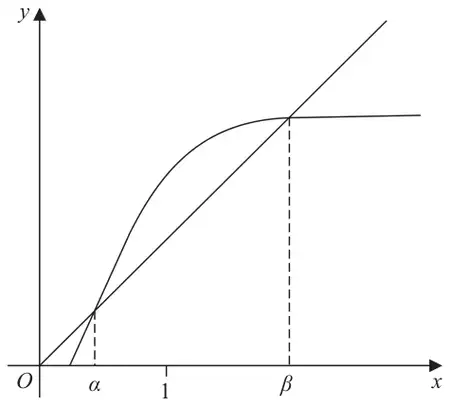
Using Diagram 1 on page 42
Use the iteration formula with \(x_1 = 1\), to find, to 3 decimal places,
Using a suitable interval and a suitable function that should be stated
| Scheme | Marks | AO |
|---|---|---|
| \(\ldots x\mathrm{e}^{x} + \ldots\mathrm{e}^{x}\) | M1 | 1.1b |
| \(k\left(x\mathrm{e}^{x} + \mathrm{e}^{x}\right)\) | A1 | 1.1b |
| \(\dfrac{\mathrm{d}}{\mathrm{d}x}\left(\sqrt{\mathrm{e}^{3x} - 2}\right) = \dfrac{1}{2} \times 3\mathrm{e}^{3x}\left(\mathrm{e}^{3x} - 2\right)^{-\frac{1}{2}}\) | B1 | 1.1b |
| \(\left(\mathrm{f}^{\prime}(x) =\right) \dfrac{(\mathrm{e}^{3x} - 2)^{\frac{1}{2}}(\text{``}7\text{''}x\mathrm{e}^{x} + \text{``}7\text{''}\mathrm{e}^{x}) - \text{``}\frac{3}{2}\text{''}\mathrm{e}^{3x}(\mathrm{e}^{3x} - 2)^{-\frac{1}{2}} \times \text{``}7\text{''}x\mathrm{e}^{x}}{\mathrm{e}^{3x} - 2}\) | dM1 | 2.1 |
| \(\mathrm{f}^{\prime}(x) = \dfrac{7\mathrm{e}^{x}\left(\mathrm{e}^{3x}(2 - x) - 4x - 4\right)}{2(\mathrm{e}^{3x} - 2)^{\frac{3}{2}}}\) | A1 | 1.1b |
| (5) |
Notes
M1: Attempts the product rule on \(x\mathrm{e}^{x}\) (or may be \(7x\mathrm{e}^{x}\)) achieving an expression of the form \(\ldots x\mathrm{e}^{x} \pm \ldots\mathrm{e}^{x}\).
If it is clear that the quotient rule has been applied instead which may be quoted then M0.
A1: \(k\left(x\mathrm{e}^{x} + \mathrm{e}^{x}\right)\) (e.g. \(7(x\mathrm{e}^{x} + \mathrm{e}^{x})\)) or equivalent which may be unsimplified (may be implied by further work)
B1: \(\left(\dfrac{\mathrm{d}}{\mathrm{d}x}\left(\sqrt{\mathrm{e}^{3x} - 2}\right) =\right) \dfrac{1}{2} \times 3\mathrm{e}^{3x}\left(\mathrm{e}^{3x} - 2\right)^{-\frac{1}{2}}\) (simplified or unsimplified)
dM1: Attempts to use the quotient rule. It is dependent on the previous method mark.
Score for achieving an expression of the form
\(\left(\mathrm{f}^{\prime}(x) =\right) \dfrac{(\mathrm{e}^{3x} - 2)^{\frac{1}{2}}(\text{``}7\text{''}x\mathrm{e}^{x} + \text{``}7\text{''}\mathrm{e}^{x}) - \text{``}\frac{3}{2}\text{''}\mathrm{e}^{3x}(\mathrm{e}^{3x} - 2)^{-\frac{1}{2}} \times \text{``}7\text{''}x\mathrm{e}^{x}}{\mathrm{e}^{3x} - 2}\) or equivalent (do not be concerned by the constants for their “7” or their “\(\dfrac{3}{2}\)” which may be both 1)
If it is clear that the quotient rule has been applied the wrong way round then score M0.
Alternatively, applies the product rule. Score for achieving an expression of the form
\(\left(\mathrm{f}^{\prime}(x) =\right) (\mathrm{e}^{3x} - 2)^{-\frac{1}{2}}(\text{``}7\text{''}x\mathrm{e}^{x} + \text{``}7\text{''}\mathrm{e}^{x}) - \text{``}\dfrac{3}{2}\text{''}\mathrm{e}^{3x}(\mathrm{e}^{3x} - 2)^{-\frac{3}{2}} \times \text{``}7\text{''}x\mathrm{e}^{x}\) or equivalent (do not be concerned by the constants for their “7” or their “\(\dfrac{3}{2}\)” which may be both 1)
Do not condone invisible brackets.
A1: \(\left(\mathrm{f}^{\prime}(x) =\right) \dfrac{7\mathrm{e}^{x}\left(\mathrm{e}^{3x}(2 - x) - 4x - 4\right)}{2(\mathrm{e}^{3x} - 2)^{\frac{3}{2}}}\) following a fully correct differentiated expression.
You may need to check to see if (a) is continued after other parts for evidence of this.
Condone the lack of \(\mathrm{f}^{\prime}(x) =\) on the left hand side or allow the use of \(\dfrac{\mathrm{d}y}{\mathrm{d}x}\) or \(y^{\prime}\) instead.
Alternative (a) attempt using the triple product rule
e.g. \(\dfrac{\mathrm{d}}{\mathrm{d}x}\left(7x\mathrm{e}^{x}(\mathrm{e}^{3x} - 2)^{-\frac{1}{2}}\right) = 7\mathrm{e}^{x}(\mathrm{e}^{3x} - 2)^{-\frac{1}{2}} + 7x\mathrm{e}^{x}(\mathrm{e}^{3x} - 2)^{-\frac{1}{2}} + 7x\mathrm{e}^{x} \times \left(-\dfrac{1}{2}\right) \times 3\mathrm{e}^{3x}(\mathrm{e}^{3x} - 2)^{-\frac{3}{2}}\)
\(\Rightarrow \dfrac{\left(7\mathrm{e}^{x} + 7x\mathrm{e}^{x}\right)(\mathrm{e}^{3x} - 2) + 7x\mathrm{e}^{x} \times \left(-\frac{1}{2}\right) \times 3\mathrm{e}^{3x}}{(\mathrm{e}^{3x} - 2)^{\frac{3}{2}}} = \dfrac{7\mathrm{e}^{x}\left(\mathrm{e}^{3x} - 2 + x\mathrm{e}^{3x} - 2x - \frac{3}{2}x\mathrm{e}^{3x}\right)}{(\mathrm{e}^{3x} - 2)^{\frac{3}{2}}} \Rightarrow \dfrac{7\mathrm{e}^{x}\left(\mathrm{e}^{3x}(2 - x) - 4x - 4\right)}{2(\mathrm{e}^{3x} - 2)^{\frac{3}{2}}}\)
M1: Attempts the product rule on \(x\mathrm{e}^{x} \rightarrow \ldots x\mathrm{e}^{x} \pm \ldots\mathrm{e}^{x}\) which may be seen within the expression
\(\ldots\mathrm{e}^{x}(\mathrm{e}^{3x} - 2)^{-\frac{1}{2}} \pm \ldots x\mathrm{e}^{x}(\mathrm{e}^{3x} - 2)^{-\frac{1}{2}} + \ldots\) simplified or unsimplified.
A1: \(k\left(x\mathrm{e}^{x} + \mathrm{e}^{x}\right)\) which may be seen within the expression \(k\left(\mathrm{e}^{x}(\mathrm{e}^{3x} - 2)^{-\frac{1}{2}} + x\mathrm{e}^{x}(\mathrm{e}^{3x} - 2)^{-\frac{1}{2}}\right) + \ldots\) simplified or unsimplified.
B1: \(\left(-\dfrac{1}{2}\right) \times 3\mathrm{e}^{3x}(\mathrm{e}^{3x} - 2)^{-\frac{3}{2}}\) which may be seen within the expression \(\ldots. + k\left(x\mathrm{e}^{x} \times \left(-\dfrac{1}{2}\right) \times 3\mathrm{e}^{3x}(\mathrm{e}^{3x} - 2)^{-\frac{3}{2}}\right)\) simplified or unsimplified.
dM1: A complete method using all three products (which may appear all on one line). Do not condone invisible brackets.
A1: As above in main scheme notes.
| Scheme | Marks | AO |
|---|---|---|
| \(\mathrm{e}^{3x}(2 - x) - 4x - 4 = 0 \Rightarrow x(\ldots\mathrm{e}^{3x} \pm \ldots) = \ldots\mathrm{e}^{3x} \pm \ldots\) | M1 | 1.1b |
| \(\Rightarrow x = \dfrac{2\mathrm{e}^{3x} - 4}{\mathrm{e}^{3x} + 4}\) * | A1* | 2.1 |
| (2) |
Notes
Note that if they do not have values \(A = -4,\ B = -4\) in (a) (which may be seen later) then maximum score is M1A0*
M1: Sets their \(\mathrm{e}^{3x}(2 - x) - 4x - 4\) equal to zero, collects terms in x on one side of the equation and non x terms on the other and attempts to factorise the side with x as a common factor. Condone sign slips only for this mark. Allow A and B to be used instead of \(\text{``}{-}4\text{''}\) and \(\text{``}{-}4\text{''}\)
A1*: Achieves the given answer with no errors including invisible brackets. If they do not reach the printed answer then it is A0. If they subsequently write \(x_{n+1} = \dfrac{2\mathrm{e}^{3x_n} - 4}{\mathrm{e}^{3x_n} + 4}\) then isw
| Scheme | Marks | AO |
|---|---|---|
| Draws a vertical line \(x = 1\) up to the curve then across to the line \(y = x\) then up to the curve finishing at the root (need to see a minimum of 2 vertical and horizontal lines tending to the root) | B1 | 2.1 |
| (1) |
Notes
B1: Starting at \(x_1 = 1\) look for at least 2 sets of vertical and horizontal lines drawn (may be dashes) tending to \(\beta\). Condone a lack of arrows on the lines but the sequence of lines should finish at the point of intersection where the root is. Condone the initial vertical line not starting from the x-axis. Mark the intention to draw horizontal and vertical lines. If they have any lines to the left of \(x = 1\) this is B0. If they use both diagrams and do not indicate which one they want marking, then the “copy of Diagram 1” should be marked.

| Scheme | Marks | AO |
|---|---|---|
| (i) \(x_2 = \dfrac{2\mathrm{e}^{3} - 4}{\mathrm{e}^{3} + 4} = 1.5017756\ldots\) | M1 | 1.1b |
| \(x_2 = \text{awrt } 1.502\) | A1 | 1.1b |
| (ii) \(\beta = 1.968\) | dB1 | 2.2b |
| (3) |
Notes
(d)(i) M1: Substitutes 1 into the iterative formula. The values embedded in the formula is sufficient for this mark. May be implied by awrt 1.50
A1: awrt 1.502 isw
(d)(ii) dB1: 1.968 cao (which can only be scored if M1 is scored in (d)(i))
SC: If (d)(i) is rounded to 1.50 then allow 1.97 in (d)(ii) to score M1A0dB1 for (d)
| Scheme | Marks | AO |
|---|---|---|
| \(\mathrm{h}(x) = \dfrac{2\mathrm{e}^{3x} - 4}{\mathrm{e}^{3x} + 4} - x\) \(\mathrm{h}(0.4315) = -0.000297\ldots \qquad \mathrm{h}(0.4325) = 0.000947\ldots\) | M1 | 3.1a |
Both calculations correct and e.g. states:
| A1cao | 2.4 |
| (2) | ||
| (13 marks) |
Notes
M1: Attempts to substitute \(x = 0.4315\) and 0.4325 into a suitable function and gets one value correct (rounded or truncated to 1sf). It is allowable to use a tighter interval that contains the root 0.4317388728…
If no function is stated then may be implied by their answers to e.g. \(\mathrm{f}^{\prime}(0.4315),\ \mathrm{f}^{\prime}(0.4325)\)
You will need to check their calculation is correct.
Other possible functions include:
- \(\mathrm{h}(x) = x - \dfrac{2\mathrm{e}^{3x} - 4}{\mathrm{e}^{3x} + 4}\) (other way round to MS) \(\mathrm{h}(0.4315) = 0.0002974\ldots,\ \mathrm{h}(0.4325) = -0.0009479\ldots\)
- their \(\mathrm{f}^{\prime}(x) = \pm\left(\dfrac{7\mathrm{e}^{x}\left(\mathrm{e}^{3x}(2 - x) - 4x - 4\right)}{2(\mathrm{e}^{3x} - 2)^{\frac{3}{2}}}\right)\)
(If correct A and B then \(\mathrm{f}^{\prime}(0.4315) = \mp 0.005789\ldots,\ \mathrm{f}^{\prime}(0.4325) = \pm 0.01831\ldots\)) - their \(\mathrm{g}(x) = \pm\left(\mathrm{e}^{3x}(2 - x) - 4x - 4\right)\)
(If correct A and B then \(\mathrm{g}(0.4315) = \mp 0.002275\ldots,\ \mathrm{g}(0.4325) = \pm 0.007261\ldots\))
A1: Requires
- Both calculations correct (rounded or truncated to 1sf)
- A statement that there is a change in sign and that their function is continuous (must refer to the function used for the substitution (which is not \(\mathrm{f}(x)\))
Accept equivalent statements for \(\mathrm{f}^{\prime}(0.4315) \lt 0,\ \mathrm{f}^{\prime}(0.4325) \gt 0\) e.g. \(\mathrm{f}^{\prime}(0.4315) \times \mathrm{f}^{\prime}(0.4325) \lt 0\), “one negative one positive”. A minimum is “change of sign and continuous” but do not allow this mark if the comment about continuity is clearly incorrect e.g. “because x is continuous” or “because the interval is continuous” - A minimal conclusion e.g. “hence \(\alpha = 0.432\)”, “so rounds to 0.432”. Do not allow “hence root”