
June 2023 Paper 1 Q11
11.
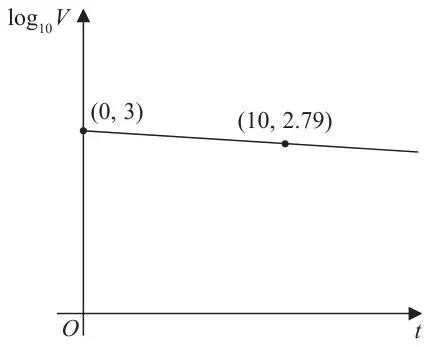
The value, \(V\) pounds, of a mobile phone, \(t\) months after it was bought, is modelled by\[V = ab^t\]where \(a\) and \(b\) are constants.
Figure 2 shows the linear relationship between \(\log_{10} V\) and \(t\).
The line passes through the points \((0,\ 3)\) and \((10,\ 2.79)\) as shown.
Using these points,
Exactly 2 years after it was bought, the value of the phone was £320
| Scheme | Marks | AO |
|---|---|---|
| \(\log_{10} V = 3 \Rightarrow V = 10^3\) | M1 | 1.1b |
| \((V =)\) £1000 | A1 | 3.4 |
| (2) |
Notes
M1: Sets \(\log_{10} V = 3\) and attempts to find a value for a or an expression for V when \(t = 0\). Score for sight of \(10^3\) or implied by the correct answer.
There may be more complicated routes to finding the initial value. e.g. finding a complete equation such as \(\left(\log_{10} V = 3 + \dfrac{2.79 - 3}{10}t \Rightarrow \log_{10} V = 3 \Rightarrow V =\right) 10^3\)
This mark can also be scored for the equation \(V = 10^3 \times 10^{\text{``}{-}0.021\text{''}t}\) or \(V = 1000 \times (\ldots.)^t\) but not \(V = 10^{3 - \text{``}0.021\text{''}t}\) (the \(10^3\) has not been split up from \(10^{\text{``}{-}0.021\text{''}t}\))
A1: £1000 cao (including units) do not accept £\(10^3\)
| Scheme | Marks | AO |
|---|---|---|
| e.g. \(\left(\log_{10} b =\right) \dfrac{2.79 - 3}{10 - 0} = -0.021\) or \(\log_{10} V = 3 - 0.021t\) or \(10^{2.79} = \text{``}1000\text{''}b^{10}\) | M1 | 1.1b |
| e.g. \(b = 10^{-0.021}\ (= 0.952796\ldots.)\) or \(V = 10^3 \times 10^{-0.021t}\) or \(b = \sqrt[10]{\text{``}0.61659\ldots\text{''}}\) | M1 | 3.1b |
| \(V = 1000 \times 0.953^t\) | A1ft | 3.3 |
| (3) |
Notes
(b) Mark (b) and (c) together. Note work seen in (a) must be used in (b) to score
M1: Either
- finds the gradient between the two points. Score for the expression \(\dfrac{2.79 - 3}{10 - 0}\) o.e. e.g. \(-0.021\)
Do not condone sign slips for this mark. May be implied by later work such as sight of \(10^{-0.021}\). - finds the equation for \(\log_{10} V\) in terms of t e.g. \(\log_{10} V = 3 - \text{``}0.021\text{''}t\) which may be unsimplified.
- forms the equation \(10^{2.79}\ (= 616.5\ldots) = \text{``}1000\text{''}b^{10}\) o.e. such as \(2.79 = 3 + 10\log b\)
M1: Attempts to find the value or an expression for b using their gradient or their equation
Score for either:
- the expression \(10^{\text{``}{-}0.021\text{''}}\) o.e such as \(10^{\frac{2.79 - 3}{10 - 0}}\) or may be implied by a correct value using their gradient. You may need to check this on your calculator.
- correctly proceeding from \(\log_{10} V = 3 - \text{``}0.021\text{''}t\) to \(V = 10^{3 - \text{``}0.021\text{''}t}\) and splitting this into \(V = 10^3 \times 10^{-\text{``}0.021\text{''}t}\)
- attempting to equate coefficients:
\(\log_{10} V = \log_{10} a + (\log_{10} b)t \Leftrightarrow \log_{10} V = 3 - \text{``}0.021\text{''}t \Rightarrow \log_{10} b = \text{``}{-}0.021\text{''} \Rightarrow b = 10^{\text{``}{-}0.021\text{''}}\) - using their equation \(10^{2.79} = \text{``}1000\text{''}b^{10}\) or \(2.79 = \text{``}3\text{''} + 10\log b\) and proceeding to
e.g. \(b = \sqrt[10]{\text{``}0.61659\ldots\text{''}}\) or \(b = 10^{\text{``}{-}0.021\text{''}}\)
A1ft: Complete correct equation, follow through on their “1000” so score for \(V = \text{``}1000\text{''} \times (\text{awrt } 0.953)^t\) or accept \(V = \text{``}10^3\text{''} \times (\text{awrt } 0.953)^t\). Just stating the values of a and b is A0ft, but if the equation is written in (c) before substituting in \(t = 24\) then this mark can be awarded.
| Scheme | Marks | AO |
|---|---|---|
| e.g. \(V = 1000 \times \text{``}0.953\text{''}^{24}\) (= £315) or e.g. \(\log_{10} V = 3 - \text{``}0.021\text{''} \times 24 \Rightarrow V = \ldots\) (= £313) | M1 | 3.4 |
| which is close (to £320) so it is a suitable model | A1 | 3.2b |
| (2) | ||
| (7 marks) |
Notes
(c) Mark (b) and (c) together
M1: A full and valid attempt to:
- either substitute \(t = 24\) into their model of the form \(V = ab^t\) where a is positive and finds a value for V
- or substitutes \(t = 24\) into their model of the form \(\log_{10} V = p + qt\) where p is positive and finds a value for V (if they only proceed as far as \(\log_{10} V\) they would also have to find the value of \(\log_{10} 320\))
- or substitutes \(V = 320\) into their \(V = 1000 \times 0.953^t\) o.e. and finds a value for t
(to enable the candidate to compare real life data with that of the model.)
Do not be too concerned with the mechanics of the solution but they must be attempting to find two values which can be compared (e.g. usually 320 and a value for V, but they could proceed to find \(\log_{10} 320\) and compare with \(\log_{10} V = 2.496\) when \(t = 24\), or a value for t to compare with \(t = 24\))
In cases with no working you will need to check the calculation.
A1: Compares their awrt £313-£315 with £320 or their awrt \(t = 23.5 - 23.7\) with \(t = 24\) or \(\log_{10} 320 = 2.505\ldots\) with 2.496 and makes a valid conclusion with a reason.
For this mark you require:
- correct calculations (if using percentage error allow this to be rounded to compare awrt £313-£315 with £320 then it will be in the range (1.4, 2.4). For £314.94 this is = awrt1.6%)
- a reason such as “the values are close”, “the values are similar”, “the values are approximately equal”. Allow use of “\(\approx\)”. Allow the calculation of the % error as reason.
- a statement that it is a “good” or “accurate” model or similar wording.
Note: Condone as a minimum e.g. “£314.94 and £320 so good model” (we accept the two values being stated here as a comparison that they are similar)
Do not allow incorrect statements such as the model is incorrect as it does not give £320.
Do not allow just “the model gives an underestimate of the true value” (does not comment sufficiently on whether the model is reliable)
Do not allow comments suggesting that the model is not reliable.
Note using the full value for b leads to 313.3285724…