
June 2023 Paper 1 Q8
8.
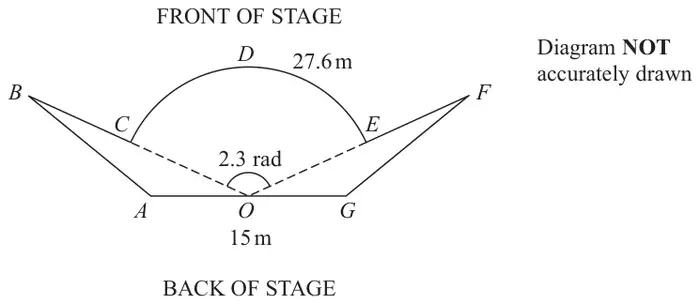
Figure 1 shows the plan view of a stage.
The plan view shows two congruent triangles \(ABO\) and \(GFO\) joined to a sector \(OCDEO\) of a circle, centre \(O\), where
- angle \(COE = 2.3\) radians
- arc length \(CDE = 27.6\text{ m}\)
- \(AOG\) is a straight line of length \(15\text{ m}\)
Given that the total length of the front of the stage, \(BCDEF\), is \(35\text{ m}\),
| Scheme | Marks | AO |
|---|---|---|
| \(OC \times 2.3 = 27.6\) | M1 | 1.1b |
| e.g. \(OC = \dfrac{27.6}{2.3} = 12\text{ m}\) * | A1* | 2.1 |
| (2) |
Notes
M1: Uses \(l = r\theta\) with \(l = 27.6\) and \(\theta = 2.3\) correctly substituted in (may be labelled differently in their equation). Values just need to be embedded in an equation or accept an expression for OC e.g. \(\dfrac{27.6}{2.3}\).
May work in degrees which is acceptable.
Condone an alternative letter being used to denote OC such as r
Alternatively, they use \(l = r\theta\) with \(r = 12\) and \(\theta = 2.3\) and verify that \(l = 27.6\text{ m}\)
A1*: Achieves an expression for OC before proceeding to \(OC = 12\) (m) with no errors seen (condone lack of units)
They must show at least \(\dfrac{27.6}{2.3} \Rightarrow OC = 12\) (m) which can score M1A1*
\(r = \dfrac{27.6}{2.3} = 12\) is M1A1* (condone alternative letters for OC)
BUT e.g. \(\dfrac{27.6}{2.3} = 12\text{(m)}\) on its own is M1A0*
e.g. \(OC \times 2.3 = 27.6 \Rightarrow OC = 12\text{(m)}\) is M1A0*
In the alternative method they verify \(l = 27.6\) and conclude that \(OC = 12\text{ m}\)
We must see the calculation \(12 \times 2.3 = 27.6\) and conclude that \(OC = 12\text{(m)}\)
e.g. \(\text{arc} = 12 \times 2.3 = 27.6\) so \(OC = 12\text{(m)}\) is M1A1* whereas \(12 \times 2.3 = 27.6\) is M1A0*
Also allow e.g. if \(OC = 12\text{(m)}\) then \(12 \times 2.3 = 27.6\ \checkmark\) is M1A1*
If they work in degrees and use rounded values this scores A0* (If they work with e.g. \(\dfrac{414}{\pi}\) to keep the angle exact then A1* can still be scored)
| Scheme | Marks | AO |
|---|---|---|
| e.g. \((2AOB =)\ \pi - 2.3\) | M1 | 1.1b |
| \(\dfrac{\pi - 2.3}{2} \Rightarrow 0.421\text{ rad}\) * | A1* | 2.1 |
| (2) |
Notes
M1: Attempts to subtract 2.3 from \(\pi\) (which may be implied by an expression for AOB which is not the given answer)
e.g. \(\dfrac{1}{2}(\pi - 2.3)\) or \(\dfrac{\pi}{2} - 1.15\) score M1
May work in degrees e.g. \(180 - \text{awrt}132\) is M1
Condone invisible brackets e.g. \(\pi - 2.3 \div 2\) can still score M1.
A1*: Achieves 0.421 (rad) with no errors seen (ignore any side working which is not part of their main solution). Look for a correct expression which is awrt 0.421 before proceeding to the answer.
Alternatively, they may write
e.g \(2AOB = \pi - 2.3\ (= 0.8415..) \Rightarrow AOB = 0.421\)
Condone if they do not round their answer at the end to 0.421.
Condone lack of units. Condone poor labelling of other angles and it does not require AOB = to score this mark, but do not accept e.g. ABO =
If they work in degrees then withhold this mark if they do not show the conversion back to radians.
| e.g. | \(\dfrac{\pi - 2.3}{2} = 0.421\text{(rad)}\) is M1A1* |
| e.g. | \(\dfrac{180 - \text{awrt}131.8}{2} \div \dfrac{180}{\pi} = 0.421\) (rad) is M1A1* (conversion from degrees to radians seen) |
| e.g. | \(\pi - 2.3 \div 2 = 0.421\text{(rad)}\) is M1A0* (invisible/lack of brackets) |
| e.g. | \(\pi - 2.3 = \dfrac{0.842\ldots}{2} = 0.421\) M1A0* (incorrect joined statement) |
| Scheme | Marks | AO |
|---|---|---|
| Area \(OCDE = \dfrac{1}{2} \times 12^2 \times 2.3\) | M1 | 1.1b |
| \(= 165.6\ (\text{m}^2)\) (accept awrt 166) | A1 | 1.1b |
| \((OB =)\ \dfrac{35 - 27.6}{2} + 12 = 15.7\text{ m}\) | B1 | 2.1 |
| Area of \(OAB\ (\text{or } OFG) = \dfrac{1}{2} \times \text{``}15.7\text{''} \times 7.5 \times \sin 0.421 \quad \left(= 24.0\ldots\text{m}^2\right)\) | M1 | 1.1b |
| Total area \(= \text{``}165.6\text{''} + 2 \times \text{``}24.1\text{''}\) | dM1 | 3.1a |
| \(= \text{awrt } 214\ (\text{m}^2)\) | A1 | 1.1b |
| (6) | ||
| (10 marks) |
Notes
M1: Attempts to use \(A = \dfrac{1}{2}r^2\theta\) with \(r = 12\) and \(\theta = 2.3\) The values embedded in the formula is sufficient for this mark. May be implied by a correct answer or further work. Look out for alternative more complex ways to find the area of the sector. e.g. area of semicircle – area of two sectors with \(r = 12\) and \(\theta = 0.421\)
A1: awrt 166 (may be implied by later work)
B1: A correct expression or value for the length OB or OF which may be a part of a calculation (may see 15.7 in the equation to find the area of AOB). May be implied by a correct value for the area of a congruent triangle (or both)
M1: Attempts to find the area of at least one of the two congruent triangles using their OB found from \(\dfrac{35 - 27.6}{2} + 12\ (= 15.7)\), \(OA = 7.5\) and \(\theta = 0.421\) in \(\dfrac{1}{2} \times OA \times OB \times \sin C\) (may work in degrees)
Be aware that omitting sine in the formula may give a value close to the area of the triangle which would be M0. Condone use of \(\theta = 0.4\) or \(\theta = 0.42\) if they have rounded angle AOB.
The values embedded in the expression is sufficient to score the mark or may be implied by the value.
Look out for more complex methods to find the area of one or both of the two congruent triangles
e.g. they may split the congruent triangle into two right angled triangles and add the separate areas.
Other alternatives
e.g. finding the area of the trapezium ABFG:
\(BF = 2 \times 15.7\cos 0.421\)
Area of \(AOB = \dfrac{1}{2}\left(\left(\dfrac{15 + 2 \times 15.7\cos 0.421}{2}\right) \times 15.7\sin 0.421 - \dfrac{1}{2} \times 15.7^2 \times \sin 2.3\right)\) o.e.
e.g. finding the length AB and either angle OAB or angle ABO:
\(AB^2 = 15.7^2 + 7.5^2 - 2 \times 15.7 \times 7.5 \times \cos 0.421 \Rightarrow AB = 9.37\ldots\)
\(\dfrac{\sin ABO}{7.5} = \dfrac{\sin 0.421}{9.37\ldots} \Rightarrow ABO = 0.333\ldots\) or \(\dfrac{\sin OAB}{15.7} = \dfrac{\sin 0.421}{9.37\ldots} \Rightarrow OAB = 2.4\)
Area of \(ABO\) \(\dfrac{1}{2} \times 15.7 \times 9.37\ldots \times \sin 0.333\ldots\) or \(\dfrac{1}{2} \times 7.5 \times 9.37\ldots \times \sin 2.4\)
Approximate values are shown below for some of the lengths you may see in calculations:

dM1: Solves the problem by combining appropriate areas together which result in the total area of the concert stage (usually the sum of the areas of the two congruent triangles and the area of the sector).
It is dependent on the previous method marks and the B mark.
A1: awrt 214 (\(\text{m}^2\)) (condone lack of units). Must follow from a correct method. Isw if they round incorrectly.