
October 2021 Paper 3 Q14
14
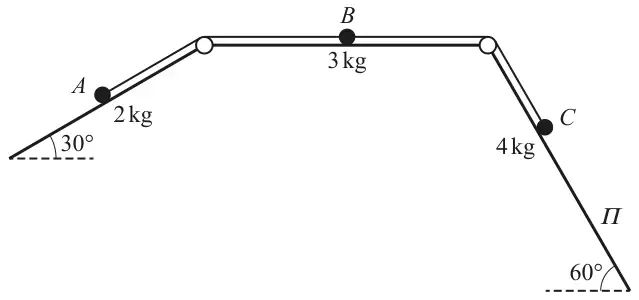
One end of a light inextensible string is attached to a particle \(A\) of mass \(2\,\mathrm{kg}\). The other end of the string is attached to a second particle \(B\) of mass \(3\,\mathrm{kg}\). Particle \(A\) is in contact with a smooth plane inclined at \(30^\circ\) to the horizontal and particle \(B\) is in contact with a rough horizontal plane.
A second light inextensible string is attached to \(B\). The other end of this second string is attached to a third particle \(C\) of mass \(4\,\mathrm{kg}\). Particle \(C\) is in contact with a smooth plane \(\mathit{\Pi}\) inclined at an angle of \(60^\circ\) to the horizontal.
Both strings are taut and pass over small smooth pulleys that are at the tops of the inclined planes. The parts of the strings from \(A\) to the pulley, and from \(C\) to the pulley, are parallel to lines of greatest slope of the corresponding planes (see diagram).
The coefficient of friction between \(B\) and the horizontal plane is \(\mu\). The system is released from rest and in the subsequent motion \(C\) moves down \(\mathit{\Pi}\) with acceleration \(a\,\mathrm{m\,s^{-2}}\).
| Scheme | Marks | AO |
|---|---|---|
| \(T_{AB} - 2g\sin 30 = 2a\) | M1* | 3.3 |
| \(4g\sin 60 - T_{BC} = 4a\) | M1* | 3.3 |
| \(T_{BC} - T_{AB} - F_B = 3a\) | M1* | 3.3 |
| \(4g\sin 60 - 4a - 2g\sin 30 - 2a - F_B = 3a\) | M1dep* | 2.1 |
| \(9a = g(4\sin 60 - 2\sin 30 - 3\mu)\) | A1 | 3.3 |
| \((\mu =)\,\dfrac{1}{3}\left(2\sqrt{3} - 1 - 9\dfrac{a}{g}\right) \gt 0\) | M1 | 3.1b |
| \(a \lt \dfrac{1}{9}g\left(2\sqrt{3} - 1\right)\) | A1 | 2.2a |
| [7] |
Notes
M1*: N2L parallel to plane for \(A\) – correct number of terms, allow cos/sin confusion
Dimensionally consistent equations for M marks
M1*: N2L parallel to plane for \(C\) – correct number of terms, allow cos/sin confusion
M1M0M0 if \(T\) used in both equations
M1*: N2L parallel to plane for \(B\)
M1dep*: Eliminates both tensions
Allow in terms of \(F_B\)
A1: Use of \(F_B = \mu(3g)\) to get a correct equation in \(a\) and \(\mu\)
\(9a = g\left(2\sqrt{3} - 1 - 3\mu\right)\)
M1: Explicitly uses \(\mu \gt 0\) to get a strict inequality in \(a\) and \(g\) only. If \(a = \frac{1}{9}g\left(2\sqrt{3} - 1 - 3\mu\right) \Rightarrow a \lt \frac{1}{9}g\left(2\sqrt{3} - 1\right)\) without justification is M0
Dependent on all previous M marks
A1: AG – must follow from a correct equation involving \(\mu, a\) and \(g\)
SC considering whole system with no friction B2 only for deriving \(9a = g\left(2\sqrt{3} - 1\right)\)
| Scheme | Marks | AO |
|---|---|---|
| \(a = \dfrac{1}{9}g \Rightarrow \mu = \dfrac{2}{3}\left(\sqrt{3} - 1\right)\) | B1 | 1.1 |
| \(F_B = 2\left(\sqrt{3} - 1\right)g\) | B1 | 3.4 |
| \(\sqrt{(3g)^2 + \left(2\left(\sqrt{3} - 1\right)g\right)^2}\) | M1 | 3.1a |
| 32.7 (N) | A1 | 2.2a |
| [4] |
Notes
B1: Correct value of \(\mu\) (oe) using given \(a\) (soi)
\(\mu = 0.488033\ldots\)
B1: Correct value for \(F_B\)
\(F_B = 14.34819\ldots\)
M1: \(\sqrt{(3g)^2 + F_B^{\,2}}\) allow any value for \(F_B\) or even just the expression \(F_B\)
A1: (For reference: 32.71438099…)