
June 2022 Paper 3 Q6
6 In this question you must show detailed reasoning.
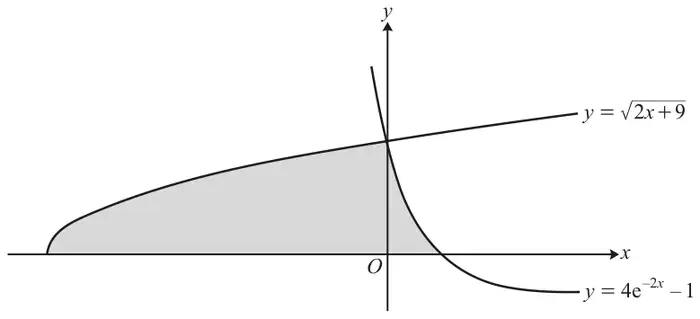
The diagram shows the curves \(y = \sqrt{2x + 9}\) and \(y = 4\mathrm{e}^{-2x} - 1\) which intersect on the \(y\)-axis. The shaded region is bounded by the curves and the \(x\)-axis.
Determine the area of the shaded region, giving your answer in the form \(p + q\ln 2\) where \(p\) and \(q\) are constants to be determined. [8]
| Scheme | Marks | AO |
|---|---|---|
| DR \(\displaystyle\int (2x + 9)^{\frac{1}{2}}\,\mathrm{d}x = \frac{1}{3}(2x + 9)^{\frac{3}{2}}\) | M1 A1 | 2.1 1.1 |
| \(\left[\dfrac{(2x + 9)^{\frac{3}{2}}}{3}\right]_{-\frac{9}{2}}^{0} = 9\) | A1 | 1.1 |
| \(4\mathrm{e}^{-2x} - 1 = 0 \Rightarrow \mathrm{e}^{-2x} = \dfrac{1}{4}\) \(-2x = \ln\left(\dfrac{1}{4}\right)\) | M1* | 3.1a |
| \(x = -\dfrac{1}{2}\ln\left(\dfrac{1}{4}\right)\) | A1 | 1.1 |
| \(\displaystyle\int \left(4\mathrm{e}^{-2x} - 1\right)\mathrm{d}x = -2\mathrm{e}^{-2x} - x\) | M1* | 1.1 |
| \(\displaystyle\int_0^{\frac{1}{2}\ln 4} \left(4\mathrm{e}^{-2x} - 1\right)\mathrm{d}x = \left(-2\mathrm{e}^{-\ln 4} - \frac{1}{2}\ln 4\right) - (-2)\) | M1dep* | 1.1 |
| Area \(= 9 + \dfrac{3}{2} - \dfrac{1}{2}\ln 4 = \dfrac{21}{2} - \dfrac{1}{2}\ln 4 = \dfrac{21}{2} - \ln 2\) | A1 | 2.2a |
| [8] |
Notes
M1: M1 for \(k(2x + 9)^{\frac{3}{2}}\) with non-zero \(k\), \(k \ne 1\)
A1: cao (allow unsimplified)
A1: Uses correct limits (or implies correct limits) to get 9. Condone limits the wrong way round leading to \(-9\) but must be changed to \(+9\)
M1*: Attempt to solve \(4\mathrm{e}^{-2x} - 1 = 0\) by correctly taking logs of both sides leading to \(\pm 2x = \pm\ln\alpha\) where \(\alpha \gt 0\)
Allow sign errors and other minor slips only
A1: Or equivalent exact value (soi possibly by correct exact value used later) e.g. \(\frac{1}{2}\ln 4\) or \(\ln 2\)
M1*: Integrate \(4\mathrm{e}^{-2x} - 1\) to obtain \(c\mathrm{e}^{-2x} \pm x\)
Where \(c\) is non-zero and \(c \ne 4\)
M1dep*: Uses limits correctly \(F\left(\frac{1}{2}\ln 4\right) - F(0)\) (with their \(\frac{1}{2}\ln 4\)) – dependent on the previous two M marks (allow non-exact top limit). Condone limits the wrong way round only if the sign of their answer is subsequently changed
If zero limit is assumed to give 0 (with no working) then M0
A1: If the values of the integral(s) are changed from negative to positive (e.g. from limits the wrong way round) with no justification given then A0
\(p\) and \(q\) need not be explicitly stated. \(p = \dfrac{21}{2}\) (oe) and \(q = -1\)