The questions in this section refer to the article on the Insert. You should read the article before attempting the questions.
The relevant parts of the article “Which is bigger?” are reproduced below; the line numbers are those printed on the Insert.
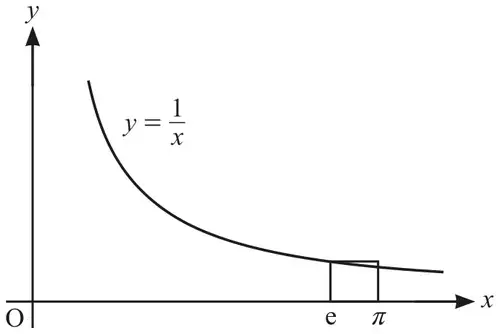
Lines 31–34 An indirect method, using calculus, enables us to prove that \(\mathrm{e}^{\pi}\) is larger than \(\pi^{\mathrm{e}}\). Fig. C2 shows the curve \(y = \dfrac{1}{x}\) in the first quadrant together with the rectangle with vertices at the points \((\mathrm{e}, 0)\), \(\left(\mathrm{e}, \dfrac{1}{\mathrm{e}}\right)\), \(\left(\pi, \dfrac{1}{\mathrm{e}}\right)\) and \((\pi, 0)\). We use the fact that the area under the curve between e and \(\pi\) is less than the area of this rectangle.
Fig. C2
Line 35 The area of the rectangle is \(\dfrac{1}{\mathrm{e}}(\pi - \mathrm{e})\)
Line 36 \(\displaystyle\int_{\mathrm{e}}^{\pi} \frac{1}{x}\,\mathrm{d}x < \frac{1}{\mathrm{e}}(\pi - \mathrm{e})\)
Line 37 \(\ln\pi - 1 < \dfrac{\pi}{\mathrm{e}} - 1\)
Line 38 \(\ln\pi < \dfrac{\pi}{\mathrm{e}}\)
In this question you must show detailed reasoning.
Show that \(\displaystyle\int_{\mathrm{e}}^{\pi} \frac{1}{x}\,\mathrm{d}x = \ln\pi - 1\) as given in line 37. [2]
Mark scheme
Scheme
Marks
AO
DR \(\displaystyle\int_{\mathrm{e}}^{\pi} \frac{1}{x}\,\mathrm{d}x = [\ln x]_{\mathrm{e}}^{\pi}\)
M1
1.1a
\(\ln\pi - \ln\mathrm{e} = \ln\pi - 1\)
A1
2.2a
[2]
Notes
M1: May have \(\ln|x|\) Don’t allow if ‘+ c’ or if no [ ] or limits but condone no dx
A1: Convincing completion inc at least 1 intermediate line of working (AG)