
October 2020 Paper 1 Q5
5 A child is running up and down a path. A simplified model of the child’s motion is as follows:
- he first runs north for 5 s at \(4\,\mathrm{m\,s^{-1}}\);
- he then suddenly stops and waits for 8 s;
- finally he runs in the opposite direction for 7 s at \(3.5\,\mathrm{m\,s^{-1}}\).
(a) Taking north to be the positive direction, sketch a velocity-time graph for this model of the child’s motion. [2]
Using this model,
(b) calculate the total distance travelled by the child, [2]
(c) find his final displacement from his original position. [1]
| Scheme | Marks | AO |
|---|---|---|
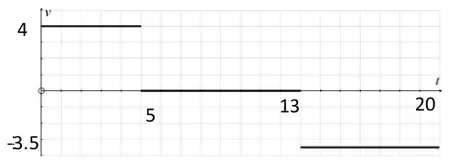 | B1 B1 | 1.1 1.1 |
| [2] |
Notes
B1: Graph from 3 horizontal line segments. Correct velocities labelled
Any lines joining the horizontal lines should be vertical
B1: Times seen – either \(t\) = 5, 13, 20 or lengths of line segments 5, 8, 7 seen.
| Scheme | Marks | AO |
|---|---|---|
| Distance \(= (4 \times 5) + (7 \times 3.5)\) m | M1 | 1.1a |
| \(= 44.5\) | A1 | 1.1 |
| [2] |
Notes
M1: finding the area of at least one region from their graph oe
May work directly from the information in the question without reference to their graph
A1: cao
| Scheme | Marks | AO |
|---|---|---|
| Displacement \(= 20 - 24.5 = -4.5\) m | B1 | 1.1 |
| [1] |
Notes
B1: Allow for –4.5 m or for 4.5 m south
Do not allow -4.5 m south