(i) Given that\[y = 2^x\]write down \(\dfrac{\mathrm{d}y}{\mathrm{d}x}\) [1 mark]
(ii) Hence find\[\int 2^x\,\mathrm{d}x\] [2 marks]
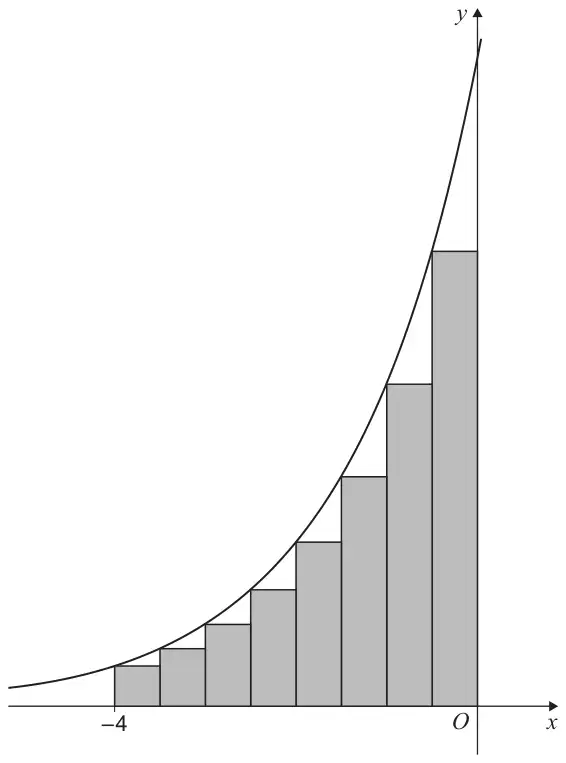
(b) The area, \(A\), bounded by the curve with equation \(y = 2^x\), the \(x\)-axis, the \(y\)-axis and the line \(x = -4\) is approximated using eight rectangles of equal width as shown in the diagram below.
(i) Show that the exact area of the largest rectangle is \(\dfrac{\sqrt{2}}{4}\) [2 marks]
(ii) The areas of these rectangles form a geometric sequence with common ratio \(\dfrac{\sqrt{2}}{2}\)
Find the exact value of the total area of the eight rectangles.
Give your answer in the form \(k\left(1 + \sqrt{2}\right)\) where \(k\) is a rational number. [3 marks]
(iii) More accurate approximations for \(A\) can be found by increasing the number, \(n\), of rectangles used.
Find the exact value of the limit of the approximations for \(A\) as \(n \to \infty\) [3 marks]
Mark scheme (a)
Scheme
Marks
AO
(i) Obtains \(2^x\ln 2\) Or \(\ln 2\,\mathrm{e}^{x\ln 2}\)
B1
1.2
(1)
(ii) Integrates to obtain \(k2^x,\ k \neq 1 \text{ or } 0\) OE
M1
1.1a
Deduces \(\displaystyle\int 2^x\,\mathrm{d}x = \frac{2^x}{\ln 2} + c\) OE Must include +c
R1
2.2a
(2)
Typical solution
(i)
\[\frac{\mathrm{d}y}{\mathrm{d}x} = 2^x\ln 2\]
(ii)
\[\int 2^x\,\mathrm{d}x = \frac{2^x}{\ln 2} + c\]
Mark scheme (b)
Scheme
Marks
AO
(i) Obtains \(2^{-\frac{1}{2}}\) Exact value ACF
M1
1.1a
Writes the product \(0.5 \times 2^{-\frac{1}{2}}\) in exact form ACF to obtain given answer. Condone \(-0.5 \times 2^{-\frac{1}{2}}\) if reason given for rejecting the negative sign
R1
2.1
(2)
(ii) Uses \(S_n = \dfrac{a\left(1 - r^n\right)}{1 - r}\) With at least two of \(a = \dfrac{\sqrt{2}}{4}\), \(r = \dfrac{\sqrt{2}}{2}\) and \(n\) = 8 correct Or with at least two of \(a = \dfrac{1}{32}\), \(r = \sqrt{2}\) and \(n\) = 8 correct
Or Forms the sum of 8 rectangles using \(\dfrac{1}{2}\left(\begin{array}{l} \dfrac{1}{\sqrt{2}} + \dfrac{1}{2} + \dfrac{1}{2\sqrt{2}} + \dfrac{1}{4} + \\[8pt] \dfrac{1}{4\sqrt{2}} + \dfrac{1}{8} + \dfrac{1}{8\sqrt{2}} + \dfrac{1}{16} \end{array}\right)\) OE with at least 4 correct terms
M1
1.1a
Obtains a correct expression can be left unsimplified.
A1
1.1b
Obtains \(\dfrac{15\left(1 + \sqrt{2}\right)}{32}\) or \(\dfrac{15}{32}\left(1 + \sqrt{2}\right)\) Do not award value of \(k\) is just stated without either of these answers.
R1
2.1
(3)
(iii) Forms the definite integral \(\displaystyle\int_{-4}^{0} 2^x\,\mathrm{d}x\) PI by \(\dfrac{1}{\ln 2}\left[2^x\right]_{-4}^{0}\) Condone swapped limits and missing d\(x\) PI by AWRT \(\pm\)1.35
M1
3.1a
Substitutes 0 and -4 correctly into the correct integrated expression Or Obtains AWRT 1.35