
June 2023 Paper 2 Q4
4 The diagram shows part of the graph of \(y = x^2\). The normal to the curve at the point \(A\)(1, 1) meets the curve again at \(B\). Angle \(AOB\) is denoted by \(\alpha\).
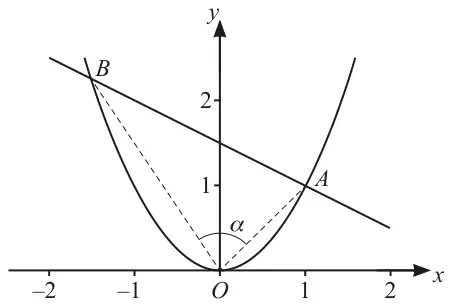
| Scheme | Marks | AO |
|---|---|---|
| \(\dfrac{\mathrm{d}y}{\mathrm{d}x} = 2x\). | M1 | 3.1a |
| Gradient of tangent at (1, 1) is 2 Gradient of normal at (1, 1) \(= -\frac{1}{2}\) | A1 | 1.1 |
| Equation of normal is \(y - 1 = -\frac{1}{2}(x - 1)\) | M1* | 1.1 |
| At \(B\): \(x^2 = -\frac{1}{2}x + \frac{3}{2}\) | M1dep* | 3.1a |
| \(2x^2 + x - 3 = 0\) | A1 | 1.1 |
| \(B\) is \(\left(-\frac{3}{2}, \frac{9}{4}\right)\) | A1 | 1.1 |
| [6] |
Notes
A1: For correct gradient of either tangent or normal
M1*: Using their gradient of normal and (1,1) to form an equation or \(y = -\frac{1}{2}x + \frac{3}{2}\) (must find a value for c for this mark to be awarded) FT their gradient of normal (not = 2)
M1dep*: Substituting \(y = x^2\) and attempting to solve (may see quadratic in \(x\) or \(y\))
A1: Correct quadratic in \(x\) or \(y\), in any form or \(4y^2 - 13y + 9 = 0\)
A1: Allow (−1.5, 2.25). Accept \(x = \ldots\), \(y = \ldots\) but must see both.
| Scheme | Marks | AO |
|---|---|---|
| \(AB^2 = \left(1 - \left(-\frac{3}{2}\right)\right)^2 + \left(1 - \frac{9}{4}\right)^2\quad \left(= \frac{125}{16}\right)\) \(OB^2 = \left(\frac{3}{2}\right)^2 + \left(\frac{9}{4}\right)^2\quad \left(= \frac{117}{16}\right)\) \(OA^2 = 2\) | M1 | 2.1 |
| \(\cos\alpha = \dfrac{\frac{117}{16} + 2 - \frac{125}{16}}{2 \times \sqrt{\frac{117}{16}} \times \sqrt{2}}\) | M1dep | 1.1 |
| \(\cos\alpha = \dfrac{1}{\sqrt{26}}\) OR \(\tan\alpha = \dfrac{\sqrt{26 - 1}}{1}\) \(\tan\alpha = 5\) | A1 | 1.1 |
| [3] |
Notes
or \(AB = \dfrac{5\sqrt{5}}{4}\), or \(OB = \dfrac{3\sqrt{13}}{4}\), or \(OA = \sqrt{2}\)
M1: Attempt to find all three, squared or not (may see on diagram)
M1dep: Correct use of cos rule in any form, FT their \(AB\), \(OB\) & \(OA\)
A1: Must be exact and come from exact working for \(\cos\alpha\). Must see an exact intermediate step – either \(\frac{1}{\sqrt{26}}\) or \(\frac{\sqrt{26 - 1}}{1}\).
Decimals used throughout can achieve max [2/3] M1M1A0
Do not penalise candidates who write down \(\alpha = 78.69\ldots^\circ\) but the final answer must come from exact working (not BC).
Alternative method (1)
| Scheme | Marks |
|---|---|
| \(\tan\beta = \dfrac{9}{4} \div \dfrac{3}{2} = \dfrac{3}{2},\ \tan\gamma = 1\) | M1 |
| \(\tan\alpha = -\tan(\beta + \gamma) = -\dfrac{\frac{3}{2} + 1}{1 - \frac{3}{2} \times 1}\) | M1dep |
| \(= 5\) | A1 |
M1: Attempt to find \(\tan\beta\) & \(\tan\gamma\)
\(\beta\) and \(\gamma\) are the angles made by OB and OA respectively with the horizontal
(Alternatively with angles to the vertical, \(\tan\beta = \frac{2}{3}\))
M1dep: Correct use of \(\tan(180 - \theta) = -\tan\theta\) and \(\tan(A + B)\) formula using their \(\tan\beta\) & \(\tan\gamma\) (or, with angles to the vertical, \(\tan\alpha = \dfrac{1 + \frac{2}{3}}{1 - \frac{2}{3} \times 1}\))
A1: Must be exact and come from exact working.
Do not penalise candidates who write down \(\alpha = 78.69\ldots^\circ\) but the final answer must come from exact working (not BC).
Alternative method (2)
| Scheme | Marks |
|---|---|
| \(\tan BOx = \frac{9}{4} \div \left(-\frac{3}{2}\right) = -\frac{3}{2},\ \tan AOx = 1\) \(\tan(BOx - AOx)\) | M1 |
| \(= \dfrac{-\frac{3}{2} - 1}{1 + \left(-\frac{3}{2}\right) \times 1}\) | M1dep |
| \(= 5\) | A1 |
M1: Attempt find \(\tan BOx\) & \(\tan AOx\) and use \(\tan(\theta - \varphi)\) formula
M1dep: Correct use of \(\tan(\theta - \varphi)\) using their \(\tan BOx\) & \(\tan AOx\)
A1: Must be exact and come from exact working.
Alternative method (3)
| Scheme | Marks |
|---|---|
| \(\overrightarrow{OB} \cdot \overrightarrow{OA} = -\dfrac{3}{2} + \dfrac{9}{4} = \sqrt{2} \times \frac{3\sqrt{13}}{4}\cos\alpha\) | M1 |
| \(\cos\alpha = \dfrac{\frac{3}{4}}{\sqrt{2 \times \frac{117}{16}}}\) | M1dep |
| \(\cos\alpha = \dfrac{1}{\sqrt{26}}\) OR \(\tan\alpha = \dfrac{\sqrt{26 - 1}}{1}\) \(\tan\alpha = 5\) | A1 |
M1: Attempt \(\overrightarrow{OB} \cdot \overrightarrow{OA}\)
M1dep: Correct dot product with exact values
A1: Must be exact and come from exact working for \(\cos\alpha\). Must see an exact intermediate step – either \(\frac{1}{\sqrt{26}}\) or \(\frac{\sqrt{26 - 1}}{1}\).