
June 2025 Paper 3 Q3
3
Hence find all the possible integer values \(N\) that satisfy the inequality
\(\left|2\mathrm{e}^{0.1N} - 5\right| \lt 1\). [3]
| Scheme | Marks | AO |
|---|---|---|
 | M1 A1 | 1.1 1.1 |
| [2] |
Notes
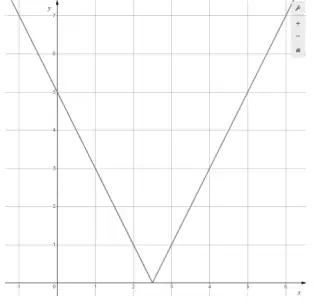
M1: V-shape with the cusp on the positive \(x\)-axis – need not be symmetrical – this mark can be awarded if V-shape appears in the first quadrant only (so stops at \(y\)-axis)
M0 if V-shape appears in third or fourth quadrants but condone if RH branch appears in third and fourth quadrants (BOD that this is a continuation of the line with equation \(y = 2x - 5\))
A1: Fully correct (so appearing in first and second quadrants) with \(x\)-intercept labelled as \(\frac{5}{2}\) and \(y\)-intercept labelled as 5 – need not be symmetrical– condone if appearing in third and fourth quadrants only as a dashed line. Ignore horizontal line if drawn at \(y = 1\) (assume working for part (b))
Condone \((5, 0)\) labelled on the \(y\)-axis, and \(\left(0, \frac{5}{2}\right)\) labelled on the \(x\)-axis
| Scheme | Marks | AO |
|---|---|---|
| \(|2x - 5| \lt 1 \Rightarrow -1 \lt 2x - 5 \lt 1\) \(4 \lt 2x \lt 6\) | M1 | 1.1 |
| \(2 \lt x \lt 3\) | A1 | 1.1 |
| [2] |
Notes
M1: Re-write as \(-1 \lt 2x - 5 \lt 1\) followed by \(a \lt 2x \lt b\) with either \(a\) or \(b\) correct or \(c \lt x - \frac{5}{2} \lt d\) with either \(c\) or \(d\) correct or for either \(x \gt 2\) or \(x \lt 3\) (so dealing with one inequality correctly) or for both critical values (so 2 and 3 www)
\(a = 4\), \(b = 6\)
\(c = -\frac{1}{2}\), \(d = \frac{1}{2}\)
M1 for \(|2x - 5| \lt 1 \Rightarrow (2x - 4)(2x - 6) \lt 0\)
A1: cao – allow as two separate inequalities and allow e.g. ‘\(x \gt 2\) or \(x \lt 3\)’. ‘\(x \gt 2\), \(x \lt 3\)’, ‘\(x \gt 2\) and \(x \lt 3\)’ etc.
Ignore incorrect set notation provided the intention of the correct inequalities is clear
| Scheme | Marks | AO |
|---|---|---|
| DR | ||
| \(2 \lt \mathrm{e}^{0.1N} \lt 3\) | M1* | 3.1a |
| \(10\ln 2 \lt N \lt 10\ln 3\) | M1dep* | 1.1 |
| \(6.9(314\ldots) \lt N \lt 10.9(861\ldots)\) so \(N = 7, 8, 9\) and \(10\) | A1 | 3.2a |
| [3] |
Notes
M1*: Use their answer to part (b) to re-write in terms of \(\mathrm{e}^{0.1N}\). Must imply either \(\mathrm{e}^{0.1N} \gt k_1\) and \(\mathrm{e}^{0.1N} \lt k_2\) where \(k_1 \lt k_2\) with both positive or \(\mathrm{e}^{0.1N} = k_1\) and \(\mathrm{e}^{0.1N} = k_2\) where \(k_1 \neq k_2\) with both positive
Allow \(n\), \(x\) etc. for \(N\) throughout
\(k_1\) and \(k_2\) are their critical values from part (b)
M0 for \(\mathrm{e}^{0.1N} \gt k_2\) and \(\mathrm{e}^{0.1N} \lt k_1\) where \(k_1 \lt k_2\)
M1dep*: Correctly take logs of both sides and make \(N\) the subject of both inequalities/equations e.g. \(\dfrac{\ln 2}{0.1} \lt N \lt \dfrac{\ln 3}{0.1}\), \(10 \times 0.693.. \lt N \lt 10 \times 1.098\ldots\) (at least to 1 dp), \(N = 10\ln 2\) and \(N = 10\ln 3\)
Must be correct inequalities/equations for \(N\) following through their values of \(k_1\) and \(k_2\)
If M0 M0 then SC B1 for 6.93… and 10.98… or \(10\ln 2\) and \(10\ln 3\)
A1: cao www – must see at least \(6.9\ldots \lt N \lt 10.9\ldots\) followed by all four integer values (and no others) stated explicitly or correct four integer values stated from correct critical values of 6.9… and 10.9…
A0 for \(7 \lt N \lt 10\) oe e.g. 7 – 10
See Appendix for those using T and I
Appendix: Trial and Improvement in 3(c)
Trial and Improvement in 3(c) – if only the first M mark awarded by main scheme, then for B2 (so for possibly full marks) allow one of the two following cases (the working below is the minimum required)
Case 1:
\(\mathrm{e}^{0.1N} \lt 3 \Rightarrow N \lt 10.98\ldots\) and \(\mathrm{e}^{0.1N} \gt 2\)
When \(N = 7, \mathrm{e}^{0.1 \times 7} = 2.0137\ldots \gt 2\) and when \(N = 6, \mathrm{e}^{0.1 \times 6} = 1.822 \lt 2\) therefore \(N = 7, 8, 9\) and \(10\)
Case 2:
\(\mathrm{e}^{0.1N} \lt 3, \mathrm{e}^{0.1N} \gt 2 \Rightarrow N \gt 6.93\ldots\)
When \(N = 10, \mathrm{e}^{0.1 \times 10} = 2.7182\ldots \lt 3\) and when \(N = 11, \mathrm{e}^{0.1 \times 11} = 3.0041\ldots \gt 3\) therefore \(N = 7, 8, 9\) and \(10\)