
June 2024 Paper 3 Q2
2 In this question you must show detailed reasoning.
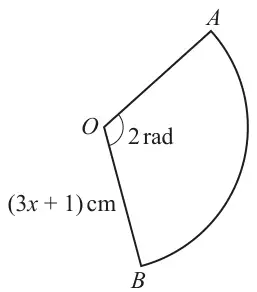
The diagram shows a sector \(AOB\) of a circle with centre \(O\) and radius \((3x+1)\,\mathrm{cm}\). The angle \(AOB\) is 2 radians. The area of sector \(AOB\) is less than \((44x - 7)\,\mathrm{cm}^2\).
Find the set of possible values of \(x\). Give your answer in set notation. [5]
| Scheme | Marks | AO |
|---|---|---|
| DR \(\frac{1}{2}(3x+1)^2(2)\) or \((3x+1)^2\) | B1* | 1.1 |
| \(9x^2 + 6x + 1 \lt 44x - 7 \Rightarrow 9x^2 - 38x + 8\ (\lt 0)\) | B1dep* | 1.1 |
| \(9x^2 - 38x + 8\ (\lt 0) \Rightarrow (9x-2)(x-4)\ (\lt 0)\) | M1dep* | 1.1 |
| c.v. of \(x\) are \(\frac{2}{9}, 4\) | B1 | 1.1 |
| \(\left\{x : \frac{2}{9} \lt x \lt 4\right\}\) | B1FT dep* | 2.5 |
| [5] |
Notes
For reference only: \(\frac{1}{2}(3x+1)^2(2) \lt 44x - 7\)
B1*: Correct use of \(A = \frac{1}{2}r^2\theta\)
B1dep*: Expand and re-arrange to correct 3TQ expression in \(x\)
Allow any inequality sign or equals
M1dep*: SEE APPENDIX for awarding this mark (solving 3TQ expressions) - dependent on first B mark only (this mark is for solving their 3TQ but not for solving \((3x+1)^2 = 0\))
Correct quadratic followed immediately by correct critical values (with no working) is M0
B1: Correct critical values of \(x\) (if factorisation shown then it must imply these two c.v.)
Must be \(\frac{2}{9}\) or \(0.\dot{2}\) but B0 for 0.222…
B1FT dep*: FT their two positive critical values \(x_1, x_2\) e.g. \(\{x : x_1 \lt x \lt x_2\}\) where \(x_2 \gt x_1\); allow \(\left\{x : x \gt \frac{2}{9}\right\} \cap \{x : x \lt 4\}\) but ‘union’ is B0
B0 for interval notation e.g. \(\left(\frac{2}{9}, 4\right)\)
Answer must be in set notation for this mark – dependent on first B mark only
Appendix: rules for solving quadratics in questions 2 and 4(b)(i) only
In questions 2 and 4(b)(i) candidates are required to solve 3 term quadratics (3TQ) using DR – therefore we must see a correct, complete method for solving these quadratics – the correct answers do not imply the corresponding M mark, for example in question 2, \(9x^2 - 38x + 8 = 0 \Rightarrow x = 4\) or \(x = \frac{2}{9}\) is M0
Rules for factorising:
\(at^2 + bt + c \Rightarrow (mt + n)(pt + q)\) where \(a = mp\) and one of \(mq + np = b\) or \(c = nq\) (so when expanding their factorised expression it must give the correct quadratic term and one other term correct of the preceding 3TQ expression/equation)
e.g. in question 2 (and similarly for question 4(b)(i)):
\(9x^2 - 38x + 8 = \left(x - \frac{2}{9}\right)(x - 4)\) is M0 (but the following B1 for the correct c.v. of \(\frac{2}{9}\) and 4 in qu. 2 can still be awarded as they follow from these two factors)
\(9x^2 - 38x + 8 = (3x + 8)(3x + 1)\) is M1 (when expanded the \(x^2\) and constant terms are correct)
Allow correct part factorisation for their 3TQ expression e.g. if correct 3TQ then in question 2 the expression \(9x(x - 4) - 2(x - 4)\) scores M1
Rules for the formula:
Must apply the correct formula for their three-term quadratic (no errors even if correct formula is stated) – note that stating the formula (in terms of \(a\), \(b\) and \(c\)) followed immediately by the corresponding roots is M0 – we must see the formula being applied e.g. \(9x^2 - 38x + 8 = 0 \Rightarrow x = \dfrac{38 \pm \sqrt{38^2 - 4(9)(8)}}{2(9)}\).
Minimal acceptable working would be \(x = \dfrac{38 \pm \sqrt{1156}}{18}\) (so must explicitly see the discriminant) for M1
Rules for completing the square – using \(9x^2 - 38x + 8 = 0\) as an example:
The M1 is not awarded until correctly getting to the stage of \(x - \frac{19}{9} = \pm\sqrt{\frac{289}{81}}\) (must include \(\pm\) so implying two roots) with no errors (so consistent with applying the formula correctly)