
June 2024 Paper 1 Q12
12 In this question you must show detailed reasoning.
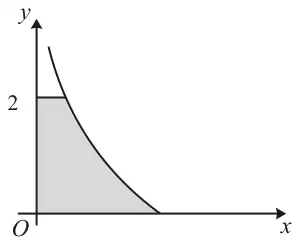
The diagram shows the curve with parametric equations \(x = \dfrac{2}{(2t + 1)^4}\), \(y = 2t^2 + 3t\) for \(t \geqslant 0\).
The shaded region is enclosed by the curve, the \(x\)-axis, the \(y\)-axis and the line \(y = 2\).
| Scheme | Marks | AO |
|---|---|---|
| DR area \(= \displaystyle\int x\frac{\mathrm{d}y}{\mathrm{d}t}\,\mathrm{d}t\) \(\dfrac{\mathrm{d}y}{\mathrm{d}t} = 4t + 3\) hence \(\displaystyle\int \frac{2}{(2t + 1)^4}(4t + 3)\,\mathrm{d}t\) | M1 | 1.2 |
| \(\displaystyle\int \frac{8t + 6}{(2t + 1)^4}\,\mathrm{d}t\quad\) A.G. | A1 | 2.1 |
| \(a = 0\), from \(t = 0\) oe | B1 | 2.2a |
| \(2t^2 + 3t = 2\) | M1 | 2.1 |
| \((2t - 1)(t + 2) = 0\) \(t = \tfrac{1}{2}\quad t = -2\) but \(t \gt 0\), so \(b = \tfrac{1}{2}\) | A1 | 2.1 |
| [5] |
Notes
M1: Attempt \(\displaystyle\int x\frac{\mathrm{d}y}{\mathrm{d}t}\,\mathrm{d}t\) in terms of \(t\), detail required
Clear indication that integrand is given by \(\displaystyle\int x\frac{\mathrm{d}y}{\mathrm{d}t}\,\mathrm{d}t\) (condone just \(\displaystyle\int x\frac{\mathrm{d}y}{\mathrm{d}t}\)), along with \(\dfrac{\mathrm{d}y}{\mathrm{d}t} = 4t + 3\) and full substitution into integrand
Condone no d\(t\) in integrand in initial statement and/or when substituting
May instead see integrand as \(\displaystyle\int x\,\mathrm{d}y\) with \(\mathrm{d}y = (4t + 3)\,\mathrm{d}t\)
A1: Obtain correct given integrand
d\(t\) required throughout
B1: Determine correct lower limit from solving equation
Evidence for \(a = 0\) required eg \(2t^2 + 3t = 0\)
\(a = 0\) doesn’t need to be seen explicitly, and could be implied by 0 appearing as the lower limit on an integral sign once sufficient evidence seen
Mark independently of any integrand attempted
M1: Equate expression for \(y\) to 2
Could be implied by \(t = \tfrac{1}{2}\) seen as a limit
A1: Obtain \(b = \tfrac{1}{2}\) as upper limit www
No need for \(t = -2\) to be explicitly rejected
\(b = \tfrac{1}{2}\) doesn’t need to be seen, and may be implied by appearing as the upper limit on an integral sign
Mark independently of any integrand attempted
| Scheme | Marks | AO |
|---|---|---|
| DR \(u = 2t + 1,\ \mathrm{d}u = 2\,\mathrm{d}t,\ 8t + 6 = 4u + 2\) | M1* | 3.1a |
| \(\displaystyle\int \frac{4t + 3}{(2t + 1)^4}\,2\,\mathrm{d}t = \int \frac{2u + 1}{u^4}\,\mathrm{d}u\) | A1 | 1.1 |
| \(\displaystyle\int \frac{2}{u^3} + \frac{1}{u^4}\,\mathrm{d}u = -\frac{1}{u^2} - \frac{1}{3u^3}\) | M1* | 3.1a |
| Obtain fully correct integral | A1 | 1.1 |
| \(\left[-\dfrac{1}{u^2} - \dfrac{1}{3u^3}\right]_1^2 = \left(-\dfrac{1}{4} - \dfrac{1}{24}\right) - \left(-1 - \dfrac{1}{3}\right)\) | M1d* | 3.1a |
| \(= \dfrac{25}{24}\) | A1 | 1.1 |
| [6] |
Notes
M1*: Use \(u = 2t + 1\) to attempt to change entire integrand to a function of \(u\)
Attempt to write numerator, denominator and d\(t\) in terms of \(u\)
A1: Obtain correct integrand
Condone no d\(u\)
M1*: Attempt integration to obtain integral of form \(au^{-2} + bu^{-3}\)
M0 if additional terms
M1d*: Attempt use of correct limits: either correct \(t\) limits (ie \(a = 0\) and \(b = \tfrac{1}{2}\)) in a \(t\)-integral or commensurate upper and lower limits in an integral involving a substitution (eg with \(u = 2t + 1\), then upper limit must be 2 and lower limit must be 1)
Dependent on M1 M1
Minimum evidence needed is two terms ie \(\left(-\dfrac{7}{24}\right) - \left(-\dfrac{4}{3}\right)\) or \(\left(\dfrac{3}{4}\right) + \left(\dfrac{7}{24}\right)\)
If these values are not seen then M1 can be awarded for term by term substitution seen (ie 4 terms needed), but allow one error
A1: Obtain correct area, any exact equivalent
Explicit use of limits must be seen in a correct integral for A1
Candidates may mix and match methods eg start with substitution and then try to do the actual integration by parts – the MS allows M1A1 for changing the integrand to useable form; M1A1 for doing the integration; M1A1 for use of limits
Alternative method (integration by parts)
| Scheme | Marks |
|---|---|
| \(u = 8t + 6,\ u' = 8\) \(v' = (2t + 1)^{-4},\ v = -\tfrac{1}{6}(2t + 1)^{-3}\) \(\mathrm{I} = -\tfrac{1}{6}(8t + 6)(2t + 1)^{-3} - \displaystyle\int -\tfrac{8}{6}(2t + 1)^{-3}\,\mathrm{d}t\) | M1* |
| Obtain correct first step | A1 |
| \(\mathrm{I} = (8t + 6) \times -\tfrac{1}{6}(2t + 1)^{-3} + \tfrac{8}{6} \times -\tfrac{1}{4}(2t + 1)^{-2}\) | M1* |
| Obtain fully correct integral | A1 |
| \(\left(-\tfrac{5}{24} - (-1)\right) + \left(-\tfrac{1}{12} - \left(-\tfrac{1}{3}\right)\right)\) \(= \left(\tfrac{19}{24}\right) + \left(\tfrac{1}{4}\right)\) | M1d* |
| \(= \dfrac{25}{24}\) | A1 |
M1*: Attempt integration by parts
Correct parts and correct formula
A1: Obtain correct first step
Allow unsimplified
M1*: Attempt integration to obtain integral of form \(a(8t + 6)(2t + 1)^{-3} + b(2t + 1)^{-2}\)
A1: Obtain fully correct integral
Allow unsimplified
M1d*: Attempt use of correct limits
See guidance in main MS
A1: Obtain correct area, any exact equivalent
Alternative method (separate fractions)
| Scheme | Marks |
|---|---|
| \(\dfrac{4(2t + 1) + 2}{(2t + 1)^4} = \dfrac{4}{(2t + 1)^3} + \dfrac{2}{(2t + 1)^4}\) \(\displaystyle\int \frac{8t + 6}{(2t + 1)^4}\,\mathrm{d}t = \int \frac{4}{(2t + 1)^3} + \frac{2}{(2t + 1)^4}\,\mathrm{d}t\) | M1* |
| Obtain correct integrand | A1 |
| \(\displaystyle\int \frac{8t + 6}{(2t + 1)^4}\,\mathrm{d}t = -\frac{1}{(2t + 1)^2} - \frac{1}{3(2t + 1)^3}\) | M1* |
| Obtain fully correct integral | A1 |
| \(\left(-\dfrac{1}{4} - \dfrac{1}{24}\right) - \left(-1 - \dfrac{1}{3}\right)\) | M1d* |
| \(= \dfrac{25}{24}\) | A1 |
M1*: Attempt to rewrite integrand as separate fractions with constant numerators
Could be informal method, or use of partial fractions (extending expected knowledge)
As far as \(\dfrac{P}{(2t + 1)^3} + \dfrac{Q}{(2t + 1)^4}\), with \(P\) and \(Q\) as constants, and no other fractions
A1: Obtain correct integrand
M1*: Attempt integration to obtain integral of form \(\dfrac{a}{(2t + 1)^2} + \dfrac{b}{(2t + 1)^3}\)
A1: Obtain fully correct integral
Allow unsimplified
M1d*: Attempt use of correct limits
See guidance in main MS
A1: Obtain correct area, any exact equivalent
Alternative method (integrating between curve and \(x\)-axis)
| Scheme | Marks |
|---|---|
| \(\displaystyle\int y\frac{\mathrm{d}x}{\mathrm{d}t}\,\mathrm{d}t = \int -\frac{16(2t^2 + 3t)}{(2t + 1)^5}\,\mathrm{d}t\) | M1* |
| \(\displaystyle\int \frac{(u + 2)(4 - 4u)}{u^5}\,\mathrm{d}u\) or \(2(2t^2 + 3t)(2t + 1)^{-4}\) \(\displaystyle -\int 2(4t + 3)(2t + 1)^{-4}\,\mathrm{d}t\) | A1 |
| Attempt integration to obtain integral of required form | M1* |
| \(\dfrac{2}{u^2} + \dfrac{4}{3u^3} - \dfrac{2}{u^4}\) or \(2(2t^2 + 3t)(2t + 1)^{-4} + \dfrac{1}{3}(4t + 3)(2t + 1)^{-3} + \dfrac{1}{3}(2t + 1)^{-2}\) | A1 |
| \(\left(\dfrac{4}{3}\right) - \left(\dfrac{13}{24}\right) + \dfrac{1}{4}\) | M1d* |
| \(= \dfrac{25}{24}\) | A1 |
M1*: Attempt integration by substitution / integration by parts on correct expression
Apply the same MS as for integrating between curve and \(y\)-axis
A1: Obtain correct integrand
Using substitution eg \(u = 2t + 1\)
Using integration by parts – first stage required for M1
M1*: Apply the same MS as for integrating between curve and \(y\)-axis
A1: Obtain fully correct integral
Allow unsimplified
M1d*: Attempt use of correct limits, and combine with correct area of rectangle \(\left(= \tfrac{1}{4}\right)\)
Limits must be \(\displaystyle\int_{\frac{1}{2}}^{0}\) or commensurate \(u\)-limits, and used in the correct order
See guidance in main MS, but must also add on the correct area of the rectangle
A1: Obtain correct area, any exact equivalent