
June 2024 Paper 2 Q9
9.
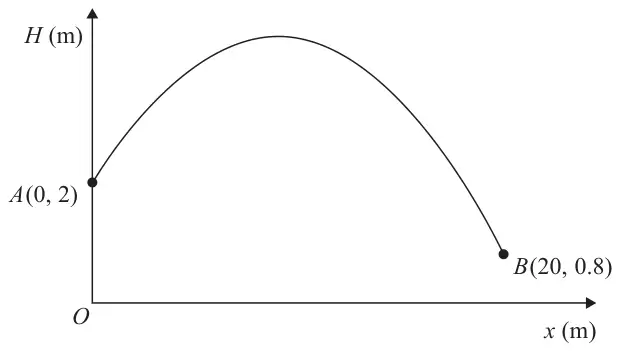
The graph in Figure 3 shows the path of a small ball.
The ball travels in a vertical plane above horizontal ground.
The ball is thrown from the point represented by \(A\) and caught at the point represented by \(B\).
The height, \(H\) metres, of the ball above the ground has been plotted against the horizontal distance, \(x\) metres, measured from the point where the ball was thrown.
With respect to a fixed origin \(O\), the point \(A\) has coordinates \((0, 2)\) and the point \(B\) has coordinates \((20, 0.8)\), as shown in Figure 3.
The ball reaches its maximum height when \(x = 9\)
A quadratic function, linking \(H\) with \(x\), is used to model the path of the ball.
Chandra is standing directly under the path of the ball at a point 16 m horizontally from \(O\).
Chandra can catch the ball if the ball is less than 2.5 m above the ground.
| Scheme | Marks | AO |
|---|---|---|
| \(H = \pm ax^2 \pm bx \pm c\) \(x = 0, H = 2 \Rightarrow c = 2\) and either \(x = 20, H = 0.8 \Rightarrow 0.8 = 400a + 20b + 2\) or \(H = ax^2 + bx + c \Rightarrow \dfrac{\mathrm{d}H}{\mathrm{d}x} = 2ax + b\) \(x = 9, \dfrac{\mathrm{d}H}{\mathrm{d}x} = 0 \Rightarrow 18a + b = 0\) | M1 | 3.3 |
| \(H = \pm ax^2 \pm bx \pm c\) \(x = 0, H = 2 \Rightarrow c = 2\) and \(x = 20, H = 0.8 \Rightarrow 0.8 = 20^2a + 20b + 2\) and \(H = ax^2 + bx + c \Rightarrow \dfrac{\mathrm{d}H}{\mathrm{d}x} = 2ax + b\) \(x = 9, \dfrac{\mathrm{d}H}{\mathrm{d}x} = 0 \Rightarrow 18a + b = 0\) | dM1 | 3.1b |
| \(0.8 = 400a + 20b + 2,\ 18a + b = 0 \Rightarrow a = \ldots, b = \ldots\) | ddM1 | 1.1b |
| \(H = -0.03x^2 + 0.54x + 2\) | A1 | 2.2a |
| (4) |
Notes
(a) Way 1 Notes
Condone use of \(y\) for \(H\) for the method marks.
A model of the form \(H = x^2 + ax + b\) or \(H = -x^2 + ax + b\) will score no marks.
Note that it is possible to identify (by symmetry) that the points \((-2, 0.8)\) and \((18, 2)\) also lie on the parabola so you may see valid use of these points.
M1: Uses the equation \(H = \pm ax^2 \pm bx \pm c\) to model the path and uses \(x = 0\) and \(H = 2\) correctly placed to establish the value of the constant term and uses \(x = 20\) and \(H = 0.8\) or \(x = 9, \dfrac{\mathrm{d}H}{\mathrm{d}x} = 0\) to give an equation in ‘\(a\)’ and ‘\(b\)’ with \(\dfrac{\mathrm{d}H}{\mathrm{d}x}\) of the form \(\ldots\alpha x + \beta\)
An alternative is to recognise that the maximum occurs when \(x = -\dfrac{b}{2a} = 9\) or equivalent
e.g. maximum when \(x = 9 \Rightarrow H = a(x-9)^2 + \ldots = ax^2 - 18ax + \ldots \Rightarrow b = -18a\)
Award for \(\pm\dfrac{b}{2a} = 9\) or equivalent.
They may also use e.g. \((-2, 0.8)\) or \((18, 2)\) to give an equation in \(a\) and \(b\).
dM1: This mark requires:
- uses the equation \(H = \pm ax^2 \pm bx \pm c\) to model the path and uses \(x = 0\) and \(H = 2\) correctly placed to establish the value of the constant term
- uses \(x = 20\) and \(H = 0.8\) correctly placed and \(x = 9, \dfrac{\mathrm{d}H}{\mathrm{d}x} = 0\) to give 2 equations in ‘\(a\)’ and ‘\(b\)’ with \(\dfrac{\mathrm{d}H}{\mathrm{d}x}\) of the form \(\ldots ax + b\) or as above using \(\pm\dfrac{b}{2a} = 9\)
They may also use e.g. \((-2, 0.8)\) or \((18, 2)\) to give an equation in \(a\) and \(b\).
ddM1: Solves their 2 equations in “\(a\)” and “\(b\)” to find their ‘\(a\)’ and ‘\(b\)’.
This may be done on a calculator. You do not need to check their method for solving.
A1: Correct equation. Must be \(H = \mathrm{f}(x)\).
(a) Way 2
| Scheme | Marks |
|---|---|
| \(x = 9 \text{ at max} \Rightarrow H = A \pm B(x-9)^2\) and either \(x = 0, H = 2 \Rightarrow 2 = A + 81B\) or \(x = 20, H = 0.8 \Rightarrow 0.8 = A + 121B\) | M1 |
| \(x = 9 \text{ at max} \Rightarrow H = A + B(x-9)^2\) and \(x = 0, H = 2 \Rightarrow 2 = A + 81B\) and \(x = 20, H = 0.8 \Rightarrow 0.8 = A + 121B\) | dM1 |
| \(2 = A + 81B,\ 0.8 = A + 121B \Rightarrow A = 4.43,\ B = -0.03\) | ddM1 |
| \(H = 4.43 - 0.03(x-9)^2\) | A1 |
| (4) |
(a) Way 2 Notes
Condone use of \(y\) for \(H\) for the method marks.
A model of the form \(H = A \pm (x-9)^2\) will score no marks.
M1: Uses the equation \(H = A \pm B(x-9)^2\) or \(H = A \pm B(9-x)^2\) to model the path and uses one of the ‘end points’ correctly placed to give an equation in ‘\(A\)’ and ‘\(B\)’
They may also use e.g. \((-2, 0.8)\) or \((18, 2)\) to give an equation in \(A\) and \(B\).
dM1: Uses the equation \(H = A + B(x-9)^2\) or \(H = A + B(9-x)^2\) to model the path and uses both ‘end points’ correctly placed to give 2 equations in ‘\(A\)’ and ‘\(B\)’
They may also use e.g. \((-2, 0.8)\) or \((18, 2)\) to give an equation in \(A\) and \(B\).
ddM1: Solves their 2 equations in “\(A\)” and “\(B\)” to find their ‘\(A\)’ and ‘\(B\)’.
This may be done on a calculator. You do not need to check their method for solving.
A1: Correct equation. Must be \(H = \mathrm{f}(x)\).
Note that using \(H = A + B(x-9)^2\) followed by the incorrect assumption that \(A = 2\) is unlikely to score any marks as they will subsequently not be able to produce 2 equations in “\(A\)” and “\(B\)”
Possible alternative 3:
\[\begin{gathered}H = A\left((x-9)^2 - 81\right) + B\\x = 0, H = 2 \Rightarrow B = 2\\x = 20, H = 0.8 \Rightarrow 0.8 = 40A + B\\B = 2 \Rightarrow A = -0.03\\H = 2 - 0.03\left((x-9)^2 - 81\right)\end{gathered}\]M1: Uses the equation \(H = A\left((x-9)^2 - 81\right) + B\) to model the path and uses \(H = 2\) when \(x = 0\) correctly placed to find “\(B\)”
dM1: Uses the equation \(H = A\left((x-9)^2 - 81\right) + B\) to model the path and uses \(H = 0.8\) when \(x = 20\) correctly placed. May also use e.g. \((-2, 0.8)\) or \((18, 2)\)
ddM1: Substitutes their value for “\(B\)” to find a value for “\(A\)”
A1: Correct equation. Must be \(H = \mathrm{f}(x)\).
| Scheme | Marks | AO |
|---|---|---|
Examples must focus on why the model may not be appropriate or give situations where the model would break down e.g.:
| B1 | 3.5b |
| (1) |
Notes
B1: Gives a suitable limitation – see scheme
If more than one limitation is given and one is acceptable then award this mark as long as none of the other statements are contradictory (they may be incorrect/inappropriate)
| Scheme | Marks | AO |
|---|---|---|
| \(x = 16 \Rightarrow H = -0.03(16)^2 + 0.54(16) + 2 = \ldots\) | M1 | 3.4 |
| \(H = 2.96\) So Chandra would not be able to catch the ball | A1 | 3.2a |
| (2) | ||
| (7 marks) |
Notes
M1: Substitutes \(x = 16\) into their equation modelling the path to obtain a value for \(H\).
This may be seen explicitly as above or may be implied by their value (you may need to check). Must have a quadratic function in \(x\).
A1: Depends on
- A correct equation
- \(H = 2.96\)
- Correct conclusion that she cannot catch the ball or equivalent
A minimum for M1A1 could be e.g. \(x = 16 \Rightarrow H = 2.96\) “so no”
(c) Alternative:
\[\text{e.g. } 2.5 = 4.43 - 0.03(x-9)^2 \Rightarrow x = 9 + \frac{\sqrt{579}}{3} = 17.02\ldots\]So Chandra would not be able to catch the ball
M1: Substitutes \(H = 2.5\) into their quadratic equation modelling the path to obtain a value for \(x\). This may be seen explicitly as above or may be implied by their value (you may need to check). Must have a quadratic function in \(x\).
A1: Depends on
- A correct equation
- \(x =\) awrt 17
- Correct conclusion that she cannot catch the ball or equivalent.
A minimum for M1A1 could be e.g. \(H = 2.5 \Rightarrow x = 17\) “so no”