The questions in this section refer to the article on the Insert. You should read the article before attempting the questions.
The relevant parts of the article “The trisectrix of Maclaurin” are reproduced below; the line numbers are those printed on the Insert.
Line 8 The equation of the curve in cartesian form is \(y^2 = \dfrac{x^2(3a-x)}{a+x}\), where \(a\) is a constant.
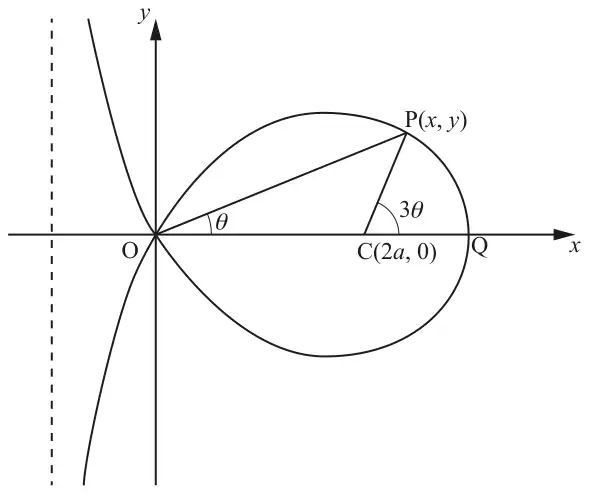
Fig. C2
Lines 14–16 The point C has coordinates \((2a, 0)\) and Q is the point where the curve crosses the positive \(x\)-axis. The point P is a general point \((x, y)\) on the loop of the curve. The origin of the coordinate system is denoted by O.
Line 17 The dashed line is an asymptote to the curve.
Lines 18–19 If the line CP makes an angle \(3\theta\) with the positive \(x\)-axis then the line OP makes an angle \(\theta\) with the positive \(x\)-axis. Angles are measured anticlockwise from the positive \(x\)-axis.
Line 23 Deriving the cartesian equation of the trisectrix
Lines 24–25 Using the formula for \(\tan(A+B)\) in terms of \(\tan A\) and \(\tan B\), it can be shown that \(\tan 3\theta = \dfrac{t(3-t^2)}{1-3t^2}\), where \(t = \tan\theta\).
Lines 26–27 From this and Fig. C2 it follows that \(\dfrac{x-2a}{y} = \dfrac{1-3t^2}{t(3-t^2)}\). Hence \(\dfrac{1}{t} - \dfrac{2a}{y} = \dfrac{1-3t^2}{t(3-t^2)}\).
Lines 28–29 It then follows that \(\dfrac{2a}{y} = \dfrac{1}{t} - \dfrac{1-3t^2}{t(3-t^2)} = \dfrac{2+2t^2}{t(3-t^2)}\) so \(\dfrac{a}{y} = \dfrac{1+t^2}{t(3-t^2)}\) and this gives the parametric equation for \(y\), \(y = \dfrac{at(3-t^2)}{1+t^2}\).
Lines 30–31 The equation for \(x\) follows from \(\tan\theta = \dfrac{y}{x}\). Together with the parametric equation for \(y\), this leads to \(x = \dfrac{a(3-t^2)}{1+t^2}\).
Lines 32–33 The parameter \(t\) can be eliminated from the parametric equations to derive the cartesian equation \(y^2 = \dfrac{x^2(3a-x)}{a+x}\), as stated in line 8.
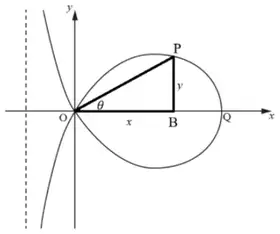
(a) Draw and label a suitable triangle on the diagram in the Printed Answer Booklet to show that \(\tan\theta = \dfrac{y}{x}\), as given in line 30. [1]
(b) Subtract \(x = \dfrac{a(3-t^2)}{1+t^2}\) from \(3a\) to show that \(3a - x = \dfrac{4at^2}{1+t^2}\). [1]
(c) Find an expression, in terms of \(a\) and \(t\), for \(a + x\). [1]
(d) Hence, or otherwise, show that the parametric equations given in lines 29 and 31 are equivalent to \(y^2 = \dfrac{x^2(3a-x)}{a+x}\), as claimed in lines 8 and 33. [2]
Mark scheme (a)
Scheme
Marks
AO
B1
3.1a
[1]
Notes
B1: Triangle POB drawn, where B is the point on the x- axis such that PB is perpendicular to the x-axis. P may be anywhere on curve in 1st quadrant. The points P and B need not be labelled Vertical and horizontal sides should be labelled y and x OR \(x\) and \(y\) clearly indicated on the axes OR Point on curve labelled \((x, y)\) Allow angle \(\theta\) not labelled Condone good freehand – mark intent
M1: Dividing the correct expressions for \(3a - x\) and \(a + x\)
A1: AG Simplifying to \(t^2\) Using \(t = \frac{y}{x}\) to give a correct completion to given result Must have at least one line of working and no incorrect work seen
M1: Substituting correct expressions for \(3a - x\) and \(a + x\) into \(y^2 = \frac{x^2(3a-x)}{a+x}\)
A1: AG Simplifying to \(x^2t^2\) Using \(t = \frac{y}{x}\) to give a correct completion to given result Must have at least one line of working and no incorrect work seen
M1: Substituting \(x = \frac{a(3-t^2)}{1+t^2}\) and \(3a - x = \frac{4at^2}{1+t^2}\) into \(y^2 = \frac{x^2(3a-x)}{a+x}\)
A1: AG Simplifying and showing \(y^2 = (xt)^2\) to give a correct completion to given result Must have at least one line of working and no incorrect work seen